Vortices in a Superconductor: Solid and Liquid express
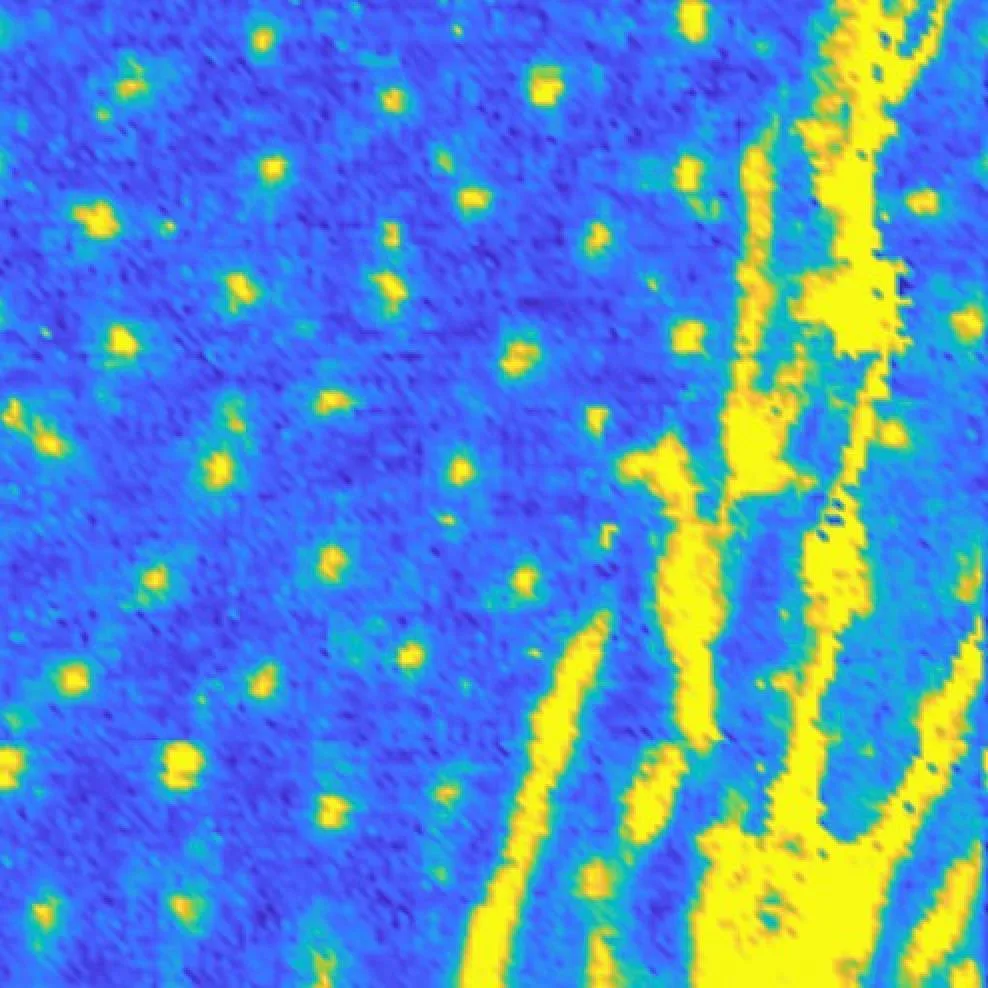
In a superconductor, electric current flows without loss, like water through a perfectly smooth pipe. But if you place such a material in a magnetic field, vortices appear inside — tiny whirlpools where superconductivity is destroyed. As long as these whirlpools stay put, current flows freely. Once they move, resistance arises, and energy starts to be wasted.
Quantum mechanics says that at low temperatures, vortices arrange into a neat lattice, like soldiers in formation. Upon heating, this formation can "melt": vortices begin to jitter and move, forming a liquid. Previously, it was thought that such melting occurs only near the critical temperature, when superconductivity is about to vanish. But a team of scientists led by Josef Lense peered inside the material using a scanning tunneling microscope — a device that senses individual vortices the way fingers feel bumps on a table.
They studied the superconductor CaKAs$_4$Fe$_4$ with a critical temperature of about 35 kelvins (minus 238 degrees Celsius). At a temperature of just 18 kelvins, half the critical temperature, in some places the vortices were no longer in formation but darted about randomly, like a crowd at a train station. These "liquid droplets" coexisted with regions where vortices remained fixed, as if rooted to the spot.
This discovery changes our understanding of how superconductors behave in real conditions. Even with moderate cooling, zones can arise where resistance is no longer zero. This matters for technology: superconducting wires, magnets in MRI machines, or particle accelerators can heat up locally, even if the average temperature seems safe.
Now that we know about "liquid droplets," engineers can look for ways to hold vortices in place — for example, by adding defects to the material that act as anchors. Then the superconductor would remain a perfect conductor over a wider range of conditions.
A scanning tunneling microscope senses vortices not with light but with an electric current that flows between a sharp needle and the surface. The needle is so fine that only a few atoms fit on its tip.
In Arthur C. Clarke's novel "The Fountains of Paradise," a superconducting cable supports a space elevator, but if the vortices "melt," the cable would lose its perfect conductivity and the elevator would crash.