Quantum Microscope Sees What Ordinary Light Can't express
Light in a microscope doesn't arrive as a steady stream but like buckshot from a bag: sometimes more photons, sometimes fewer. This random scatter is the shot noise. It sets a limit: faint signals from tiny objects get lost in the ripple.
Scientists have found a way to calm this buckshot. They take two beams of light that were born together and are linked so that their fluctuations cancel each other out. One beam passes through the sample, the other stays clean. By comparing them, you can subtract the noise and keep only the useful signal. It's like noise-canceling headphones: a quiet melody is audible even in a noisy hall.
The new microscope has already spotted the substance cytochrome c inside cells, which ordinary light didn't reveal. Now biologists can watch living processes without dyes, and materials scientists can check nanoparticles more precisely.
Original abstract
as written by the authors arXiv:2601.20632
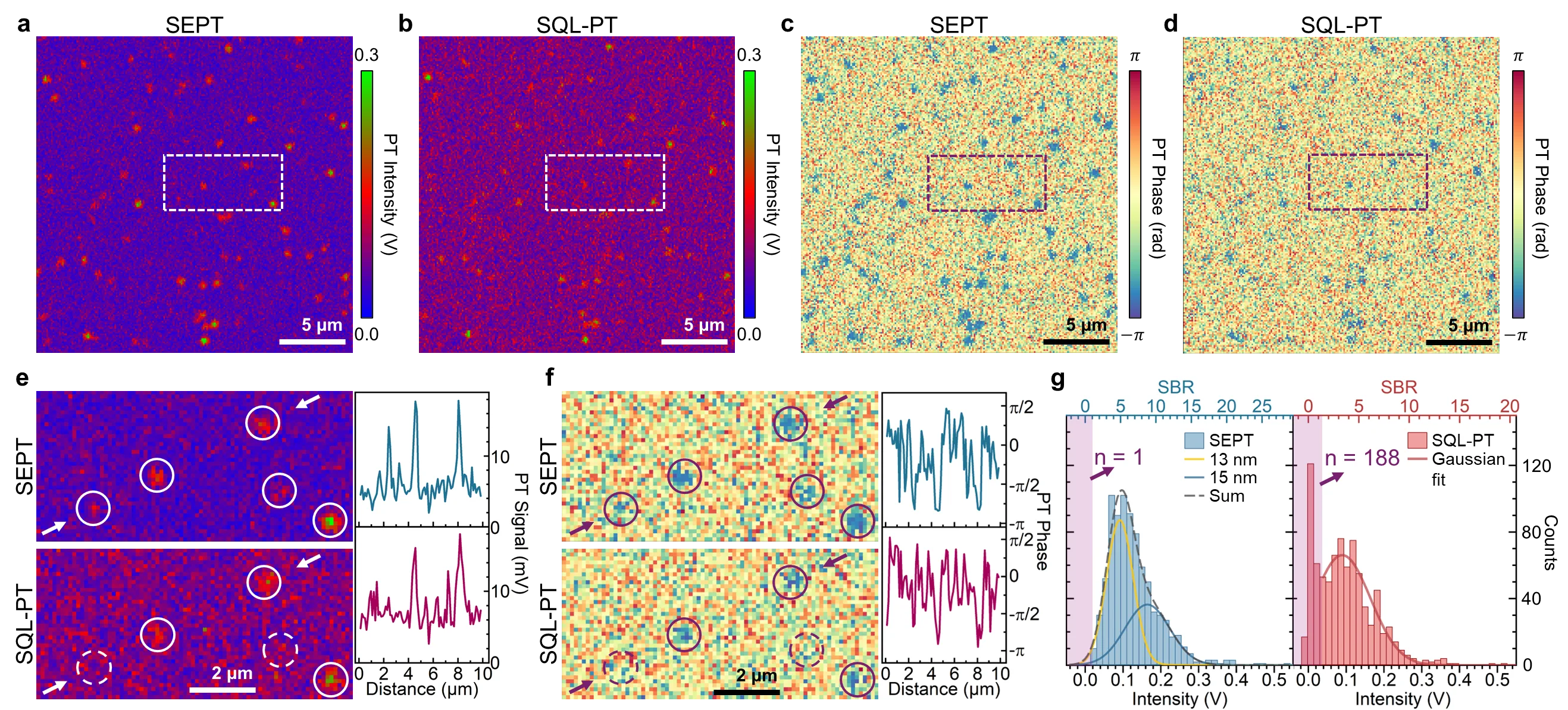
Label-free optical microscopy through absorption or scattering spectroscopy provides fundamental insights across biology and materials science, yet its sensitivity remains fundamentally limited by photon shot noise. While recent demonstrations of quantum nonlinear microscopy show sub-shot-limited sensitivity, they are intrinsically limited by availability of high peak-power squeezed light sources. Here, we introduce squeezing-enhanced photothermal (SEPT) microscopy, a quantum imaging technique that leverages twin-beam quantum correlations to detect absorption induced signals with unprecedented sensitivity. SEPT achieves 3.5 dB noise suppression beyond the standard quantum limit, enabling a 2.5-fold increase in imaging throughput or 31% reduction in pump power, while providing an unmatched versatility through the intrinsic compatibility between continuous-wave squeezing and photothermal modulation. We showcase SEPT applications by providing high-precision characterization of nanoparticles and revealing subcellular structures, such as cytochrome c, that remain undetectable under shot-noise-limited imaging. By combining label-free contrast, quantum-enhanced sensitivity, and compatibility with existing microscopy platforms, SEPT establishes a new paradigm for molecular absorption imaging with far-reaching implications in cellular biology, nanoscience, and materials characterization.
Shot noise is like the sound of rain on a roof: drops fall unevenly, and in a weak signal, that unevenness is most noticeable.