Merging Galaxy Haro 11: How Escaping Light Explains the Early Universe express
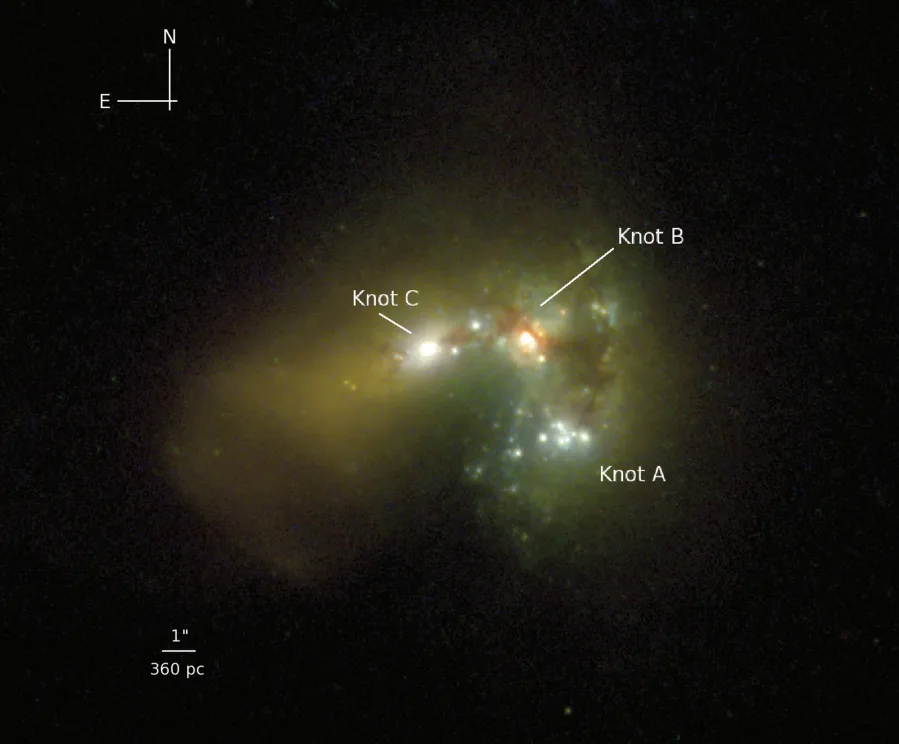
Two galaxies approach each other like a pair of dancers who drift apart and then are drawn back together. At the moment of a particularly close encounter, their gas compresses, and bright ultraviolet light bursts from within. This is exactly what happens in the Haro 11 system — the nearest pair of merging galaxies that lets such light escape. Scientists built a computer model of this dance to understand how the leak arises.
In the model, the two progenitor galaxies approached, separated, and approached again. Each time they passed close, the ultraviolet escape fraction grew by roughly a factor of ten. The reason is simple: the gas compressed, and gaps appeared through which light could burst out. Starbursts also boosted the leak — young stars pushed the gas around and punched holes in it.
Curiously, the escape of another kind of light, the Lyman-alpha line, did not grow as much. This light is emitted by hydrogen and often gets trapped in dense gas. So looking at the Lyman-alpha line can make you underestimate how much ultraviolet actually escapes a galaxy. In the model, the brightest source was a dense knot of stars called 'clump C'—it turned out to be the main contributor to the escaping radiation.
The simulated galaxy ended up resembling the real Haro 11—both in shape and brightness. So such computer dances help us understand how, in the distant past, the first galaxies cleared the universe of neutral hydrogen fog.
Original abstract
as written by the authors arXiv:2601.20943
The Haro 11 galaxy merger is the closest known Lyman Continuum (LyC) leaker and a strong Lyman-$$\alpha$$ (Ly$$\alpha$$) emitter, making it an important analogue of the high-$$z$$ galaxies that reionised the early Universe. To investigate how Haro 11's properties arise, we perform a radiation hydrodynamics simulation of the merger, and create mock observations of LyC, Ly$$\alpha$$, and H$$\alpha$$, from which we compute their luminosities ($$L$$) and escape fractions ($$f_{\rm esc}$$). We track these quantities along multiple sightlines as the two progenitor galaxies merge, from the first interaction until the system resembles present-day Haro 11. We find that $$L$$ and $$f_{\rm esc}$$ vary by 1-2 orders of magnitude for LyC due to sightline variations. At the two pericentre passages, the total $$f_{\rm esc}^{\rm LyC}$$ increases by roughly an order of magnitude. Conversely, $$f_{\rm esc}^{\rm Ly\alpha}$$ shows a moderate increase at the pericentre passages, which affects the inference of LyC properties from Ly$$\alpha$$. We attribute this to a displacement of the LyC-emitting stars relative to the \Lya-emitting gas, combined with an increased density from gas compression. Furthermore, $$f_{\rm esc}^{\rm LyC}$$ is boosted during star formation bursts, likely due to stellar feedback. As direct comparison with Haro 11, the simulation qualitatively matches its morphology and luminosities. We find that among the dense stellar knots, knot C is the main contributor to both intrinsic and escaping LyC emission. Additionally, the Ly$$\alpha$$ spectra displays distinct features found in observations, implying similar gas conditions are present.
Haro 11 lies just 82 million light-years away — by cosmic standards, that's the neighborhood. That's why it serves as a 'laboratory' for studying processes that in the early universe occurred over vast distances.