Broken Bond Makes a Molecule Dance express
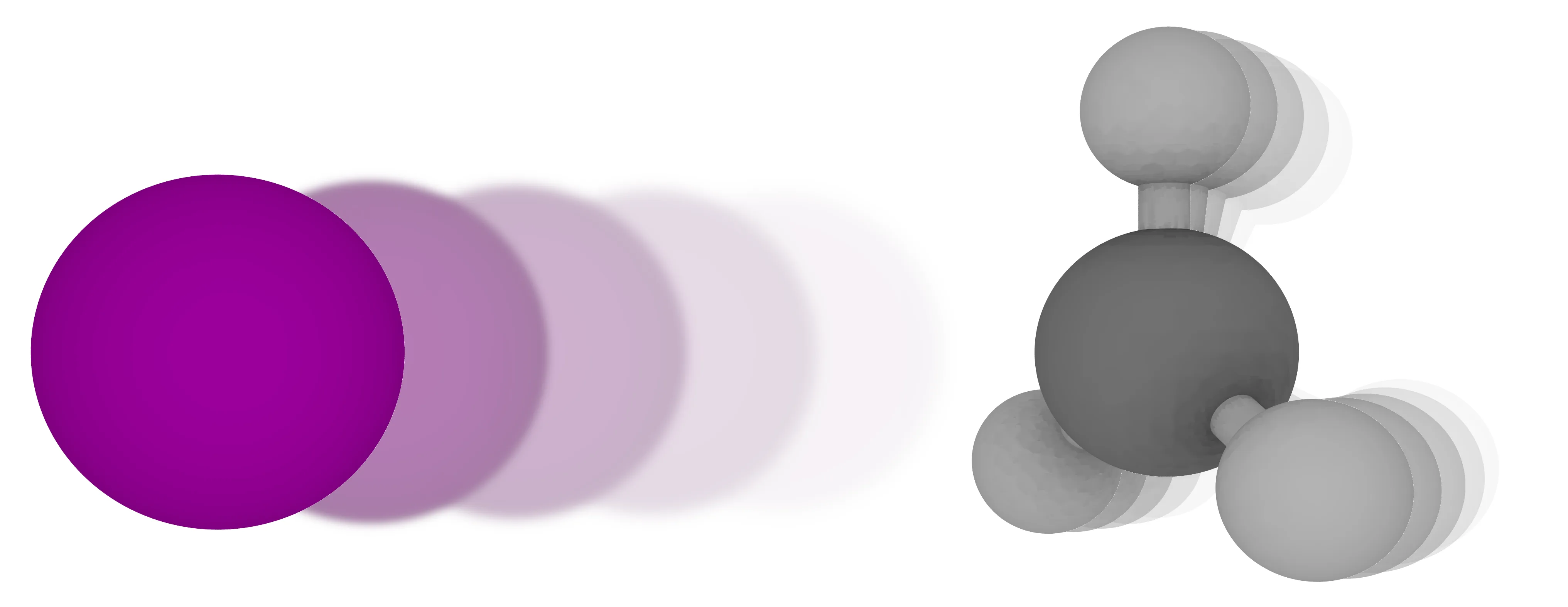
A chemical bond is like a stretched spring between atoms. When it's snapped, the molecular fragments fly apart, but they don't freeze: they keep vibrating, like a plucked string. That's exactly the vibration a team of researchers caught when they broke a methyl iodide molecule with an ultraviolet laser.
The fragment, a methyl radical, began to vibrate like an umbrella that opens and closes. The scientists tracked this motion with ultrafast X-ray pulses, which capture changes in electron energy within femtoseconds (millionths of a billionth of a second). It turned out that the radical doesn't vibrate at a single frequency but at several at once, and their combinations create a complex rhythm.
By building a quantum model, the authors not only measured the frequencies but also reconstructed the real motion of the atoms in space. They found that the trajectories resemble a heartbeat: strong excitation and a special anharmonicity (deviation from a simple pendulum) cause the vibrations to alternately strengthen and weaken. This 'quantum pulse' is key to understanding how the energy of the bond break is distributed across the molecule and triggers subsequent reactions.
This research is a step toward controlling chemical reactions at the level of individual atoms. If we learn to read the language of molecular vibrations, we'll be able to predict where a reaction will go, and even steer it in the right direction.
Original abstract
as written by the authors arXiv:2601.21949
We report on the observation of coherent molecular vibrations launched by the breaking of a molecular bond. The methyl radical, which is produced by $$267\,\mathrm{nm}$$ photodissociation of methyl iodide, is excited to high levels in its $$ u_2$$ ``umbrella" vibrational mode by the dissociation. The ensuing coherent vibrational dynamics are observed by measuring ultrafast time-dependent changes in the x-ray transition energy from the C$$1s$$ to the singly-occupied valence orbital. Due to symmetry, the real space vibrational motion appears predominantly in the x-ray energy shift at the difference frequencies of the $$ u_2$$ progression, although the fundamental frequencies of the $$ u_2$$ mode are also observed. By constructing a fully quantum-mechanical model of the dynamics the coherent superposition is rigorously characterized and the real-space motion of the radicals is reconstructed. The retrieved trajectories are dominated by pronounced quantum beating governed by the high degree of coherent excitation and the strong negative anharmonicity of the $$ u_2$$ mode.
Breaking a single bond in a methyl iodide molecule triggers vibrations that last thousands of times longer than the break itself, as if a snapped string kept sounding for several more seconds.
In Greg Egan's novel 'Quarantine,' people learn to manipulate quantum states of molecules to influence chemical reactions — here we see the first steps toward such control.