A Black Hole on the Brink express
A black hole that has almost stopped consuming matter is like a kettle coming to a boil: calm on the outside, but seething with invisible processes within. Physicists have peered into this boundary world, where space and time no longer follow the familiar rules.
They have described everything that happens right at the horizon: that invisible boundary beyond which even light cannot return. It turns out that two "voices" are at play here: one governs the oscillations of the horizon's shape, the other its electric charge. Together, they create a complex picture, like a dance between two partners.
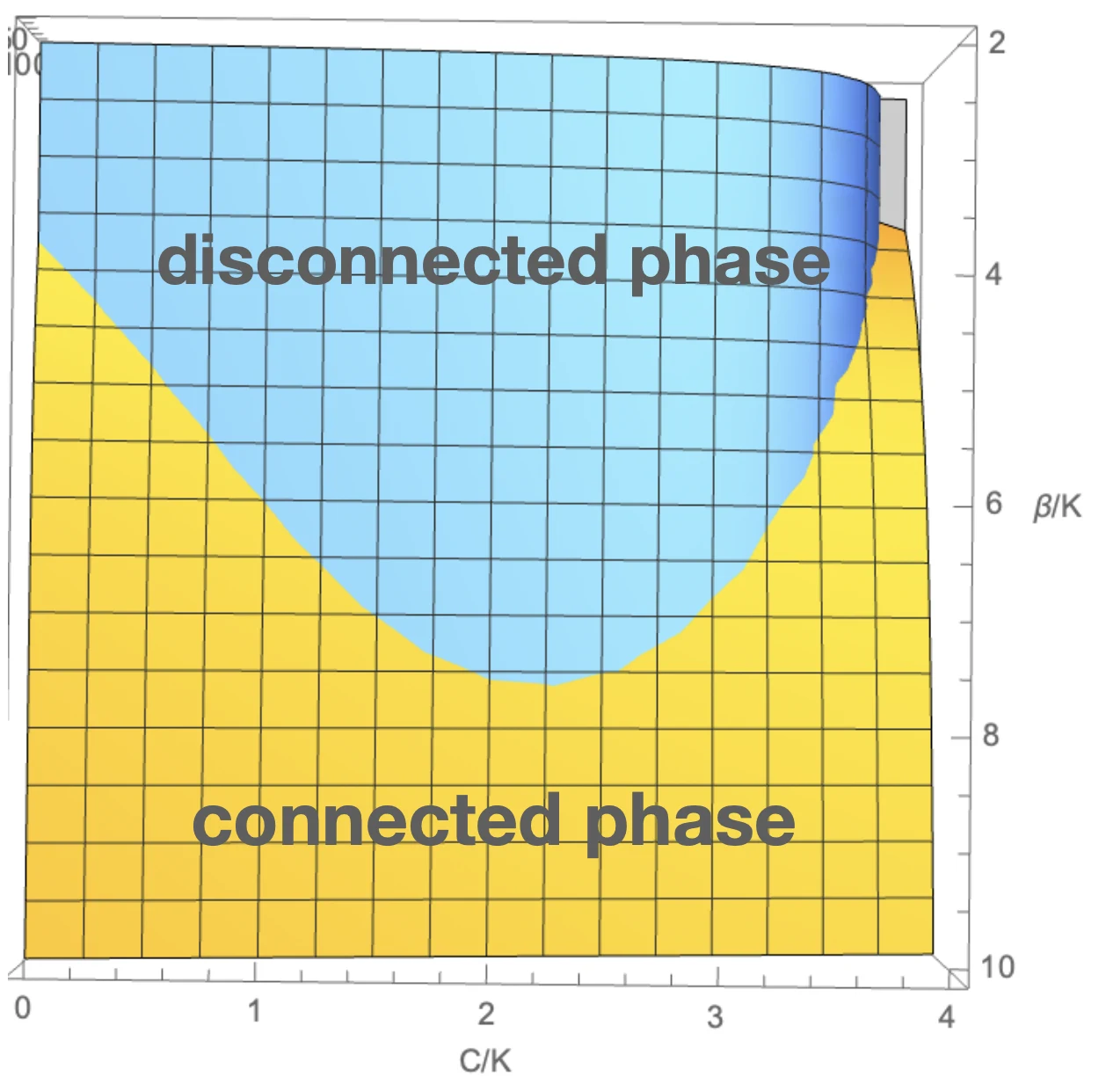
As temperature changes, the dance changes character. At low temperatures, the two voices sound in unison, as one. At high temperatures, they diverge, each carrying its own tune. This transition resembles water freezing: the substance is the same, but its properties change dramatically.
The calculation showed that three numbers play a key role — C, K, and E. They determine how strongly the horizon's oscillations and the charge are coupled. By tweaking these numbers, you can make a black hole switch from one state to another, just as turning a thermostat dial turns ice into water.
This approach lets us peer into the most mysterious realm of physics — where quantum particles meet black holes. It's a step toward understanding how gravity works at the smallest distances, where the familiar laws break down.
Original abstract
as written by the authors arXiv:2602.01096
Motivated by bulk replica wormholes, we study the boundary effective theory that describes the near-horizon fluctuations of a near-extremal Reissner-Nordstr\"om black hole. This theory consists of a Schwarzian mode and a $$U(1)$$ phase mode. We compute the partition function of this boundary theory on connected geometries, from which the entropy is derived. Our analysis reveals a rich phase structure, in which the dominance of connected or disconnected configurations leads to a phase transition controlled by the temperature and the coupling constants $$C$$, $$K$$, and $$\mathcal{E}$$ of the 1d effective theory.
A black hole's horizon is not a solid surface. It's more like a "point of no return": once you cross it, even light is doomed to move only inward.