Gravity Alters How Atoms Emit Light express
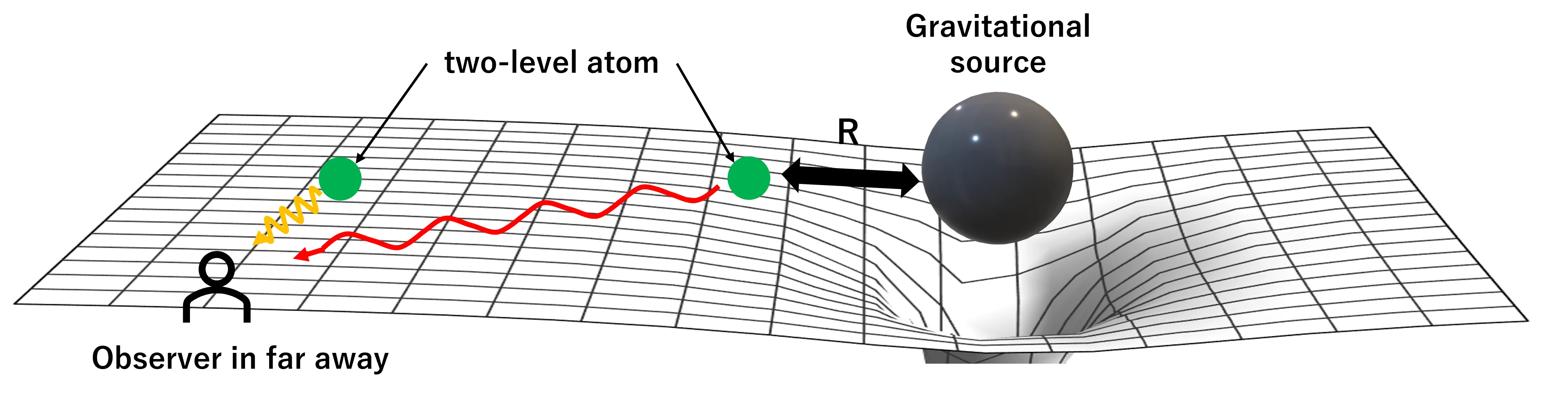
An atom excited by light gives its energy back in an instant — it emits a photon. This process is like a tired runner dropping a heavy load. But if the runner is on a mountain slope, it's harder to pick up speed. Gravity acts on the atom similarly: near a massive body, time flows slower, and the atom emits differently.
Physicists built a model where the atom interacts with the field filling space and accounted for a weak gravitational field. The calculations showed that the emission rate changes depending on where the atom is and how its dipole — the atom's tiny "antenna" — is oriented. If the atom is closer to the source of gravity, its emission can speed up or slow down. It all depends on the frequency of the emitted light.
This result is important for future experiments with quantum systems in a gravitational field. For example, precise atomic clocks at different altitudes already tick at different rates. Now we can predict how gravity will affect the emission of a single atom — a building block for quantum technologies.
Original abstract
as written by the authors arXiv:2602.01715
We investigate the dissipative dynamics of a two-level atom in a weak gravitational field. Using the Feynman--Vernon influence functional formalism, we derive a quantum master equation describing the two-level atom interacting with a scalar field in a Newtonian gravitational field, and compute the energy dissipation rate of the atom. We find that the spontaneous emission rate (the dissipation rate in vacuum) is modified by the gravitational field. Specifically, this modification depends on the atom's dipole, the position of the atom relative to the source of the gravitational field, and the frequency of the scalar radiation emitted by the atom. Furthermore, we identify the parameter regimes in which the spontaneous emission rate is enhanced or suppressed by gravity. We also discuss how the modification arises from time dilation and dipole radiation in a weak gravitational field. These findings provide a theoretical basis for exploring gravitational effects in open quantum systems.
The difference in the passage of time between the top of a skyscraper and its basement is so tiny that it can only be measured with ultra-precise atomic clocks. Gravity really does slow time, and this affects atomic emission.
In the movie "Interstellar," the characters encounter a giant time dilation near a black hole. This paper shows that even weak gravity introduces measurable corrections to quantum processes.