Gravity Alters How Atoms Emit Light express
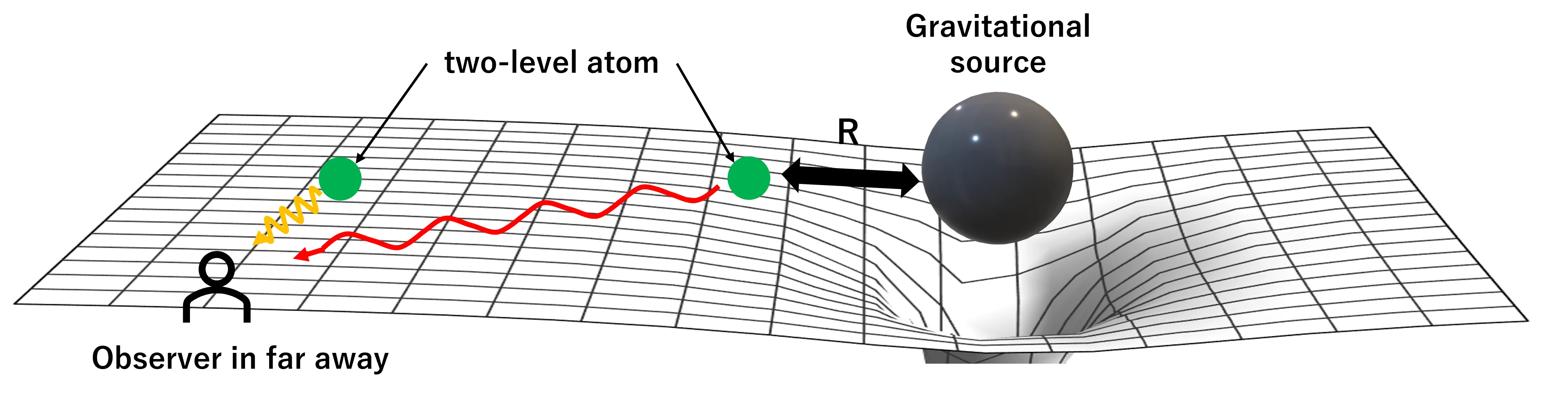
An atom excited by light gives its energy back in an instant — it emits a photon. This process is like a tired runner dropping a heavy load. But if the runner is on a mountain slope, it's harder to pick up speed. Gravity acts on the atom similarly: near a massive body, time flows slower, and the atom emits differently.
Physicists built a model where the atom interacts with the field filling space and accounted for a weak gravitational field. The calculations showed that the emission rate changes depending on where the atom is and how its dipole — the atom's tiny "antenna" — is oriented. If the atom is closer to the source of gravity, its emission can speed up or slow down. It all depends on the frequency of the emitted light.
This result is important for future experiments with quantum systems in a gravitational field. For example, precise atomic clocks at different altitudes already tick at different rates. Now we can predict how gravity will affect the emission of a single atom — a building block for quantum technologies.
The difference in the passage of time between the top of a skyscraper and its basement is so tiny that it can only be measured with ultra-precise atomic clocks. Gravity really does slow time, and this affects atomic emission.
In the movie "Interstellar," the characters encounter a giant time dilation near a black hole. This paper shows that even weak gravity introduces measurable corrections to quantum processes.