The weak force, or weak interaction, is one of the four fundamental forces of nature, alongside gravity, electromagnetism, and the strong force. It is responsible for processes like beta decay, where a neutron transforms into a proton, an electron, and an antineutrino. This force operates at incredibly short ranges, about 0.1% of the diameter of a proton, and is mediated by the W and Z bosons, which are very massive particles. The weak force is the only force that can change the flavor of quarks, which is why it is essential for the nuclear reactions that power the Sun and other stars.
History
The weak force was first described by Enrico Fermi in 1933 with his theory of beta decay. The modern theory, unifying the weak force with electromagnetism into the electroweak interaction, was developed in the 1960s by Sheldon Glashow, Abdus Salam, and Steven Weinberg, who shared the 1979 Nobel Prize in Physics for this work.
How it works
The weak force works by exchanging W or Z bosons between particles. In beta decay, a down quark in a neutron emits a W- boson, turning into an up quark, which changes the neutron into a proton. The W- boson then decays into an electron and an antineutrino. Because the W and Z bosons are so heavy (about 80-90 times the mass of a proton), the force has a very short range and is weak at low energies, but it becomes comparable in strength to electromagnetism at high energies.
In practice
The weak force is crucial in nuclear medicine, particularly in positronemission tomography (PET) scans, which rely on the weak decay of radioactive isotopes to produce positrons. It also plays a role in the operation of nuclear reactors, where the weak force is involved in the decay of fission products.
Fun fact
The weak force is the only fundamental force that violates parity symmetry, meaning it treats left-handed and right-handed particles differently, a discovery that earned Lee and Yang the 1957 Nobel Prize.
A neutron star is the remnant of an exploded star, compressed so tightly that a teaspoon of its material would weigh as much as a mountain. Inside such an object, protons and neutrons are packed tightly together, and under enormous pressure, hyperons, particles containing a strange quark, can appear.
Imagine an hourglass where the sand grains transform into other grains as they fall: that's what unstable atomic nuclei are like. They live for an instant and then decay, ejecting an electron (this is beta decay). In September 2025, theorists and experimentalists gathered under the FRIB Theory Alliance to discuss how to use such decays to probe the structure of matter.
In a quiet room, you can hear the faintest whisper. Likewise, in the hydrogen atom, the lightest of all, an uninvited guest is easier to spot. That guest could be the Z' boson, a mediator particle of a new force predicted by many unification theories. The Standard Model already has its own mediator — the Z boson.
The interiors of neutron stars are a realm of degenerate matter. Here, protons condense into a superconducting condensate, threaded by quantum vortices. Imagine tiny magnetic tops: each carries a quantum of magnetic flux and glides through the electron fluid.
An atomic nucleus is like a crowded bus. To free up space, a group of two protons and two neutrons — a helium nucleus, an alpha particle — exits through the front door: this is alpha decay, described by George Gamow as tunneling under an energy barrier.
The Universe is a vast city. In it, dark matter is the invisible framework of buildings, and dark energy is the force stretching the streets. For a long time they were considered independent, but new research has caught them in secret communication.
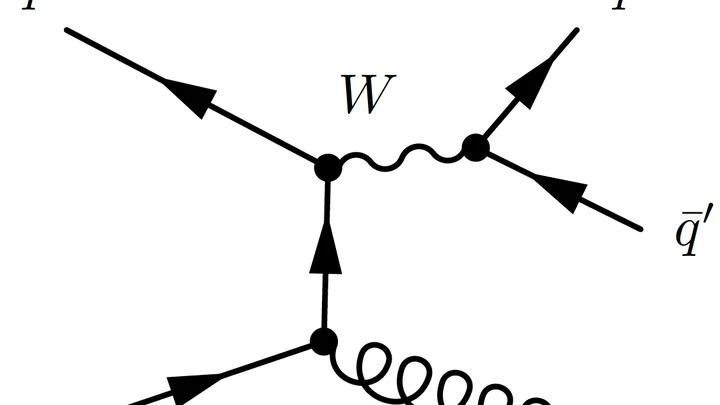
In the CMS detector at the Large Hadron Collider, protons accelerated to nearly the speed of light collided. Among billions of such collisions, physicists searched for a rare signature: the production of a single heavy particle that immediately decays into a W boson and a b quark.
A neutron star is the dead core of a star that once exploded, compressed to the size of a city. If a normal star is nearby, the neutron star siphons matter from it like a vacuum cleaner. This matter falls onto the surface and forms a crust — a solid layer of neutron-rich atomic nuclei.
When a W boson, the particle that carries the weak force, decays into a quark and an antiquark, these two fragments fly off in nearly the same direction at the collider's immense speeds.
A tiny glass sphere floats in a laser beam like a speck of dust in sunlight. Inside it is radioactive lead, which decays from time to time. Each decay ejects charged particles, and the sphere loses or gains a tiny electric charge.
An atomic nucleus usually follows its own rules: its decay doesn't care about temperature, pressure, or molecular neighbors. But the uranium-235m isotope is a striking exception. This nucleus sits in an excited state, like a tightly coiled spring, and sooner or later it releases the extra energy.
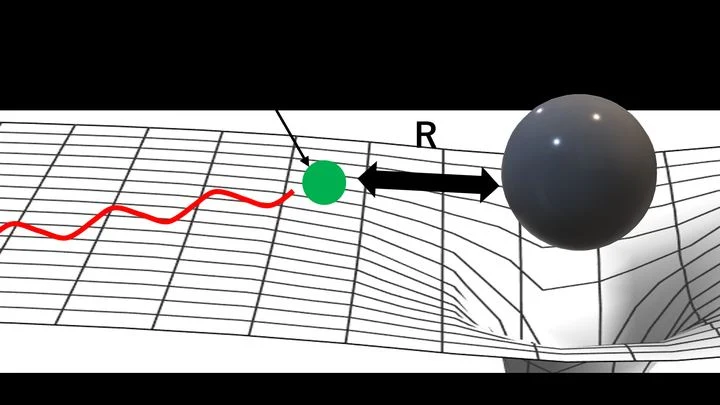
An atom excited by light gives its energy back in an instant — it emits a photon. This process is like a tired runner dropping a heavy load. But if the runner is on a mountain slope, it's harder to pick up speed. Gravity acts on the atom similarly: near a massive body, time flows slower, and the atom emits differently.
Fourteen rubidium atoms lined up like beads on a string. Each atom is a tiny magnet that can point up or down. Together they follow strict rules, similar to a train schedule: everything is predictable, everything repeats. But introduce a barely noticeable change, and the schedule goes off the rails.
A snowflake falling from a cloud chooses between a left-handed and a right-handed form. The difference between them is almost imperceptible, like a breath of wind, yet it is that very breath that decides which pattern will grow.