A Cosmic Magnet in 4U 1700-37 express
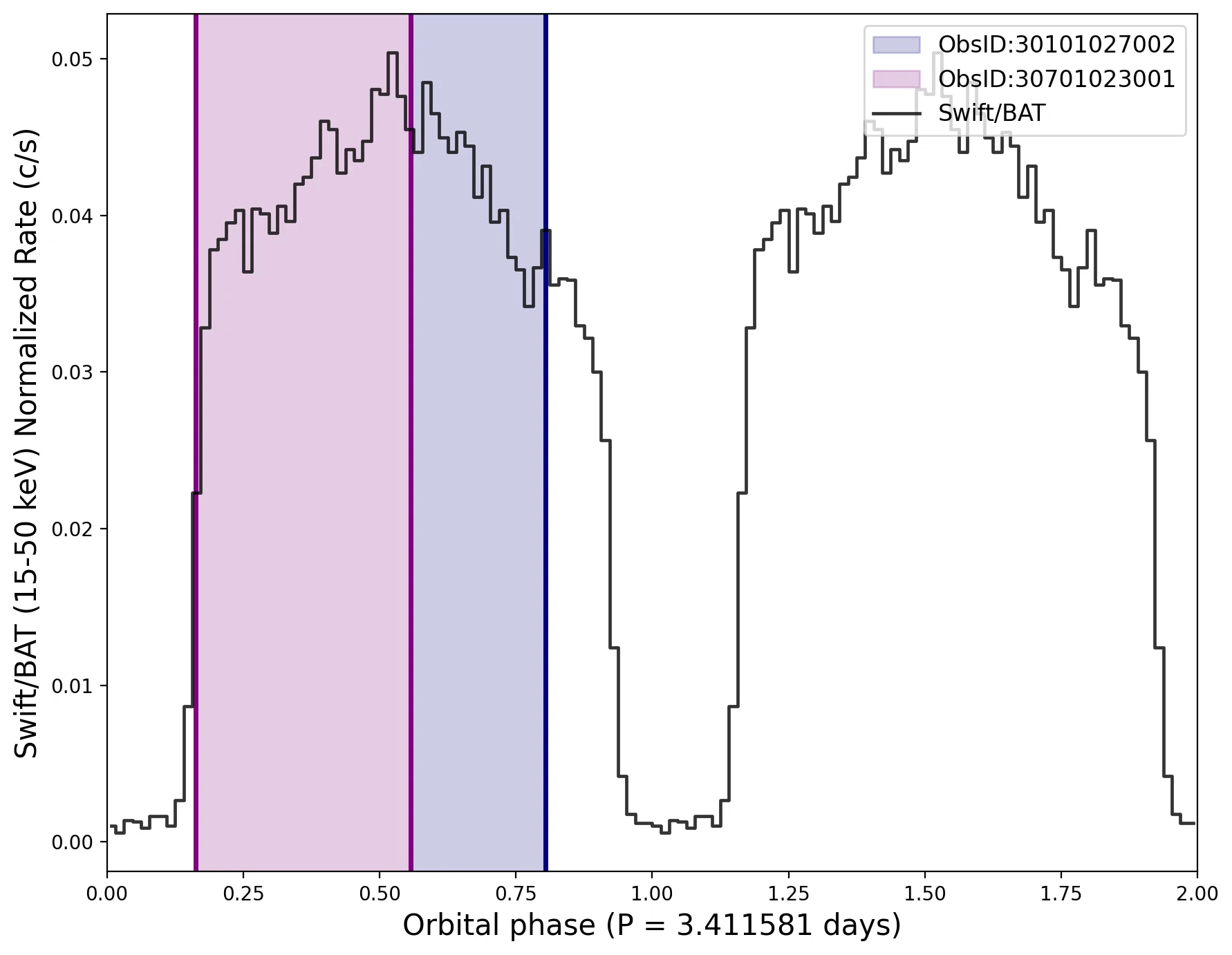
In the binary system 4U 1700-37, the massive supergiant star HD 153919 sheds a powerful stellar wind. This wind, like an invisible stream, rushes toward its compact companion — likely a neutron star. As it falls, the matter heats to millions of degrees and flares in X-rays. Astronomers pointed the orbiting NuSTAR telescope at this pair to examine the details of the glow.
No pulsations, regular bursts that would reveal rapid rotation, were detected. However, the spectrum showed excess emission around 20 and 40–50 kiloelectronvolts. These could be traces of cyclotron lines, peculiar "fingerprints" of the magnetic field that forces electrons to spiral. But confirming these lines proved elusive: the signal is too weak.
Nevertheless, modeling allowed an estimate of the magnetic field: from 1.7 to 4.4 trillion gauss. For comparison, a refrigerator magnet has only about 100 gauss. With such a field, infalling matter is not stopped by a shock wave but gradually, forming a hot "cap" above the poles. The equilibrium spin period of the star would then be about 32 minutes. This is consistent with the absence of pulsations: too slow to be noticeable.
Such measurements help tie together different observations of the same system. Earlier, different telescopes gave conflicting estimates of the cyclotron line energies. The new data suggest that the lines may shift slightly depending on the source brightness. This hints at a complex geometry of the infalling matter, as if the wind flow waxes and wanes, and the magnetic field responds to these gusts.
Original abstract
as written by the authors arXiv:2602.04622
4U 1700-37 is a wind-fed high-mass X-ray binary hosting a compact object, likely a neutron star, accreting from O6.5 Iaf+ supergiant HD 153919. Coherent pulsations not firmly detected; magnetic field strength remains uncertain. We analyze NuSTAR observations to characterize hard X-ray timing and spectral properties, test robustness of candidate cyclotron features, and constrain magnetic field and accretion regime. We perform timing and spectral analysis of two observations, modeling spectra with continua used for accreting pulsars, and use simulations to assess significance of features. No coherent pulsations detected; pulsed fraction constrained below 1.5\%. Spectra are well described by absorbed blackbody plus cutoff power-law continuum, showing residuals around 20 keV and 40--50 keV. Features improve fits but do not constitute firm cyclotron detections. Intensity-resolved spectroscopy suggests possible shifts of apparent line centroid. Results favor neutron-star magnetic field of 1.7--4.4 $$\times 10^{12}$$ G and quasi-spherical subsonic accretion regime with equilibrium spin period $$\sim 1.9$$ ks. Analysis provides quantitative constraints on magnetic field and accretion physics, helping reconcile discrepant line-energy measurements.
The neutron star in 4U 1700-37 is tens of billions of times more magnetized than the strongest magnet ever created in a laboratory.