Neutron stars are the collapsed cores of massive stars that exploded as supernovae. They pack roughly 1.4 times the Sun's mass into a sphere about 20 kilometers in diameter, making them among the densest objects in the universe. Their properties — extreme density, rapid rotation, and intense magnetic fields — are governed by nuclear physics under conditions unattainable on Earth. Key characteristics include a solid crust of neutron-rich nuclei, a possible superfluid interior, and a radius that is remarkably insensitive to mass, a feature that constrains the equation of state of nuclear matter.
History
Neutron stars were first proposed by Walter Baade and Fritz Zwicky in 1934, shortly after the discovery of the neutron. They were observationally confirmed in 1967 with the discovery of pulsars by Jocelyn Bell Burnell and Antony Hewish. The first precise mass-radius measurements came from X-ray observations in the 2000s, and gravitational wave astronomy added new insights in 2017.
How it works
Neutron stars are supported against gravitational collapse by neutron degeneracy pressure and, at higher densities, by repulsive nuclear forces. Their structure is described by the Tolman–Oppenheimer–Volkoff equation, which relates pressure and density. Observations of neutron star masses (often near 1.4 solar masses, but up to 2.1) and radii (typically 10–14 km) help physicists determine the equation of state — the relationship between pressure and density — which is still uncertain at the highest densities. Gravitational wave signals from neutron star mergers, like GW170817, have provided new constraints on their deformability and maximum mass.
In practice
Neutron star studies are a natural laboratory for testing nuclear physics at extreme densities, informing models of matter in heavy-ion collisions and potentially guiding the design of dense materials.
Fun fact
A teaspoon of neutron star material would weigh about 4 billion tons on Earth — roughly the mass of all humans combined.
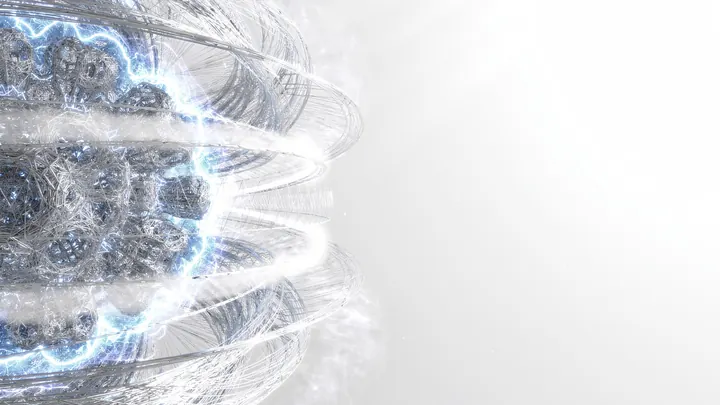
Pulsar PSR J0614-3329 spins 318 times per second. A point on its equator moves at about 10% of the speed of light. From a distance, the star looks like a lighthouse spinning so fast that its beam blurs into a continuous ring.
A star wrapped in an invisible blanket warms up more than it should. That's exactly how ten red dwarfs look, which astronomers from the Hephaistos project have been monitoring. These stars lie within 300 parsecs (about 1000 light-years) of us and emit far more infrared energy than their modest sizes can explain.
A massive star exhausts its fuel, and its core collapses in a fraction of a second. A supernova is born, along with a brief but powerful shower of neutrinos. These particles barely interact with matter, so they fly away freely, carrying information about the catastrophe.
Dark matter remains the inaudible bass line of the cosmic symphony — it emits no light, but its gravitational pull shapes galaxies. Vera Rubin first caught this rhythm in the 1970s by observing the rotation of stars.
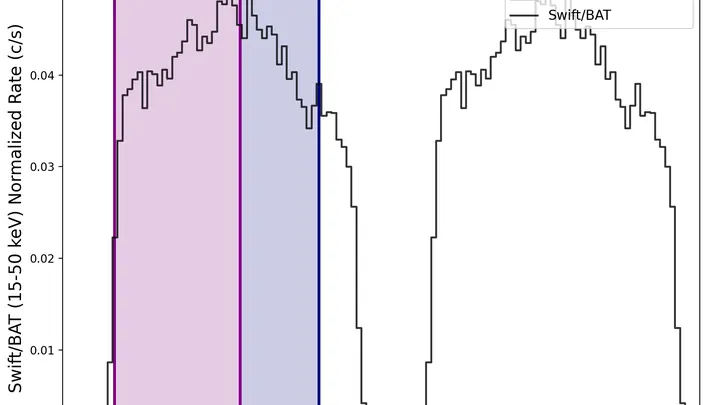
Hidden in the globular cluster Terzan 5 is the binary system IGR J17480-2446. One of its members is a neutron star that behaves strangely. It spins at just 11 hertz (11 revolutions per second) and cools suspiciously slowly after an outburst. Usually, such stars spin hundreds of times faster and cool briskly — here, it's the opposite.
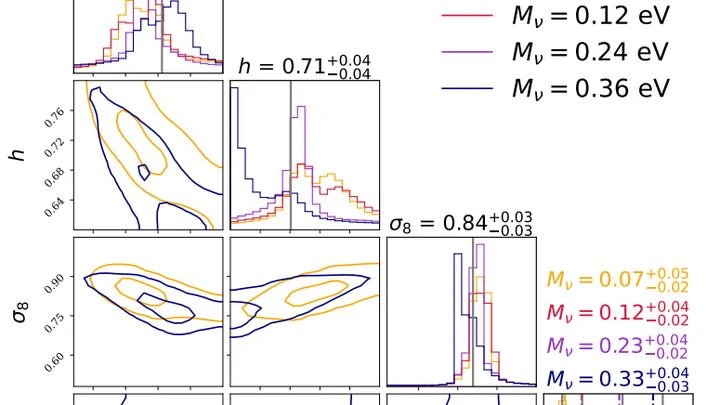
Neutrinos are the most abundant massive particles in the universe. Trillions of them pass through us every second, yet they leave barely a trace. Their collective gravity, though tiny, can influence the motion of entire galaxies. Think of two people approaching each other on a busy street; invisible passersby alter their speed.
A neutron star is the remnant of an exploded star, compressed to the size of a city. On its surface, a thermonuclear fire sometimes erupts: accumulated gas explodes like a giant hydrogen bomb. After the burst, ash remains — a mixture of heavy elements that rises to the surface and forms a hot atmosphere.
A powerful searchlight shines through thick fog. The beam itself is invisible, but the fog begins to glow faintly, and gives away the searchlight's presence.
The Universe is a colossal web of invisible dark matter and galaxies, stretched by the expansion of space. Neutrinos, nearly intangible ghost particles, barely cling to the threads, but their collective mass subtly shifts the tension of the entire network.
A massive star, 40 times heavier than the Sun, dies in a fraction of a second. Its core compresses like a spring squeezed too hard, then snaps back: that's a supernova explosion. But what if the star is also spinning, like a figure skater pulling in their arms, and threaded with a magnetic field, like invisible strings?
Neutrinos are tiny particles that barely interact with matter. They pass straight through a star like bullets through fog. When a massive star is gearing up to explode, its core contracts, temperatures soar, and neutrinos start streaming out.
In the binary system 4U 1700-37, the massive supergiant star HD 153919 sheds a powerful stellar wind. This wind, like an invisible stream, rushes toward its compact companion — likely a neutron star. As it falls, the matter heats to millions of degrees and flares in X-rays.
Supermassive bodies warp space, turning into a lens that bends light from distant objects. Such spacetime curvature allows astronomers to see the invisible. Recently, this method helped detect a hidden clump with the mass of a million Suns.
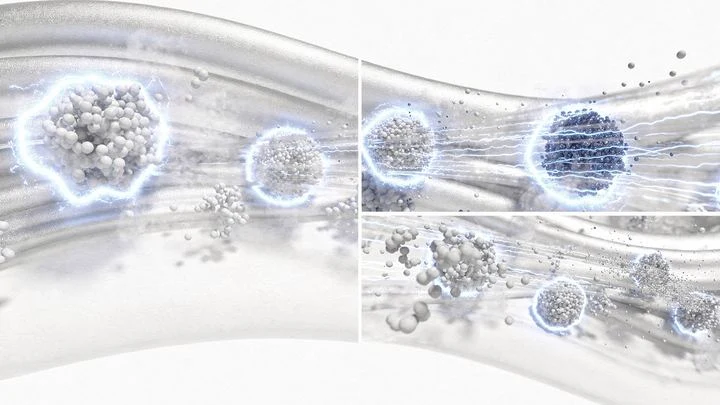
Cosmic rays are atomic nuclei accelerated to near-light speeds. They arrive at Earth from all directions, and their composition tells us what's happening in the far reaches of the Galaxy.
In the quiet harbor of the Local Bubble, a rarefied cavity of hot gas around the Sun, an explosion recently thundered. A supernova went off tens of parsecs away, and its echo still lingers in the neighborhood, reshaping the cosmic-ray landscape.