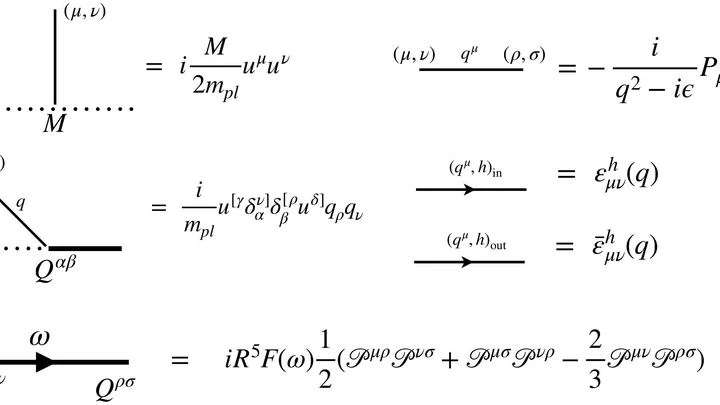
The effective number of neutrino species, denoted N_eff, is a cosmological parameter that quantifies the energy density of all relativistic particles (radiation) in the early universe, normalized to that of a single neutrino species. In the standard model, N_eff is approximately 3.046, accounting for three neutrino flavors and small corrections from neutrino decoupling. However, any additional light particles, such as sterile neutrinos or axions, would increase N_eff. Gravitational waves, if they contribute to the radiation energy density, also affect N_eff, making it a sensitive probe of new physics.
History
The concept was introduced in the context of Big Bang nucleosynthesis in the 1970s, and precise measurements from the Planck satellite have provided tight constraints, with N_eff = 2.99 ± 0.17.
How it works
N_eff is inferred from measurements of the cosmic microwave background (CMB) and the primordial abundance of light elements (Big Bang nucleosynthesis). The presence of extra radiationspeeds up the expansion of the universe, which leaves imprints on the damping tail of the CMB power spectrum and on the helium-4 abundance. By comparing observations with theoretical predictions, cosmologists can constrain N_eff. Gravitational waves, if generated in the early universe (e.g., by cosmic strings or inflation), would contribute to the radiation density and thus increase N_eff.
In practice
It is used to test the standard model of particle physics and to search for evidence of dark radiation or gravitational waves from the early universe.
Fun fact
The slight deviation of N_eff from exactly 3 is due to the fact that neutrinos are not completely decoupled from electrons and positrons during annihilation, a subtle effect that has been precisely calculated.
Imagine two spinning tops set on a table. If they spin in the same direction, their combined rotation is large; if they spin toward each other, the total rotation can be zero even though each top spins rapidly on its own. In a pair of neutron stars approaching merger, their individual rotations, spins, play the role of such tops.
Boiling milk develops a trembling skin. By watching its movements, you can guess the strength of the fire beneath the pot and the fat content of the milk. In a similar way, astrophysicists peer into the ancient microwave radiation — the oldest light that has reached us from an era when the universe was only 380,000 years old.
A cosmic "caliper" will soon measure a neutron star to within a hundred meters. For an object a couple dozen kilometers across, that's like measuring the thickness of a human hair from a kilometer away.
A neutron star is the remnant of an exploded supernova.
In May 2020, the LIGO and Virgo detectors picked up a gravitational-wave burst known as GW200105. Among the many similar gravitational waves recorded, this one stood out for an oddity: the orbit of the colliding neutron star and black hole was not a perfect circle, but a stretched ellipse.
Neutron stars are the last clumps of visible matter before collapsing into a black hole. In their interiors, matter is squeezed to trillion-fold densities. Here, nuclear forces and gravity weave into an exotic substance inaccessible to any earthly particle accelerator.
When two neutron stars circle each other, they don't remain rigid spheres. The partner's gravity stretches each star, creating tidal bulges — much like the Moon raises ocean tides on Earth. But unlike water, here it's superdense matter that deforms: a teaspoon of this stuff weighs billions of tons.
When two superdense stars circle in a tight dance, the space around them shudders. This shudder, gravitational waves, is caught by giant detectors on Earth. But deciphering the signal is tricky: you need to figure out what exactly you're dealing with — a pair of black holes or neutron stars.
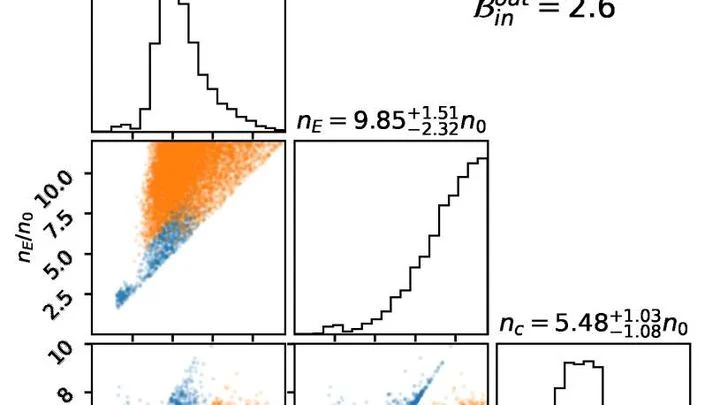
Neutron stars are cosmic 'ice cubes' of unimaginable density: a tablespoon of their material would outweigh Mount Everest. It was a mystery what lay in their cores: ordinary neutron matter (a giant atomic nucleus) or exotic quark matter, where particles are not bound into neutrons.
Light from a distant star seeps through a planet's gaseous envelope, and astronomers try to guess what that envelope is made of. That's how we study the atmospheres of worlds we can never touch. When a planet passes in front of its sun's disk, its gaseous veil briefly intercepts some of the rays.
Neutrinos are tiny particles that barely interact with matter. They pass straight through a star like bullets through fog. When a massive star is gearing up to explode, its core contracts, temperatures soar, and neutrinos start streaming out.
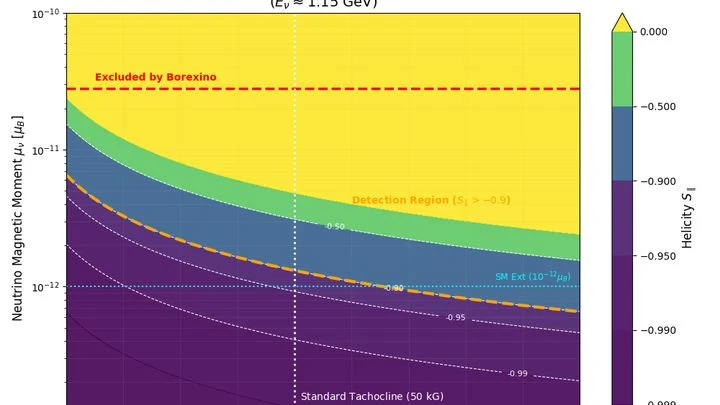
The Sun doesn't just shine: it continuously emits streams of tiny particles, neutrinos. They are born in thermonuclear reactions in the core and pass through the star almost unhindered. But inside the Sun, there are magnetic fields that can influence these particles, like invisible corridors that slightly bend their path.
Inside a neutron star, matter is squeezed so tightly that a teaspoon of its material would weigh as much as a mountain. We can't directly see what happens to particles under such conditions, but stars tell us about themselves through gravitational waves and light when two such stars merge.
Just as in a crowded room each new person sharply increases the pressure on the walls, in a neutron star increasing density leads to a rise in internal resistance. But even this resistance has an absolute ceiling.
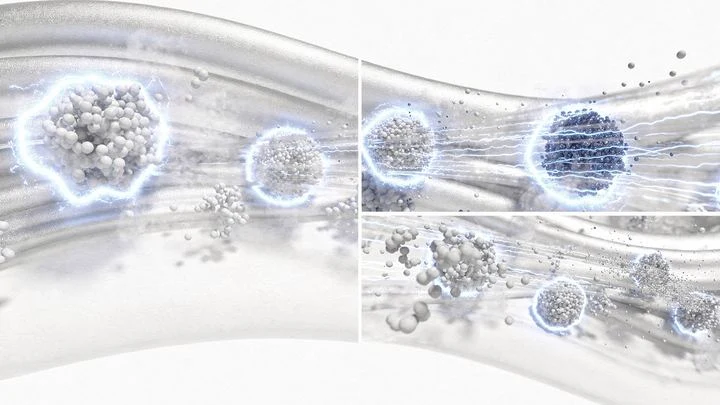
Cosmic rays are atomic nuclei accelerated to near-light speeds. They arrive at Earth from all directions, and their composition tells us what's happening in the far reaches of the Galaxy.
Like long-distance runners, atomic nuclei, from light helium to heavy iron, race toward us across the Galaxy. At the finish line, in a detector on a high-altitude balloon, we see that heavy nuclei arrive a bit more exhausted than light ones. The difference is small, but it repeats from flight to flight.