Magnetic flux density, often denoted as B, is a vector field that describes the strength and direction of a magnetic field at every point in space. It is the fundamental quantity that determines the force a moving charge experiences (via the Lorentz force) and the torque on a magnetic dipole. In everyday terms, it tells you how 'strong' a magnet is and in which direction it pushes on charged particles. The SI unit is the tesla (T), where 1 T = 1 kg/(A·s²).
History
The concept evolved from Michael Faraday's lines of force in the 1830s. James Clerk Maxwell formalized it mathematically in his 1865 paper 'A Dynamical Theory of the Electromagnetic Field', and the modern vector calculus formulation was completed by Oliver Heaviside and Josiah Willard Gibbs in the 1880s.
How it works
Magnetic flux density arises from moving electric charges (currents) and from intrinsic magnetic moments of particles. It is defined through the Lorentz force law: F = q(v × B), where F is force, q is charge, and v is velocity. The 'flux density' name comes from the concept of magnetic flux Φ, which is the integral of B over a surface: Φ = ∫ B · dA. Thus, B is the flux per unit area. In materials, B is related to the magnetic field strength H by B = μ₀(H + M), where μ₀ is the vacuum permeability and M is the magnetization.
In practice
Magnetic flux density is central to the design of electric motors, generators, transformers, MRI machines, and particle accelerators like the LHC, where superconducting magnets produce fields up to 8 T.
Fun fact
The strongest magnetic fields in the universe are found on neutron stars called magnetars, with flux densities up to 10¹¹ T — about a trillion times stronger than a typical refrigerator magnet.
Units by system: SI: tesla · CGS: gauss · Planck: planck magnetic flux density · natural: tesla
Right after the Big Bang, space was a hot plasma — a mix of charged particles and light. In such a medium, electric currents couldn't flow on their own: a 'potential difference' was needed to push electrons relative to photons.
A neat stack of atomic layers lies on a substrate. An invisible beam of terahertz light shines down on it, with a magnetic field applied from the side. After reflection, the beam's polarization rotates slightly.
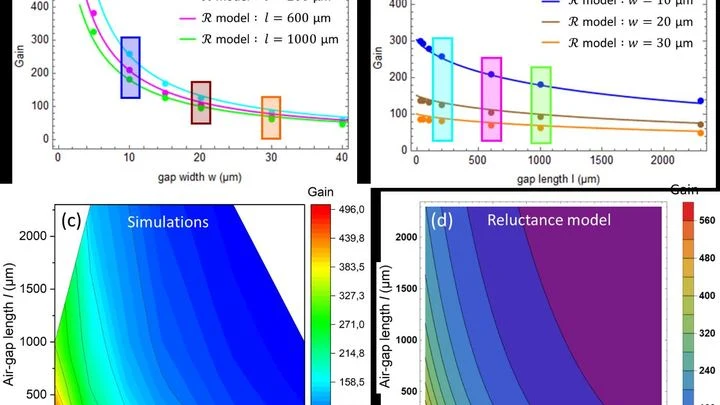
Magnetic sensors smaller than a match head can already detect weak fields — from a beating heart or a distant planet. But making them even more sensitive involves a trade-off: improve one part, and you lose performance in another.
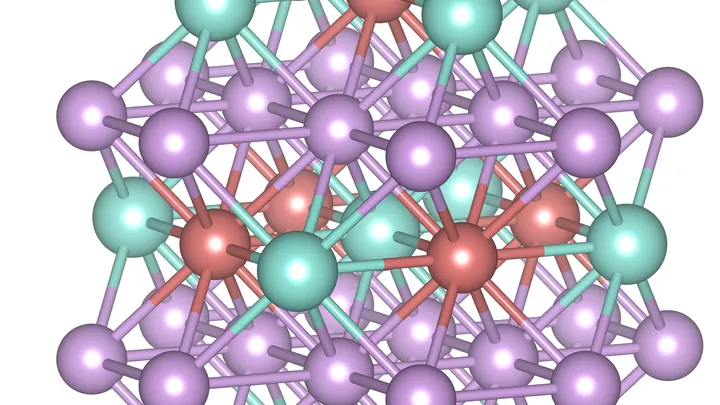
In a regular battery, the electrolyte is liquid, and charged particles (ions) move freely. In the solid-state version, they squeeze through atomic 'corridors', like pedestrians in narrow passages. For a battery to work quickly, you need a material with high ionic conductivity.
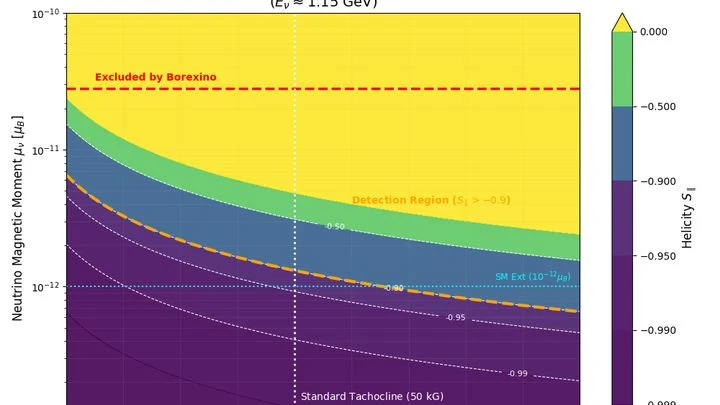
The Sun doesn't just shine: it continuously emits streams of tiny particles, neutrinos. They are born in thermonuclear reactions in the core and pass through the star almost unhindered. But inside the Sun, there are magnetic fields that can influence these particles, like invisible corridors that slightly bend their path.
Tiny particles, smaller than a hundredth of the thickness of a human hair, can be magnets that don't lose their strength even at 600 degrees Celsius. These particular particles were made from a nickel-iron-aluminum alloy. The alloy has been known for a long time, but in nanoparticle form it was produced without templates — simply by mixing solutions of metal salts.
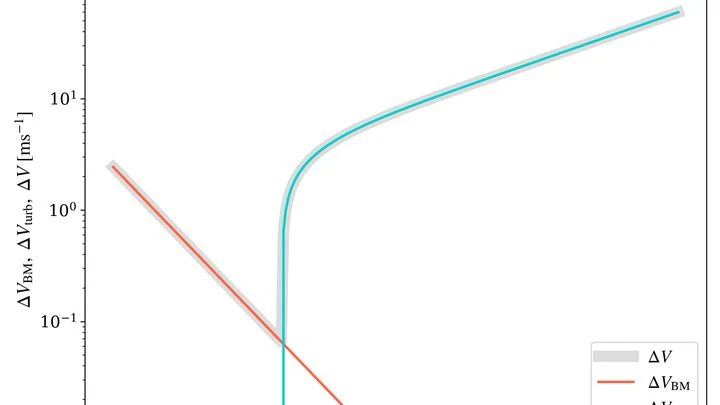
In the cold clouds of gas and dust where stars will one day ignite, some atoms have lost electrons and become charged. Charged particles feel the magnetic field, while neutral ones do not, so the charged ones slip through the neutral ones like water through a sieve. Astronomers have measured this drift speed: about a hundred meters per second.