Planets Around Giant Stars: Life on a Short Leash express
A star nine times heavier than the Sun ignites a zone around it where liquid water could slosh on a planet's surface. But this zone is like a narrow strip of beach at low tide: it will vanish in 30 million years. Such stars live bright and die young, leaving life no time for the long journey from microbes to complex beings.
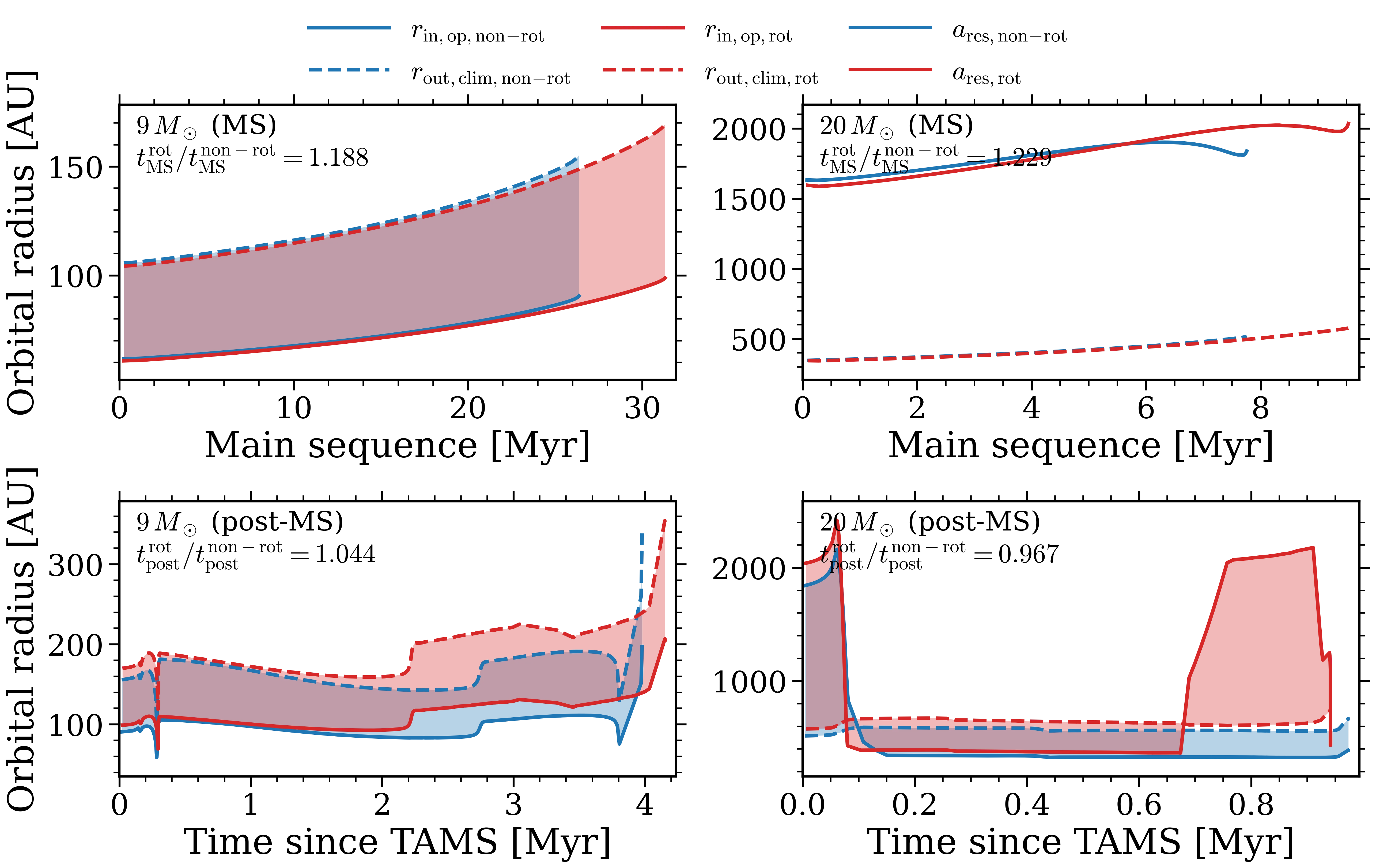
Astronomers traced the fate of Earth-like planets around stars of various masses — from light ones like our Sun to giants 120 times heavier. They accounted for how the star spins, how its wind blows, and how ultraviolet radiation strips the planet's atmosphere. It turns out that around a star of 9 solar masses, a planet can retain air and water at distances of 70–130 astronomical units — two to three times farther than Pluto is from the Sun. But already around a star of 12 solar masses, the habitable zone narrows to a thin thread, and at 15 solar masses, it disappears altogether.
After the star burns hydrogen in its core, it expands into a red giant, and the habitable zone briefly opens up again, but now at distances of hundreds of astronomical units. For a star of 25–30 solar masses, this window lasts from thirty thousand to one and a half million years. Less than the time humanity has existed as a species.
Such planets are like fireflies in a night forest: they flash for a moment and then fade. Searching for life on them is like catching a fleeting instant, but that is exactly where the most unexpected biosignatures might hide.
Original abstract
as written by the authors arXiv:2602.13875
Massive stars dominate the feedback of young stellar populations, yet their ultraviolet fields and winds are often presumed to preclude Earth like habitability. We test this by mapping time dependent habitable zones (HZs) for solar metallicity stars of $$0.8$$--$$120\,M_\odot$$. Using rotating and non rotating \textsc{GENEC} tracks, we compute bolometric climate HZ boundaries and impose XUV energy limited escape and wind ram pressure constraints for a dipole-magnetized Earth analogue. The retention limited inner edge is the most restrictive limit. We measure annulus lifetime, longest fixed orbit residence, and maximum dynamically packed terrestrial multiplicity, finding a sharp main-sequence ceiling. A rotating $$9\,M_\odot$$ star sustains a retention limited HZ for $$\sim 30$$ Myr at $$\sim 70$$--$$130$$ AU, but becomes brief and narrow by $$12\,M_\odot$$ and disappears by $$15\,M_\odot$$. Post main-sequence evolution can reopen HZs up to $$\sim 25$$--$$30\,M_\odot$$, but only for $$\sim 0.03$$--$$1.5$$ Myr at hundreds to $$\sim 10^3$$ AU, disappearing by $$\sim 40\,M_\odot$$. Stellar rotation modestly increases habitable lifetimes near the upper main sequence without altering the high mass ceiling. IMF weighting shows that massive stars contribute only $$\sim 10^{-4}$$ of the habitable planet time budget. Even so, for the fiducial occurrence normalization and if rocky planets form or survive at the required wide separations, they add a few $$10^5$$ Earth analogues satisfying the adopted criteria to the Milky Way at any instant. Massive star systems do not dominate the Galaxy-wide habitability budget, but may provide short-lived, distinct targets for biosignature searches.
The habitable zone around a star of 9 solar masses lies farther out than Pluto's orbit — at a distance of 70–130 astronomical units. A year on such a planet would last several centuries.
In Stanislaw Lem's novel 'Solaris', the planet orbits two stars, a red and a blue one, and its ocean lives its own mysterious life. Massive blue stars are exactly the kind that give planets only a brief chance at habitability.