An Alloy That Becomes a Superconductor After Heating express
A metal bar made of five different metals (hafnium, niobium, scandium, titanium, and zirconium) sits in a furnace. After heating to 600 degrees, regions appear inside it that look like a pattern of two mixed metals, like marble veins. These regions are what make the entire alloy conduct electric current without losses at a very low temperature — about minus 263 degrees Celsius. This phenomenon is called superconductivity, and it disappears at the slightest warming, so materials are kept in liquid helium.
Scientists measured the temperature at which the alloy becomes superconducting and found: the hotter the furnace during annealing, the higher this temperature. The record was 9.93 kelvin (about minus 263.2 degrees Celsius) for a sample heated to 800 degrees. That is almost two degrees higher than for ordinary alloys of this type. The reason is that heating inflates those "marble" regions: they take up more space, and superconductivity is enhanced.
Why does this happen? Analysis showed that superconductivity involves not only electrons but also vibrations of the crystal lattice atoms. Electrons pair up, and these pairs move through the metal without collisions, like a group of dancers holding hands and weaving around obstacles in sync. In the alloy with the "marble" pattern, more such pairs form, and they hold together more tightly.
Original abstract
as written by the authors arXiv:2602.19371
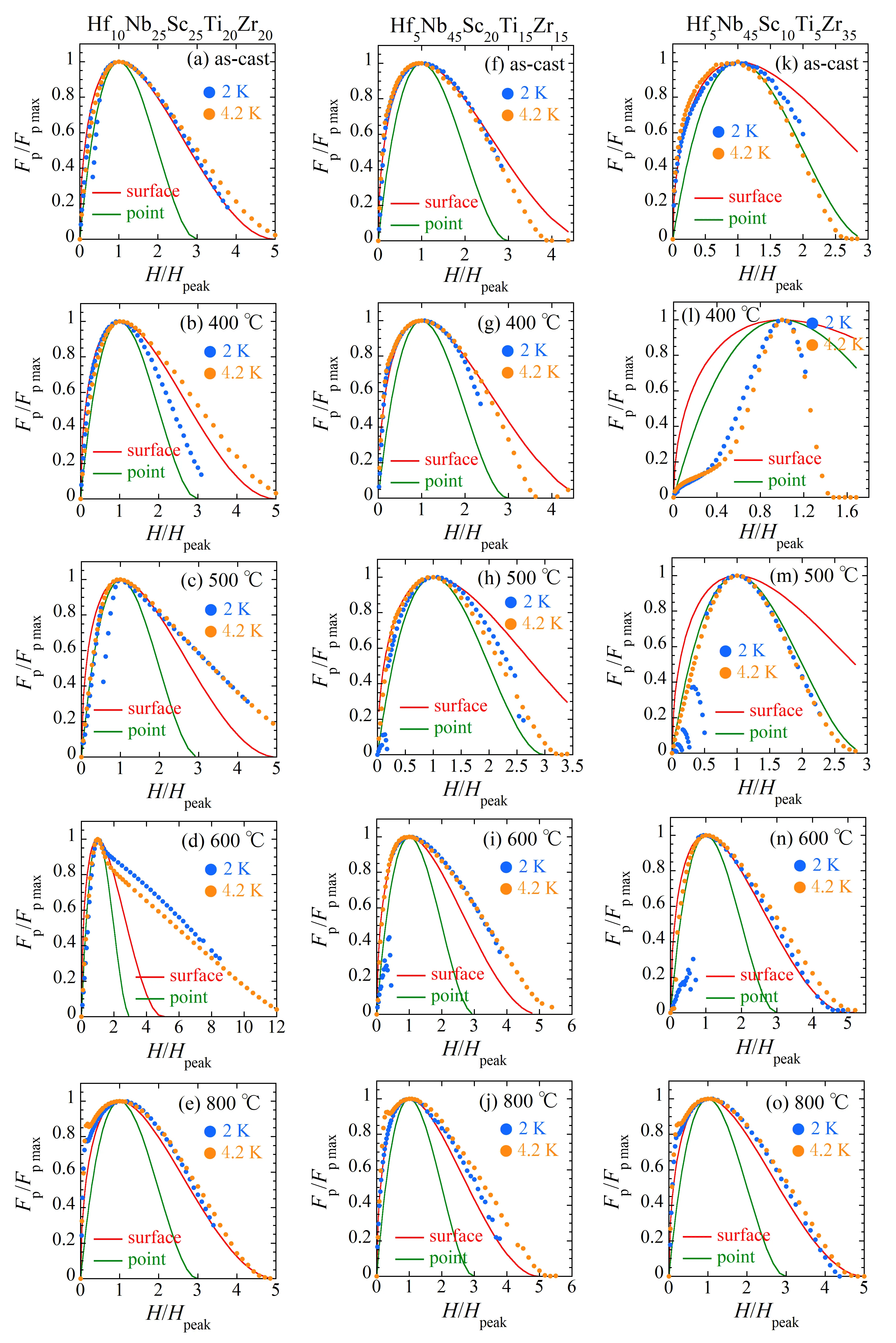
The present investigation into the superconducting properties of eutectic high-entropy alloy (HEA) Hf-Nb-Sc-Ti-Zr systems reveals an enhanced superconducting critical temperature ($$T_\mathrm{c}$$) in body-centered cubic (bcc) phases compared to typical quinary bcc HEAs. In Hf$$_{10}$$Nb$$_{25}$$Sc$$_{25}$$Ti$$_{20}$$Zr$$_{20}$$, Hf$$_{5}$$Nb$$_{45}$$Sc$$_{20}$$Ti$$_{15}$$Zr$$_{15}$$, and Hf$$_{5}$$Nb$$_{45}$$Sc$$_{10}$$Ti$$_{5}$$Zr$$_{35}$$ systems, which span a broad range of valence electron concentration per atom, lattice strain and the presence of partial or absent eutectic phases are characteristic features at lower annealing temperatures. The eutectic regions expand rapidly following annealing at 600$$^{\circ}$$C in all systems. The $$T_\mathrm{c}$$ of each system increases markedly with rising annealing temperatures from 400$$^{\circ}$$C to 600$$^{\circ}$$C, reaching a maximum value of 9.93 K in the Hf$$_{5}$$Nb$$_{45}$$Sc$$_{10}$$Ti$$_{5}$$Zr$$_{35}$$ sample annealed at 800$$^{\circ}$$C. Nearly all samples can be classified as strong-coupling superconductors. The sample annealed at 500$$^{\circ}$$C in the Hf$$_{5}$$Nb$$_{45}$$Sc$$_{10}$$Ti$$_{5}$$Zr$$_{35}$$ system exhibits a critical current density ($$J_\mathrm{c}$$) exceeding the practical threshold of 10$$^{5}$$ A/cm$$^{2}$$ up to approximately 4 T at 4.2 K and 6 T at 2 K. The elevated $$J_\mathrm{c}$$ is attributed to significant lattice strain and phase instability. The underlying mechanism for the enhanced $$T_\mathrm{c}$$ in Hf-Nb-Sc-Ti-Zr systems is examined through specific heat data analysis, suggesting that the expansion of the eutectic regions induced by thermal annealing plays a pivotal role.
The record superconducting temperature for this alloy is 9.93 kelvin, which is about minus 263.2 degrees Celsius. That is colder than the surface of Pluto, where it is about minus 230 degrees.