Heat Turned into Light: A Silicon Path to Energy express
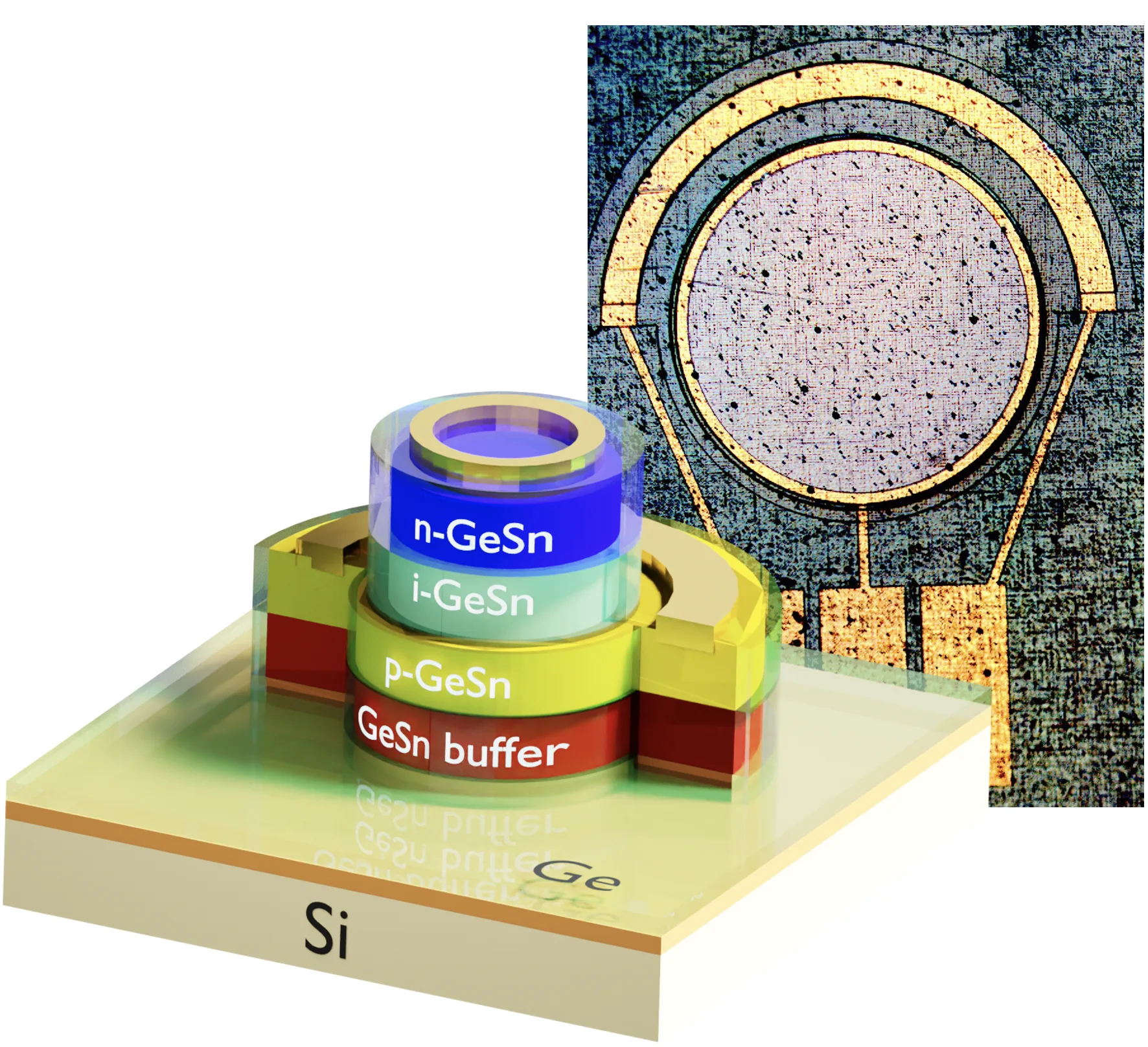
A blazing furnace in a workshop or the hot exhaust of a turbine is not just heat: it's light, invisible to the human eye. Regular solar panels catch visible light, but here you need a receiver for invisible thermal radiation. A team of researchers has, for the first time, built such a receiver from a germanium-tin alloy — a material that can be grown directly on silicon wafers, just like standard computer chips.
They tested a sample the size of a pinhead: they aimed a laser beam with a wavelength of 2.33 microns at it, along with light from a ceramic plate heated to 1500 kelvins. The device produced a current, albeit a modest one — power output was about 0.41 milliwatts per square centimeter. That's hundreds of times less than expensive indium arsenide counterparts, but the key point is: the material works.
Calculations show that the main problem is defects in the crystal, which kill charge carriers along the way. If those are removed, power could rise to 1 watt per square centimeter — thousands of times more. Then such a device could power sensors in factories, in space, or even at home, harvesting heat that today just goes up the chimney.
The germanium-tin alloy can be applied to silicon like frosting on a cookie, in a thin layer, without cracking.