A Magnetic Compass Inside a Crystal express
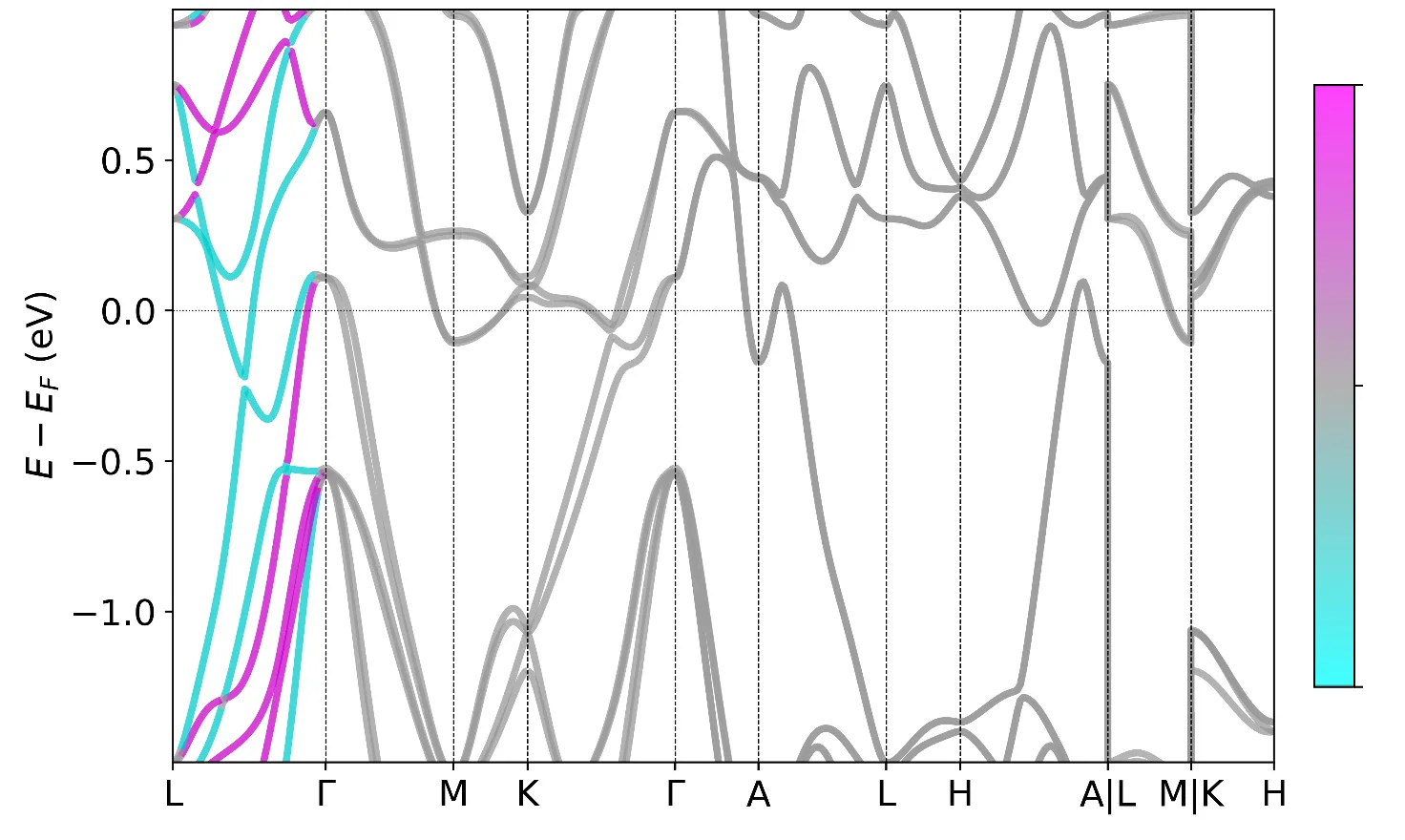
Electrons in a CrSb crystal behave like a school of fish: inside the material, they dart along their "corridors," and at the boundary with vacuum, they arrange themselves into intricate patterns. These patterns are the Fermi surface — a map of all allowed electron velocities. You can't reach out and touch it, but you can "feel" it with a magnetic field.
In the new experiment, a CrSb crystal was placed in a magnetic field of up to 68 tesla — a million times stronger than Earth's field. Under such fields, electrons start moving in circles, and the material's resistance shimmers slightly. The frequency of this shimmer, like the note of a plucked string, reveals the shape of the electronic pockets. By measuring the shimmer at different tilt angles of the field, the researchers reconstructed the entire Fermi surface.
The map matched theoretical calculations. This means scientists correctly understand how electrons in CrSb respond to magnetic order. Such materials are called altermagnets: in them, electrons with different spins (tiny magnetic moments) move differently, even though the material itself is not magnetized. This property could be useful in future electronics — for example, for storing information without electric current.
Thus, the magnetic field acted as a magnifying glass: it revealed the invisible contours along which electrons move in the crystal. Now these contours can serve as a road map for new devices.
The Fermi surface is named after physicist Enrico Fermi, who never actually saw it. It shows which electron velocities are allowed in a crystal and resembles a contour map of underwater terrain.