How a Dash of Tin Turns a Film into an Insulator express
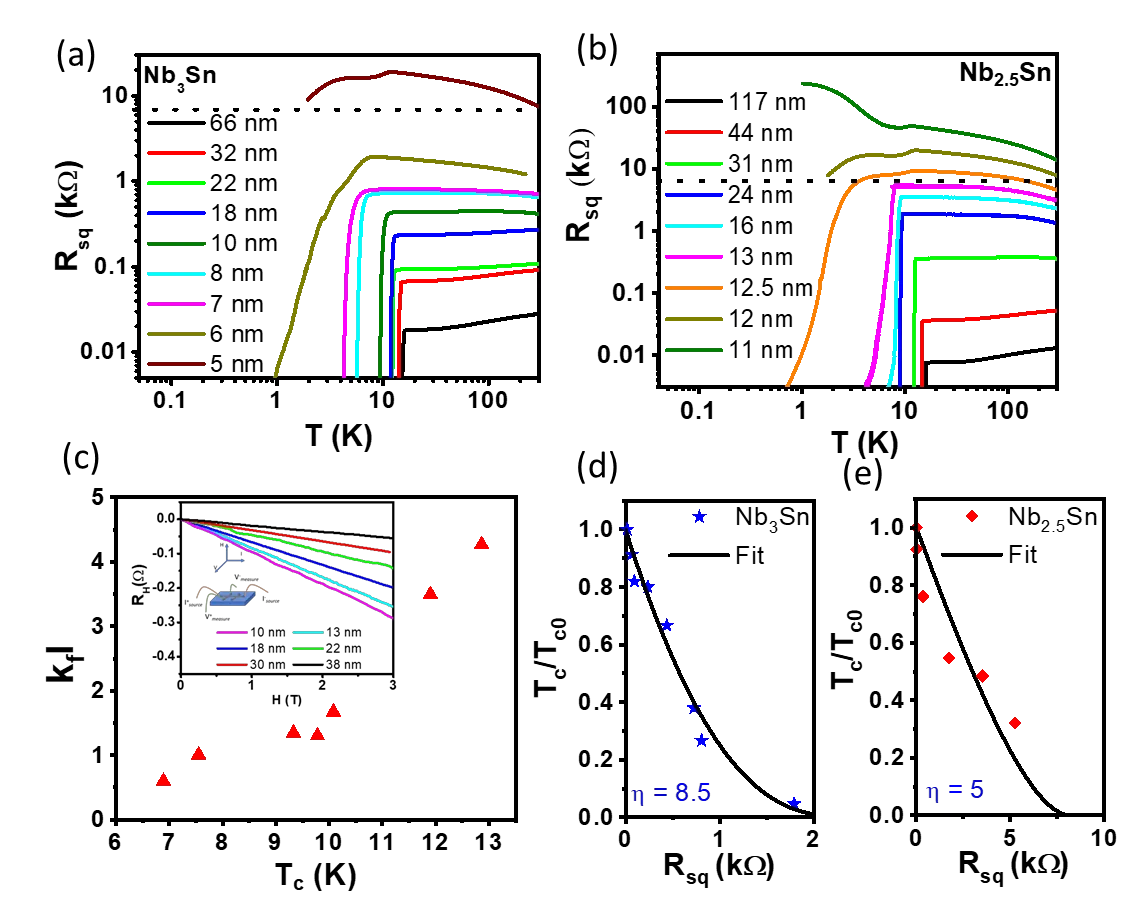
A thin film of niobium and tin conducts electricity without resistance — until you make it really thin. Then it suddenly becomes an insulator. A team of physicists tested what happens when you add a bit more tin to the film than the formula calls for.
The films were grown by sputtering onto a silicon substrate — kind of like spray-painting, but with atoms. In the tin-rich films, the crystal grains came out finer, and the boundaries between them were more pronounced. Such a film loses superconductivity at a thickness of about 11 nanometers — twice as thick as films with the exact composition. Beyond that, it behaves like an ordinary insulator.
Measurements in a magnetic field revealed another detail: in the more granular films, the superconducting state breaks down more easily. The superfluid stiffness, a measure of how firmly a superconductor holds onto its current, is noticeably lower in these films. It seems the extra tin atoms rattle the whole order, and superconductivity gives in earlier.
Such films are a convenient playground for studying the transition from conductor to insulator. By varying the composition, you can tune the thickness at which this transition occurs. And that means better understanding how disorder works in the nanoworld.
Original abstract
as written by the authors arXiv:2603.00954
Nanocrystalline superconducting films offer an excellent platform to explore the interplay between disorder, granularity, and dimensionality. In this work, we investigate two series of NbxSn thin films with near-stoichiometric (x =3) and slightly Sn-rich (x =2.5) compositions, deposited on Si (100) substrates via DC magnetron sputtering. Both series exhibit nanocrystalline morphology, with the Sn-rich films displaying smaller grain sizes and a more granular microstructure. A suppression of the superconducting transition temperature (Tc) with decreasing film thickness is observed in both series. Notably, a disorder-driven crossover to an insulating state emerges, occurring at a thickness of approximately 11 nm for the Sn-rich films-about twice that of the stoichiometric films. The estimated disorder parameter (kFl=0.4) in the thinnest films indicates proximity to the Anderson localization regime for these films. Magneto-transport measurements reveal a thickness-driven 3D to 2D crossover, with its onset strongly dependent on film stoichiometry. Furthermore, a pronounced suppression of superfluid stiffness is observed in the Sn-rich films, corroborating the structure-property correlations identified in this study. This work highlights the role of stoichiometry controlled disorder in tuning superconductivity in granular NbxSn thin films.
A thickness of 11 nanometers is about 40 atomic layers. If a sheet of paper were that thin relative to its size, it would cover a football field.
In Peter Watts's novel Blindsight, superconductors work at room temperature, but even there, the slightest disorder in the crystal nullifies their properties.