Black Hole Winds Without a Magnet express
Not all water in a whirlpool goes down the drain: some splashes back up in narrow sprays. Gas near a black hole behaves similarly. It falls, heats up, collides with itself, and part of it is ejected back into space in two narrow jets that fly in opposite directions.
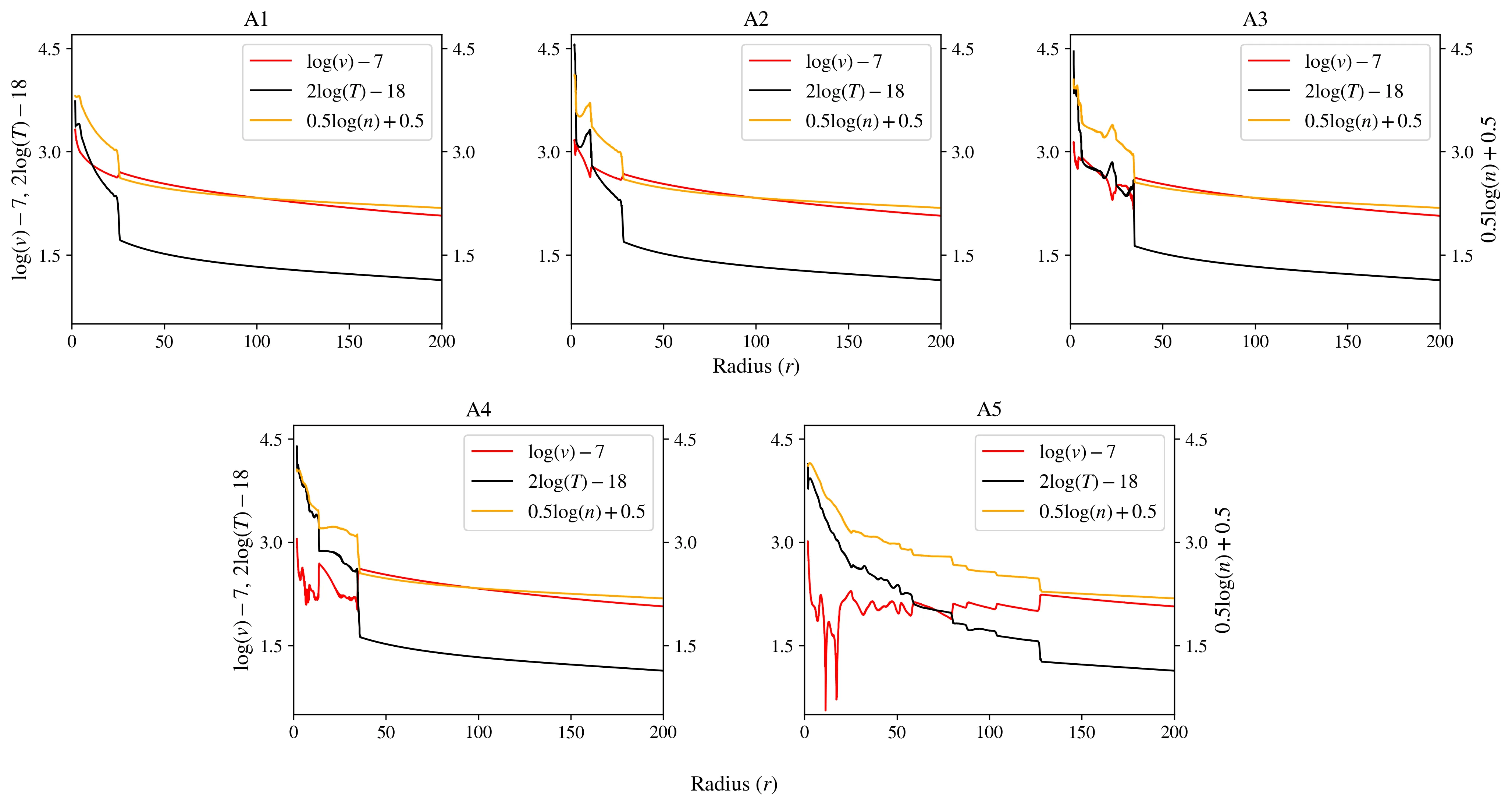
Usually, such jets are explained by magnetic fields that twist the gas and fire it along the rotation axis. But the authors removed the magnetic field entirely and still got stable outflows. In their computer model, gas falling onto a non-rotating supermassive black hole forms a thick, hot disk. Inside the disk, a shock wave develops, like a plug in a pipe, forcing some gas to abruptly change direction and shoot upward and downward.
The jets start right at the black hole's horizon and extend to the edge of the computational domain: that's 2651 Schwarzschild radii (the distance at which the escape velocity equals the speed of light; for a black hole of a million solar masses, this is about 8 million kilometers). The gas accelerates to 14% of the speed of light — faster than any human-made material.
The authors also calculated how these outflows shine in X-rays. The radiation comes from bremsstrahlung of the hot gas, amplified by electron scattering. Such spectra can be compared with observations of real active galactic nuclei.
The water in the whirlpool has splashed out, and now it's clear that even without a magnet, a black hole can send signals far into space.
Original abstract
as written by the authors arXiv:2603.01180
We study outflow from an unmagnetized, shocked accretion disk around a non-rotating super-massive black hole using multidimensional hydrodynamics simulation with radiative cooling. We aim to investigate whether such shocked accretion flow can launch sustained collimated bipolar outflow reaching out to thousands of gravitational radii even in the absence of magnetic field and if yes, what terminal velocity can they achieve? We present the results of a few simulations of geometrically thick accretion flow with increasing specific angular momentum on a vertically elongated cylindrical domain. We show thatbipolar outflow from a region very close to the black hole is originating and propagating vertically out to our simulation domain boundary at around $$2651$$ Schwarzschild radius. The outflow attains a terminal velocity with a maximum value found to be $$0.14c$$ and the outflow rate depends on the angular momentum value of the accreting material. We also compute the self-Comptonized bremsstrahlung spectra for all the disk-jet runs.
The ejected gas moves at 14% of the speed of light. That's 42,000 kilometers per second: such a stream would travel from Earth to the Moon in 9 seconds.
In the movie Interstellar, the black hole Gargantua is shown with a bright accretion disk but no jets. Yet such jets could serve as a navigational beacon for a passing spacecraft.