Foam of Realities: How Uneven Vacuum Walls Create a Gravitational Hum
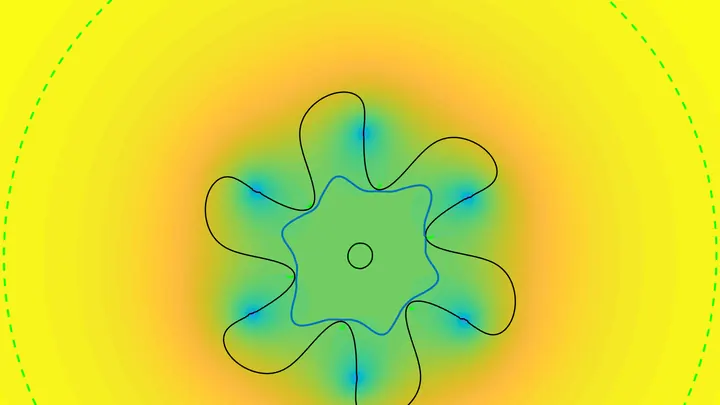
In the first moments after the Big Bang, cosmic symmetry breaking divided the hot plasma into regions with different vacuums — the lowest energy states of a field.
Systems that simulate aspects of quantum gravity or spacetime emergence in laboratory settings.Quantum gravity analogues are laboratory systems that mimic specific aspects of quantum gravity or the emergence of spacetime, even though they do not involve actual gravitational fields. These analogues are typically built from condensed matter systems, such as ultracold atomic gases, fluids of light, or even water waves, where the mathematical equations governing excitations resemble those of fields in curved spacetime. By studying these systems, physicists can probe phenomena that would otherwise be inaccessible, such as Hawking radiation from artificial event horizons or the thermodynamics of spacetime.
The concept was pioneered by William Unruh in 1981, who proposed that sound waves in a moving fluid could mimic black hole physics. Experimental realizations followed decades later, with the first sonic black hole analogue demonstrated in 2009 by Jeff Steinhauer and colleagues using a Bose-Einstein condensate.
The key mechanism is the analogy between the propagation of waves in a moving medium and the propagation of light in a curved spacetime. For example, in a fluid with a sufficiently fast flow, sound waves can be trapped behind a 'sonic horizon'—a point where the flow speed exceeds the local speed of sound—mirroring the event horizon of a black hole. Quantum fluctuations near this horizon can produce phonon pairs, analogous to Hawking radiation. In other setups, carefully engineered interactions in ultracold atoms or photonic crystals create effective metrics that simulate spacetime curvature, allowing researchers to study phenomena like particle creation or the emergence of spacetime from entanglement.
These analogues are used to test theoretical predictions of quantum gravity, such as Hawking radiation, in controlled laboratory settings, and to explore analog models of cosmological phenomena like inflation or the early universe.
In 2016, Jeff Steinhauer's lab at the Technion reported the first observation of spontaneous Hawking radiation from a sonic black hole analogue, using a Bose-Einstein condensate of rubidium atoms.
| K | variable | Leggett-Garg combination of correlation functions |
| C_{ab} | variable | Correlation function between measurements at times a and b — correlation function |
| C_{a'b} | variable | Correlation function between measurements at times a' and b — correlation function |
| C_{ab'} | variable | Correlation function between measurements at times a and b' — correlation function |
| C_{a'b'} | variable | Correlation function between measurements at times a' and b' — correlation function |
| k_{qJ} | variable | Quantum Jeans wavenumber — wavenumber reciprocal metre |
| m | variable | Particle mass — mass kilogram |
| \rho | variable | Mass density — mass density kilogram per cubic metre |
| G | constant | Universal constant of gravitation — gravitational constant = 6.67430e-11 cubic metre per kilogram per second squared |
| \hbar | constant | Planck constant divided by 2π — reduced planck constant = 1.054571817e-34 joule second |