Nuclear Customs: How to Inspect a Warhead Without Opening It express
A customs officer can't take a suitcase apart to see what's inside. They shine X-rays through it and, from the shadows on the screen, tell: here's metal, here's organic matter. In much the same way, an inspector for future nuclear disarmament treaties should be able to check a warhead — without opening it or seeing its secret internals.
Neutrons are better suited for this than X-rays. When you direct a neutron beam at an object, some neutrons get absorbed by uranium or plutonium nuclei. But absorption isn't uniform: at certain neutron energies, the nuclei 'gobble them up' especially eagerly. It's like light passing through a stained-glass window: the glass lets some colors through and blocks others. By which colors are missing, you can tell what metals were added to the glass.
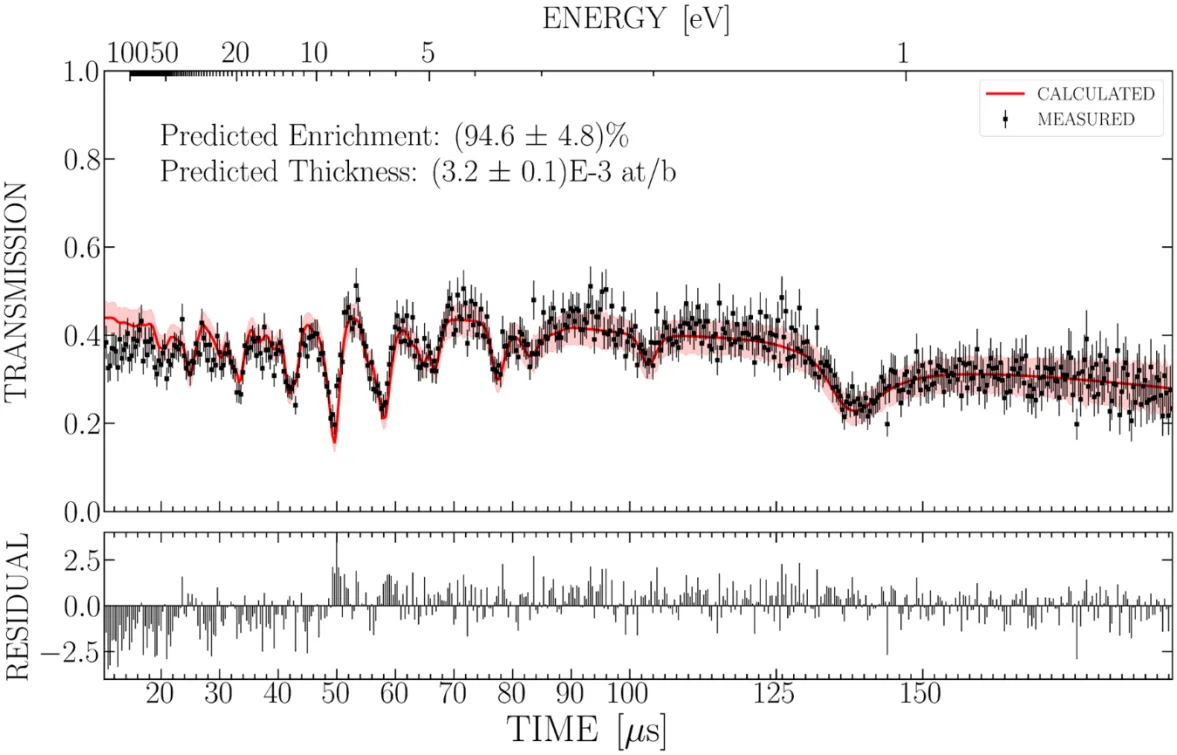
The scientists built a device about the size of a small table. Inside, neutrons travel just two meters, and their time of flight is measured — from which their energy is calculated. If the sample contains, say, uranium-235, a characteristic dip appears on the graph at an energy around 1–100 electron-volts. Such a dip is like a fingerprint: each isotope has its own, and it tells you exactly what's in front of the inspector.
They tested it on three materials: highly enriched uranium, depleted uranium, and reactor-grade plutonium. In two hours, they gathered enough data to see all the needed dips. Then a program called REFIT compared them with calculated ones and produced the composition: the fraction of uranium-235 was determined to within 5%, and the isotopic composition of plutonium to within 6%. For a first proof of concept, that's a good result.
Such a device could become a tool of trust: one side shows that the warhead really contains uranium, not a dummy, without revealing the exact design. The neutron 'stained glass' reveals only composition, not blueprints. It's like a signature on a document: it confirms authenticity but doesn't disclose the contents.
The time for a neutron to fly through the two-meter tube is about 200 microseconds — a hundred times faster than the blink of an eye.
In the TV series 'The Expanse', Mars customs officers scan ships for nuclear materials — looks like the future is already here.