A Bridge Between Worlds: Entangling Mechanical Oscillators with Different Frequencies
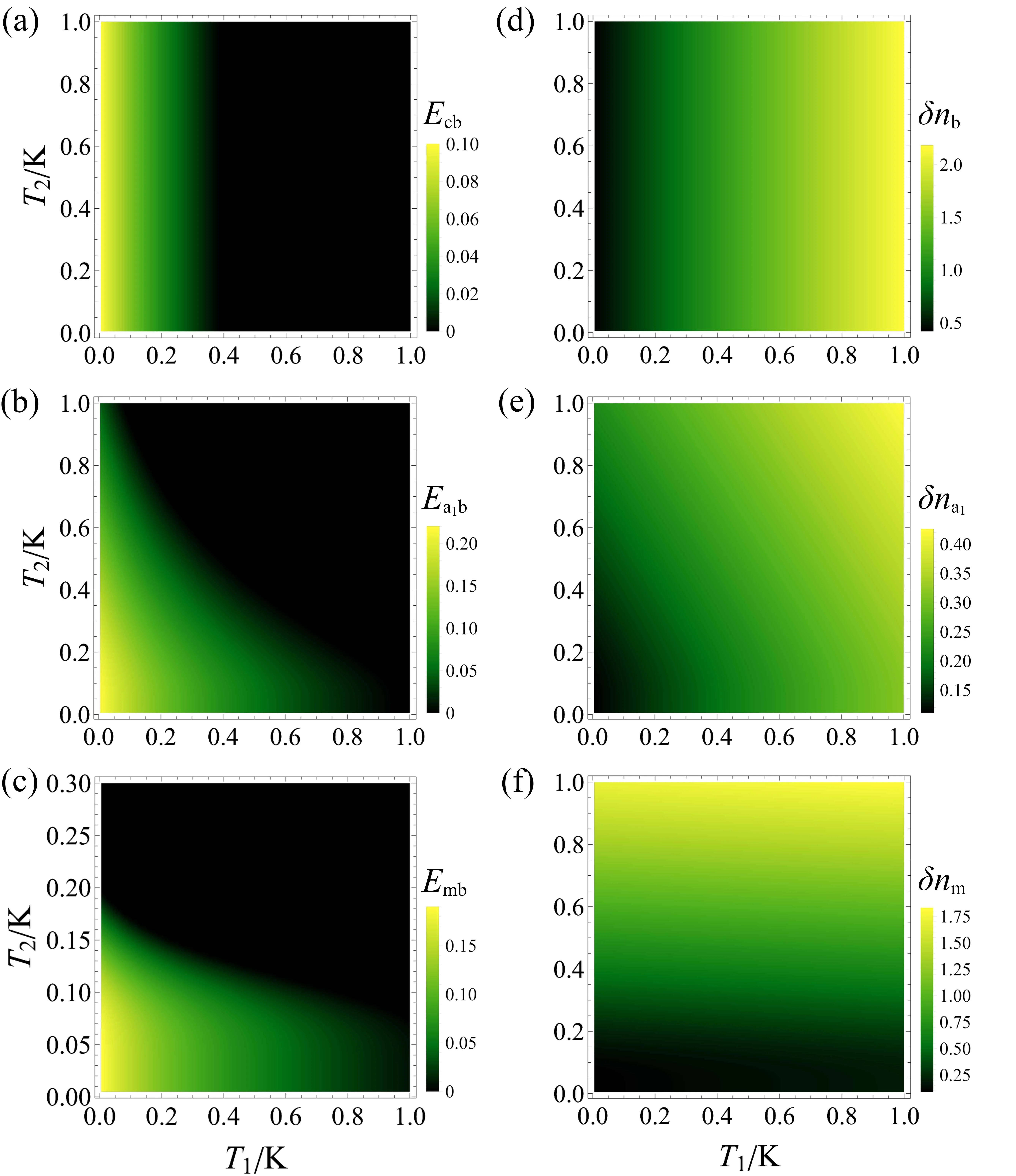
A translator is distracted by every rustle in the room, and a one-hour meeting stretches into two. That's roughly what the problem looks like when you need to link two mechanical resonators oscillating at very different frequencies. One trembles a million times per second (megahertz), the other a billion (gigahertz). The first is good for long-term storage of quantum information, the second for fast processing and protection against thermal noise. But how do you transfer an invisible quantum connection between them if they 'speak' at completely different speeds?
Physicists found the answer in light. Light is a universal translator: it can 'listen' to the slow resonator and 'whisper' to the fast one. In the first scheme, a laser cools the slow megahertz resonator and simultaneously entangles it with a particle of light. This entangled state flies through an optical waveguide to a neighboring system, where another laser transfers it to the fast gigahertz resonator. The key point is triple resonance: three waves (light, sound, and another light) match in frequency and reinforce each other, like three voices singing the same note.
In the second scheme, the route is reversed. A short laser pulse creates a squeezed state between the fast resonator and the light pulse. This pulse travels through a fiber, and at the other end a red laser pulse transfers the entanglement to the slow resonator. Calculations show that even with fiber losses up to 50%, the entanglement survives. At typical losses of 0.2 dB/km, the distance between nodes can reach tens of kilometers.
It was previously thought that linking nodes with frequencies differing by hundreds of times was impossible: the gap is too large. This work is the first to show a concrete mechanism for transferring entanglement between the megahertz and gigahertz ranges. Now one can combine long-lived slow resonators for storage with fast ones for processing. The next step is to test the scheme in the lab, and then on real optical fiber.
A translator between two speeds of speech has been found: it's light, which can adapt to both interlocutors. And a meeting that once seemed hopeless can now proceed without loss of meaning.
The mechanical resonators used in such experiments can be the size of a human hair, yet behave as quantum objects. Their vibrations are cooled to the ground state, where thermal motion almost completely disappears.
The idea of a quantum network uniting mechanical oscillators resembles the ansible from Ursula K. Le Guin's novels: a device for instantaneous communication based on entanglement. In reality, though, information transfer is still limited by the speed of light.