A Bridge Between Worlds: Entangling Mechanical Nodes with Different Frequencies
Context
Quantum networks promise to unite processors, sensors, and communication channels into a single infrastructure. But the nodes of such a network do not have to be identical: some store information better, others process it faster. Mechanical oscillators are attractive candidates for the role of nodes, because their frequencies can be varied over a wide range during fabrication. High-frequency gigahertz resonators are resistant to thermal noise and convenient for interfaces with microwave electronics. Low-frequency megahertz resonators have long coherence times and are suitable for storing quantum states. However, entangling such dissimilar nodes has so far proved impossible: the frequency gap is too large. The work sits among studies on entanglement distribution in optomechanical networks, but neighboring papers usually consider nodes with close frequencies.
Methods
The authors built a theoretical model of two optomechanical systems connected by an optical waveguide. The first system contains a megahertz mechanical resonator and an optical mode with dispersive coupling. The second contains a gigahertz resonator and two optical modes interacting through a triple resonance caused by Brillouin scattering. In the first scheme, strong red detuning of the laser cools the megahertz resonator and simultaneously entangles it with the optical mode. This entangled state is then transmitted through the waveguide to the second system, where resonant pumping activates transfer of the state to the gigahertz mechanical node. In the second scheme, a short blue laser pulse creates a two-mode squeezed state between the gigahertz resonator and the optical pulse. After passing through the waveguide, a red pulse in the remote system transfers this state to the megahertz resonator. The analysis used Langevin equations and covariance matrices, and entanglement was quantified by logarithmic negativity.
Results
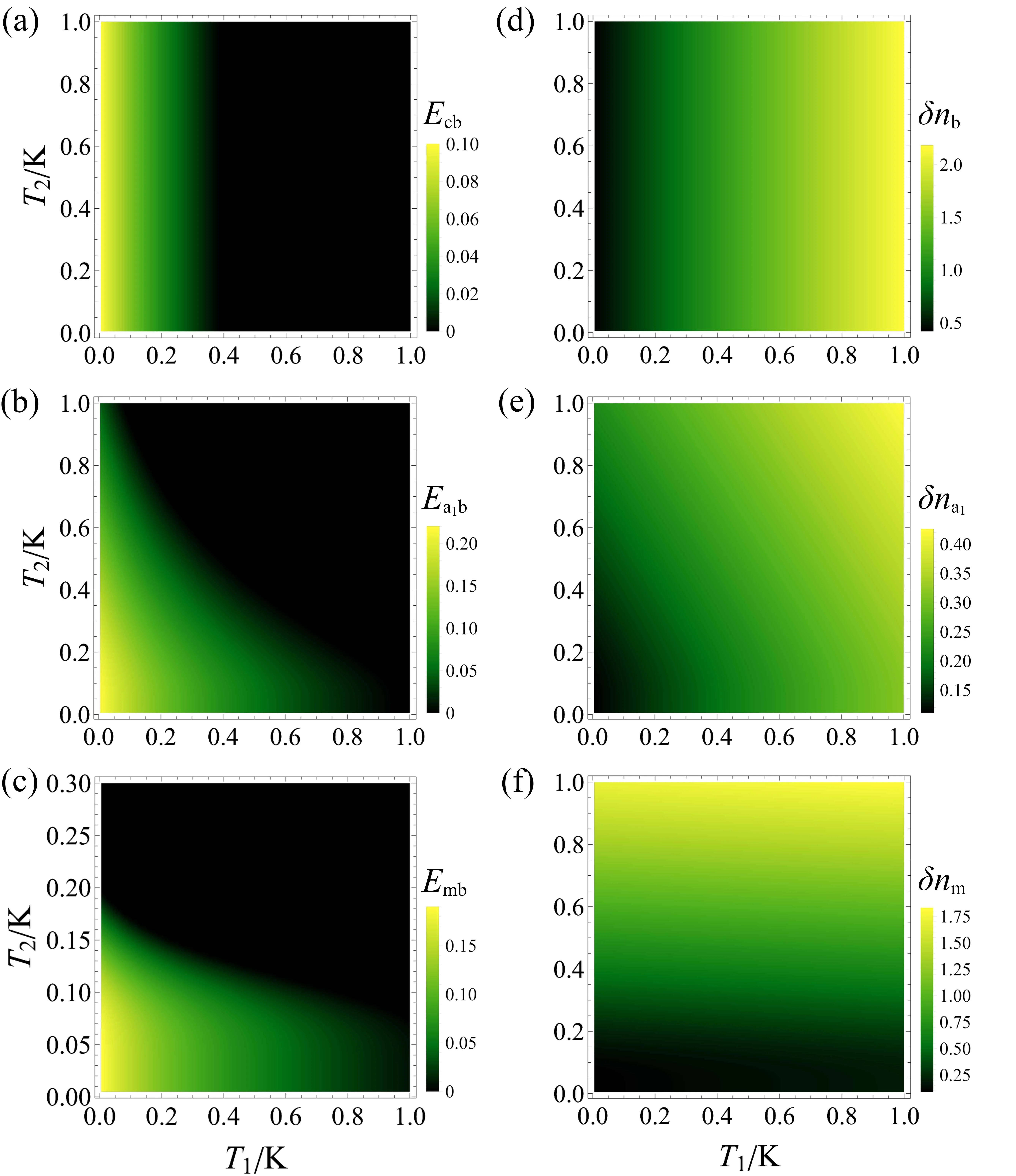
The first scheme demonstrates robust entanglement between the optical mode and the megahertz resonator at an effective coupling of about 3 MHz. This entanglement is successfully transferred to the gigahertz node, with the logarithmic negativity reaching values comparable to the initial one. Numerical analysis showed that entanglement is strongest near the frequency-downconversion sideband. The second scheme with the pulsed protocol makes it possible to obtain entanglement between mechanical nodes separated by a lossy waveguide. With a squeezing parameter r=2.18 and a state-transfer efficiency W=0.95, entanglement survives even at losses up to 50%. The authors estimated that with typical fiber losses of 0.2 dB/km, the distance between nodes could be tens of kilometers. Both schemes work at cryogenic temperatures on the order of 10 mK, achievable in modern experiments.
Implications
The work shows for the first time how to entangle mechanical nodes whose frequencies differ by three orders of magnitude. Unlike neighboring studies, where the nodes were identical or close in frequency, here a concrete mechanism is proposed for transferring entanglement between the megahertz and gigahertz ranges. This expands the toolkit of hybrid quantum networks: it is now possible to combine long-lived low-frequency resonators for storage with high-frequency ones for fast processing. The pulsed scheme additionally shows that entanglement can be distributed over long distances, overcoming fiber losses.
Future development
Possible developments include experimental implementation of the proposed schemes on existing optomechanical platforms, such as optomechanical crystals and microresonators. Precise tuning of laser pulses and control of thermal noise will be required. Further theoretical work could take into account detection imperfections and nonlinear effects. It would also be interesting to extend the approach to a larger number of nodes and to networks with quantum repeaters.
Impact
The results could influence the development of hybrid quantum networks, quantum memory, and interfaces between microwave and optical signals. They also open a path to fundamental tests of quantum mechanics on macroscopic objects with different masses and frequencies.
Next steps
The immediate step is an experimental demonstration of entanglement transfer between a megahertz and a gigahertz resonator in a single laboratory. After that, one can move on to testing the scheme at a distance with real optical fiber.
Key open problems
In optomechanics, the problem of scaling entanglement to a large number of mechanical nodes remains unsolved. This work addresses the particular task of linking two nodes with different frequencies, but it does not touch on multi-node networks or resilience to decoherence. The next major challenge will be creating a quantum repeater based on mechanical oscillators that can store entanglement and purify it from noise.
The mechanical resonators used in such experiments can be the size of a human hair, yet behave as quantum objects. Their vibrations are cooled to the ground state, where thermal motion almost completely disappears.
The idea of a quantum network uniting mechanical oscillators resembles the ansible from Ursula K. Le Guin's novels: a device for instantaneous communication based on entanglement. In reality, though, information transfer is still limited by the speed of light.
Key numbers
- frequency gap between nodes: from 10 MHz to 8.2 GHz
- experiment temperature: 10 mK
- effective optomechanical coupling: 3 MHz
- fiber losses: 0.2 dB/km
- squeezing parameter in the second scheme: r = 2.18