The path integral abandons a single trajectory in favor of a superposition of all possible paths. Instead of the Schrödinger differential equation, it uses direct summation of amplitudes: each path contributes with a complex weight exp(iS/ħ), where S is the classical action. Quantum interference highlights paths where the action barely changes (the principle of least action), thereby recovering classical mechanics. The method proved universal: it describes elementary particles, thermal fluctuations, and even black holes.
History
The early trail leads to Paul Dirac, who in 1933 noted that the quantum propagator can be written via an exponential of the classical action. John Archibald Wheeler encouraged his student Richard Feynman to think that the amplitude should be a sum over all paths. Feynman developed the framework in his 1942 dissertation and published it in 1948, revolutionizing quantum electrodynamics.
How it works
The central idea is quantum superposition: the amplitudes of all virtual trajectories interfere. The phase of each is proportional to the classical action in units of ħ. In the limit ħ→0, the stationary phase method picks out a single trajectory, recovering Newton's second law. In quantum fieldtheory, the functional integral over fields leads to a diagrammatic expansion—the basis of Standard Model calculations. Numerically, the integral is often evaluated using lattice Monte Carlo methods after switching to imaginary time.
In practice
Predicting the behavior of financial options, designing quantum computers, computing properties of new materials before they are synthesized.
Fun fact
Feynman invented the path integral while pondering how light could travel along all rays at once, like threads in steamed-up glass.
A stone thrown at a wall bounces off. In the quantum world, a particle can pass right through, as if the wall were woven from mist. This is quantum tunneling: it lights up stars, works in microchips, and even operates in the cells of our bodies. But most particles have spin — an intrinsic rotation, like a spinning top.
A quantum particle moves in a circle, passing through several stations. At each station, something happens to it — for example, its properties change slightly. After completing a full circle, the particle returns, but its state is no longer exactly what it was at the start.
In a noisy hall, an interpreter tries to catch every word, but rustles and echoes muddle the meaning. That's roughly how conventional computer methods handle complex quantum systems: the more particles and the stronger their correlations, the faster calculations drown in interference.
Quantum calculations often resemble assembling a complex mechanism: a physicist knows a part will fit, but can't always explain why. One favorite trick is to insert a 'unity' into the middle of a formula — not an ordinary one, but one built from an infinite set of all possible states of the system. This turns a cumbersome expression into a chain of simple integrals.
Space is not a void but a mosaic of tiny cells. In loop quantum gravity, spacetime curvature is transferred from a smooth sheet to a network of 'atoms' of volume — spin networks. Each node of such a network is a quantum of space, and the links between them are quanta of area.
But how does this mosaic change over time?
A quantum particle can be a wave, and pass through two paths at once. But if something 'peeks' at which path it took, the wave disappears. This effect is called loss of interference. Usually, photons or air molecules do the peeking.
Each positron annihilation is like the birth of a pair of dancers, connected by an invisible thread of polarization. Two gamma quanta fly apart, but their states remain entangled: measuring one instantly determines the other — as if one partner senses every movement of the other, no matter the distance.
An experienced detective doesn't calculate a criminal's path using the laws of physics: he checks a file of similar cases. The new prediction method works the same way: instead of complex equations, it has a vast archive of trajectories that have already happened — planetary motions, currency exchange rates, signals from space.
A complex financial contract is like a wager: the payout depends on exchange rates and accrued interest. Physicists would call this uncertainty entropy — a measure of the spread of possible outcomes. To assess the risk, you need to run through all scenarios, like finding every trap-filled dead end in a vast maze.
A neural network, like a sheet of graph paper, receives homogeneous signals at its input, and draws its own coordinate grid. Initially, connections between inputs and network cells form a gentle hill: the response is strongest at the center and fades toward the edges.
Many cutting-edge physics calculations hit a brick wall — not for lack of ideas, but because of arithmetic. We're talking about integrals that express particle collision probabilities or the shape of gravitational wave bursts.
Conventional neural networks learn from thousands of examples, burning hours and gigawatts. Physicists have found a quantum workaround. As early as Max Planck showed the discreteness of energy, today this allows generation without training.
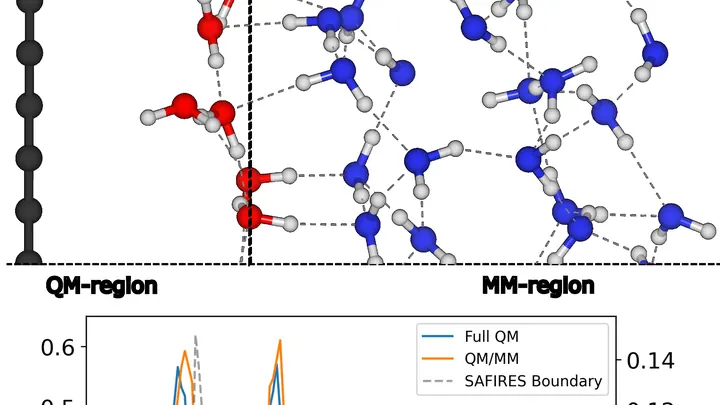
Imagine a huge swimming pool. In one corner, a chemical reaction is underway that needs to be calculated with jeweler-like precision. But the surrounding water is not just decoration: its molecules jostle, attract, and influence the reaction. How do you account for this endless dance of particles without drowning in calculations?
At the heart of quantum field theory live integrals that resemble mirages. In the familiar four-dimensional world, they are strictly zero — shadows that disappear in the light. But step into a space with a slightly shifted dimension (4 − 2ϵ), and these 'pseudo-vanishing' integrals gain substance and start influencing calculations.
A stone falls to the ground along the most economical route — the one that expends the least time and energy. This principle of least action governs all of classical physics. But in the microworld, everything jitters: fields fluctuate, and you can't say precisely where anything is.
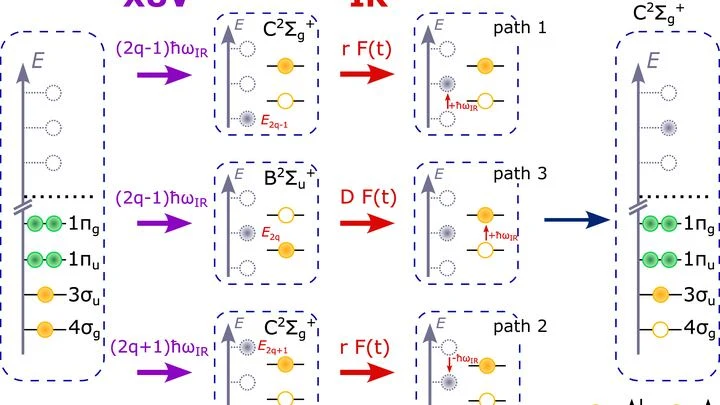
A high-speed camera capable of capturing the motion of electrons is an attosecond interferometer. It sends two laser pulses at a substance with a tiny delay. The first, ultraviolet, acts like a flash, knocking an electron out of the molecule. The second, infrared, like an invisible hand, gently nudges or slows this electron in flight.
A tailor cuts a suit, but the seams pucker and the buttons won't align. In quantum field theory, similar glitches are called anomalies: they appear when a symmetry of the equations breaks down in the transition to a quantum description. Usually, they are fixed by sewing in extra patches, the so-called Bardeen–Wess–Zumino counterterms.
A laser beam hits an atom, and an electron is knocked loose. It accelerates, returns, and, crashing into the atom, emits a flash of light — a harmonic. If there are two light beams and they are crossed like an intersection, the electron can choose different routes. In the new experiment, the two beams had comparable strength and were directed at right angles.
An optical tweezer is a beam of light that holds and moves tiny objects like bacteria or dust grains. If you need to carry a particle from point A to point B, you could simply pull it straight there. But that would consume more energy than a cleverly chosen detour.
An active particle is a microscopic object that propels itself forward, like a tiny swimmer.
An ion channel in a cell membrane is a gate just a few atoms wide. Every second, millions of charged particles, sodium and potassium ions, pass through it. Classical physics said that to get through, an ion must jump over an energy barrier, like a traveler crossing a high mountain pass.
The quantum world doesn't like being glanced at sideways. To extract all available information from an atom or photon, you need a whole fan of 'needles'—different ways to ask a question. Physicists call such a fan a complete set of measurements. But among complete sets, there are special ones: their needles are arranged so evenly that each responds with equal strength.
A pot of water on the stove is just water, but inside each molecule, a continuous dance goes on. Hydrogen and oxygen atoms jitter, even at absolute zero, because that's how the quantum world works. These jitters change how much heat water stores and how it flows.
Inside a fuel cell, protons must race through a solid material like commuters through turnstiles at rush hour. If the turnstiles are sparse and narrow, the current is weak. In the past, to find a material with good proton conductivity, chemists had to screen compounds almost blindly, one by one.
When chemists see how concentrations of substances change, they need to figure out which reactions are behind those changes. It's like trying to reconstruct a recipe from photos of plates at different stages of a meal. Previously, this often involved derivatives — instantaneous rates of concentration change.
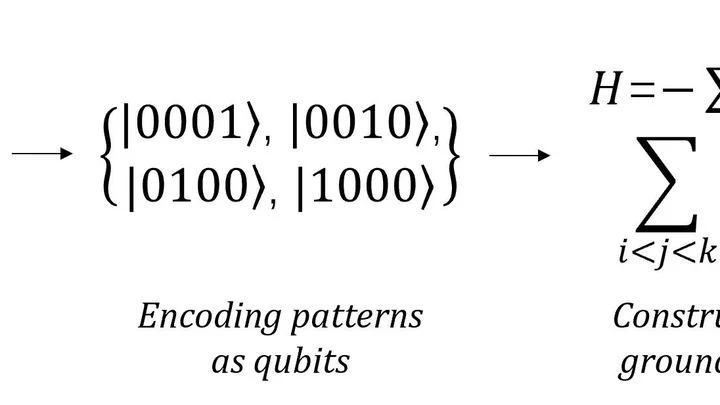
Finding the largest group of strangers among a crowd is a challenge that pops up in logistics, chemistry, and scheduling. Ordinary computers hit a black hole here: not from lack of power, but because the problem's structure swallows any classical solution.
The new quantum algorithm sidesteps the trap.
On a table lies a handful of round magnets. As long as no one touches them, they lie in disarray. But send a short current pulse through them, and each disk flips: the north pole swaps with the south. Neighboring disks push each other with their fields, like people in a crowded queue, and the whole handful arranges into a pattern that depends on which way the magnetic wind blew and how warm it is around.
Every machine, whether a car engine or a tiny nanocooler, runs with a jitter. Fuel burns unevenly, electrons slip through contacts off schedule, and the power needle on your instruments vibrates slightly. These vibrations are called fluctuations. They are not just noise: they tell you how stable a device is and how much energy it wastes.
Every breath you take and every muscle twitch runs on a stream of electrons flowing through proteins inside your cells. These proteins aren't static: they constantly change shape, like a spring that compresses and releases. But until now, no one has seen exactly how these movements open or close the path for electrons.