Laser Tape Measure with Micrometer Precision express
A standard laser rangefinder works like a stopwatch on a 100-meter dash: it times how long light takes to run to the target and back. But such a stopwatch has a limit: it ticks in steps of tens of picoseconds (trillionths of a second). In that step, light travels about a centimeter, so finer details are invisible.
Instead of single pulses, the new method uses two combs of thousands of ultra-short flashes, emitted at slightly different frequencies. Their overlap acts like a gear train: a tiny difference in speed becomes a large, easy-to-measure shift. Thus, a coarse stopwatch turns into a microscope for time.
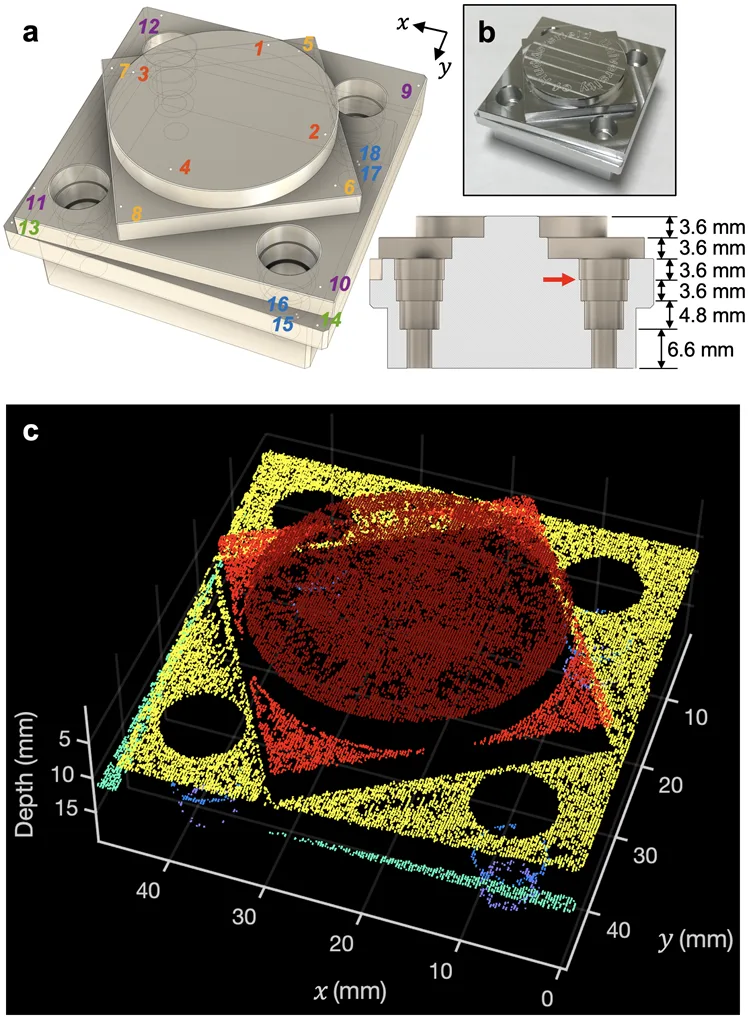
Tests on an aluminum part from a distance of 40 centimeters showed an error no greater than 38 micrometers, and after half a second of signal accumulation, the average scatter was just 1 micrometer. The result matched readings from a coordinate measuring machine that probes the surface mechanically.
Such a laser eye is useful where you cannot touch: inspecting parts on a conveyor, examining fragile museum exhibits, or scanning hot or radioactive objects. Light flies there, measures, and returns without leaving a trace.
Light travels 1 micrometer in 3.3 femtoseconds — shorter than a single molecular vibration.