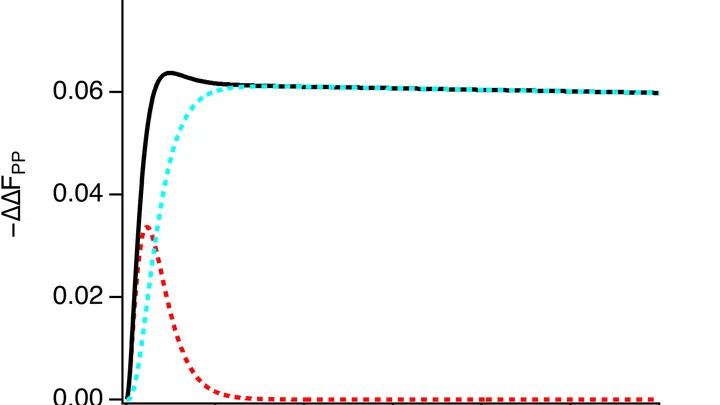
Pump-probe spectroscopy is a technique for observing events that happen on timescales of femtoseconds (10^-15 s) to picoseconds (10^-12 s), far faster than any electronic detector can directly record. It works by using two laser pulses: a 'pump' pulse initiates a process in a sample, and a 'probe' pulse, arriving after a precisely controlled delay, measures the state of the sample at that moment. By repeating the experiment with different delays, scientists can reconstruct a movie of the ultrafast dynamics.
History
The technique was pioneered in the 1970s and 1980s, with key contributions from researchers like Peter Rentzepis and Ahmed Zewail, who used it to study chemical reactions in real time.
How it works
The pump pulse excites the sample, creating a non-equilibrium state. The probe pulse, which is usually weaker and often at a different wavelength, interacts with the sample and is then measured. The delay between the two pulses is controlled by changing the optical path length of the probe beam (e.g., with a movable mirror), since light travels about 0.3 micrometers per femtosecond. The measured probe signal (e.g., transmission, reflection, or induced fluorescence) is recorded as a function of delay, building up a time-resolved trace of the system's evolution.
In practice
It is used to study photosynthesis, charge transfer in solar cells, and the dynamics of phonons and electrons in semiconductors, as well as to characterize the properties of novel materials.
Fun fact
The fastest pump-probe experiments can resolve events that last only a few attoseconds (10^-18 s), using isolated attosecond pulses rather than femtosecond ones.
A theater spotlight keeps the actor in its beam no matter where they step. The terahertz radar we are about to describe does the same with a short light pulse reflected off a moving object.
Terahertz waves sit between microwaves and infrared light.
A storm in the upper atmosphere lasts a few millionths of a second. A cosmic ray, a proton or a helium nucleus, strikes air molecules, sending a swarm of particles downward. Most of them stay together, but occasionally one particle gains so much energy that it surges ahead.
When a laser beam hits a gas, it tears electrons from atoms and accelerates them to nearly the speed of light. As these electrons fly through the plasma, they emit X-rays, like a glowing trail from a fast particle. In the new work, physicists made a single laser pulse create not one but two such trails in succession.
A shooter aims at a target, pulls the trigger, and hears two shots: one loud, one quiet. That's how the new setup works, except instead of bullets, there's an electron bunch, and instead of shots, there are two flashes of light. One flash is X-ray, the other is terahertz. They fly to the same point with perfect timing.
14 seconds. That’s all it takes for a new code to weave the full spectrum of a star, from ultraviolet to near-infrared. This spectrum is not just a rainbow but a detailed tapestry of thousands of dark absorption lines, each left by a specific atom in the star's atmosphere.
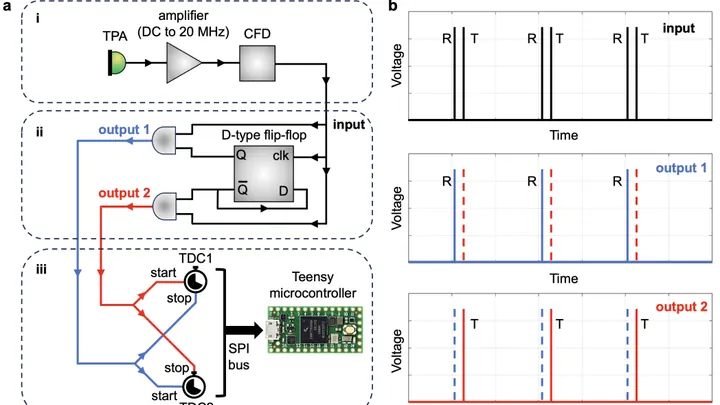
A charged particle streaks through a silicon sensor, leaving behind a trail of free electrons. The time it takes for this charge to be collected at the electrode depends on how deep in the crystal it was born. A particle entering head-on carves identical paths through neighboring pixels: their signals arrive almost simultaneously.
A typical atom trap works like a funnel: laser light and a magnetic field slow atoms down and gather them at the center. But the funnel has a limit: it only catches atoms moving within a certain speed range.
An ordinary camera flash lasts thousandths of a second. An attosecond pulse is a trillion times shorter — in the time it takes, light travels a distance smaller than the size of an atom. Such flashes act as an ultra-high-speed shutter: they freeze the motion of electrons, letting us see them jump between orbitals or take part in a chemical reaction.
An ordinary camera flash lingers for hundredths of a second, but for atoms, that's an eternity. Inside molecules, electrons jump in attoseconds: billionths of a billionth of a second. To capture that, you need a light pulse shorter than the event itself.
Physicists take an electron beam in a linear accelerator and compress it so that individual bunches become thinner than a hair — in time.
Light in a particle detector behaves like a voice in the mountains. One shout, and the echo repeats several times, growing fainter with each reflection. So it is in a silicon detector: a real flash from a particle gives rise to false ones that confuse measurements.
In giant accelerators, particles zip through detectors in billionths of a second, and telling one from another requires a stopwatch of incredible precision. The new µRWELL-PICOSEC detector acts as such a stopwatch: it captures the moment a particle passes with a precision of 48 picoseconds: that's 48 trillionths of a second.
A laser flash lasting 50 femtoseconds is like a shot that lasts one billionth of a second. In that time, light travels only 15 micrometers — less than the thickness of a human hair. But if you send such a flash through an amplifier, it starts to stretch like a rubber band and loses its sharpness.
A laser flash lasts a few femtoseconds — imagine a single instant stretched into a million parts. Such a flash mixes many colors, from red to violet. Instruments that measure the pulse shape often err: they see some colors well and others poorly, blurring the picture.
The authors propose a simple fix.
Underground, in a former gold mine, sits a tank of liquid xenon. If a dark matter particle flies through it, the xenon flashes. But it also flashes from ordinary particles, like neutrinos or leftover radioactivity. The task is to tell which flash comes from dark matter and which from noise.
A standard laser rangefinder works like a stopwatch on a 100-meter dash: it times how long light takes to run to the target and back. But such a stopwatch has a limit: it ticks in steps of tens of picoseconds (trillionths of a second). In that step, light travels about a centimeter, so finer details are invisible.
The EDA2 radio telescope in the Australian outback is like a giant ear pressed against the sky. It listens to the cosmos at very low frequencies, from 50 to 250 megahertz, where ordinary telescopes can barely make out anything.
A superconductor is a material that, when cooled sufficiently, conducts electricity without losses, like water flowing through a perfectly smooth pipe. But if you hit it with a brief flash of light, it quickly loses this property.
Two laser beams, like two pencils, draw an invisible scale on the wall. One tip moves slightly faster than the other, and by the way their strokes alternately coincide and diverge, you can calculate the distance to the wall with an accuracy down to the thickness of a spider's thread.
In the new work, physicists made these two beams work continuously, without pauses.
A laser hits the sample, and molecules inside start to vibrate. This vibration heats the material by tiny fractions of a degree. Previously, such heating was considered a nuisance, but now it's used to read chemical composition, like guessing who's coming down the hallway by the sound of footsteps.
A camera that captures not light but a stream of electrons reflected off a crystal is a hybrid pixel detector. It can count every electron that hits it, generating almost no noise of its own. In normal mode, when the electron beam flows continuously, the detector works perfectly.
If you toss a stone into a pond, ripples spread across the water. Tiny magnetic crystals also host waves — except it's not water that oscillates but the direction of magnetization. These are called spin waves. They travel through the crystal like ripples on a surface and can carry information.
The laser in question is not a thin beam but a whole running track for light. Inside the optical fiber, two ultrashort pulses race: one clockwise, the other counterclockwise. Each pulse is a single flash lasting billionths of a second.
A laser pulse racing through plasma is like a runner carving a path through a crowd. It shoves electrons aside, leaving behind a rarefied channel, just as the crowd parts for a sprinter. In this channel, the crest of the light wave moves slightly faster than light in a vacuum, and it is this speed that determines how efficiently the pulse transfers energy to particles.
A magnesium oxide crystal is like a row of soldiers: atoms stand in neat lines, and an electron runs along them. But if the electron lingers, the nearest atoms shift slightly from their positions, like neighbors in a rank turning their heads. The electron finds itself in a dip made of displaced atoms and can no longer move freely.
Even a laser beam has an invisible tremor — quantum noise. Physicists have learned to 'squeeze' it, like a balloon pinched at the waist: the noise quiets in one direction but amplifies in another. Scientists hid the excess noise where it doesn't interfere with precise light measurements.
An ordinary laser emits photons one by one, like a faucet dripping water. But what if you need several particles of light born at the same instant? Physicists have made a cloud of cold rubidium atoms emit quadruples of photons — as if the faucet suddenly released four drops at once, each falling into its own test tube.
Inside every living cell, chemical transformations are constantly taking place. Some of them create unstable particles whose electrons behave like paired magnets. Their interaction resembles a dance: each movement of the pair responds to external magnetic fields, as if to a changing rhythm.