Liquid Metal in a Maze express
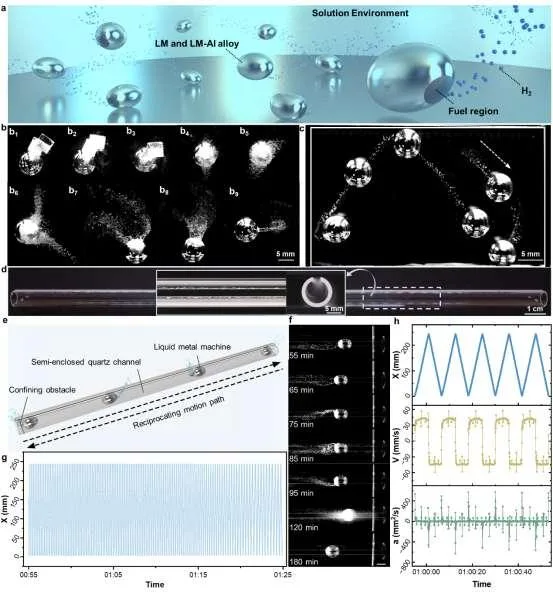
A droplet of liquid metal glides along a narrow channel like mercury from a broken thermometer. It needs no motor — the fuel is a chemical reaction with the surrounding liquid. But what happens when the droplet hits a wall? Previously, such machines were studied in open spaces, and in tight channels they behave differently.
Researchers placed liquid-metal machines into channels as wide as a human hair and filmed them with a high-speed camera. At the closed end, the droplet did not stop but turned around and crawled back. The secret lies in uneven fuel consumption: on one side of the droplet the reaction proceeds faster, and it bends like a caterpillar changing direction.
Such droplets could become couriers in the microworld — carrying heat, drugs, or charges through thin tubes without wires or batteries. By shaping the channel and obstacles, one can set the route. This is a step toward autonomous robots that work in tight spaces — from blood vessels to microchips.
Original abstract
as written by the authors arXiv:2603.18705
Self-propelled liquid metal-aluminum hybrid machines represent a promising class of autonomous motion systems capable of sustained movement without external power sources. While interactions between machines and their environment inevitably occur, the fundamental question of how spatial confinement affects the motion dynamics and the controllability of speed, direction, and lifetime of such liquid metal machines (LMMs) remains underexplored. Understanding these confined dynamics is essential for practical applications. Here, we present a comprehensive investigation of the non-symmetrical fueling principle governing the direction-tuning effect in LMMs. By confining LMMs within one-dimensional semi-open channels, we thoroughly disclose their impact and turning dynamics with different end obstacles throughout their lifecycle, with particular focus on fuel region morphological evolution, overall motion, and local flow characteristics after reaction times exceeding one hour. Utilizing ultra-high-speed imaging techniques, we systematically clarify how fuel region evolution and end-obstacle interactions influence symmetry-breaking mechanisms and reciprocating dynamics. Our findings reveal complex interactions between material properties, charge transfer processes, and fluid dynamics during end-turning processes, establishing a theoretical foundation for LMM driving dynamics. Beyond the theoretical mechanisms, we further demonstrate that LMM exhibits efficient heat and mass transfer capabilities, paving the way for applications in controlled transport systems and autonomous robotics.
The liquid metal gallium melts at just 29.8°C: you can melt it simply by holding it in your palm.