Liquid Metal in a Maze express
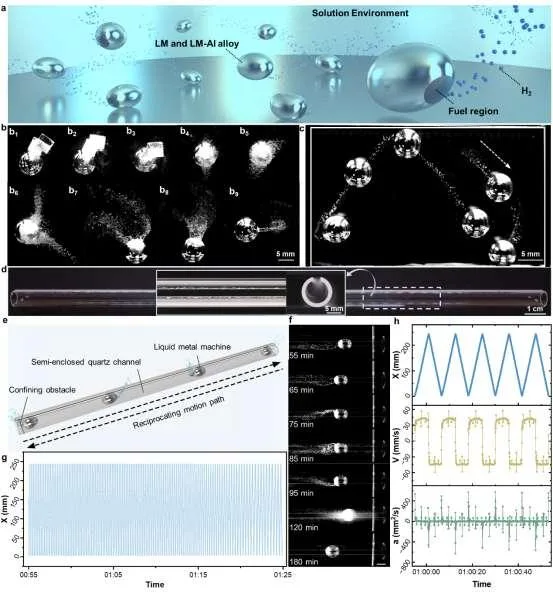
A droplet of liquid metal glides along a narrow channel like mercury from a broken thermometer. It needs no motor — the fuel is a chemical reaction with the surrounding liquid. But what happens when the droplet hits a wall? Previously, such machines were studied in open spaces, and in tight channels they behave differently.
Researchers placed liquid-metal machines into channels as wide as a human hair and filmed them with a high-speed camera. At the closed end, the droplet did not stop but turned around and crawled back. The secret lies in uneven fuel consumption: on one side of the droplet the reaction proceeds faster, and it bends like a caterpillar changing direction.
Such droplets could become couriers in the microworld — carrying heat, drugs, or charges through thin tubes without wires or batteries. By shaping the channel and obstacles, one can set the route. This is a step toward autonomous robots that work in tight spaces — from blood vessels to microchips.
The liquid metal gallium melts at just 29.8°C: you can melt it simply by holding it in your palm.