A Weak Shock Wave on the Sun Accelerates Electrons to 122 keV express
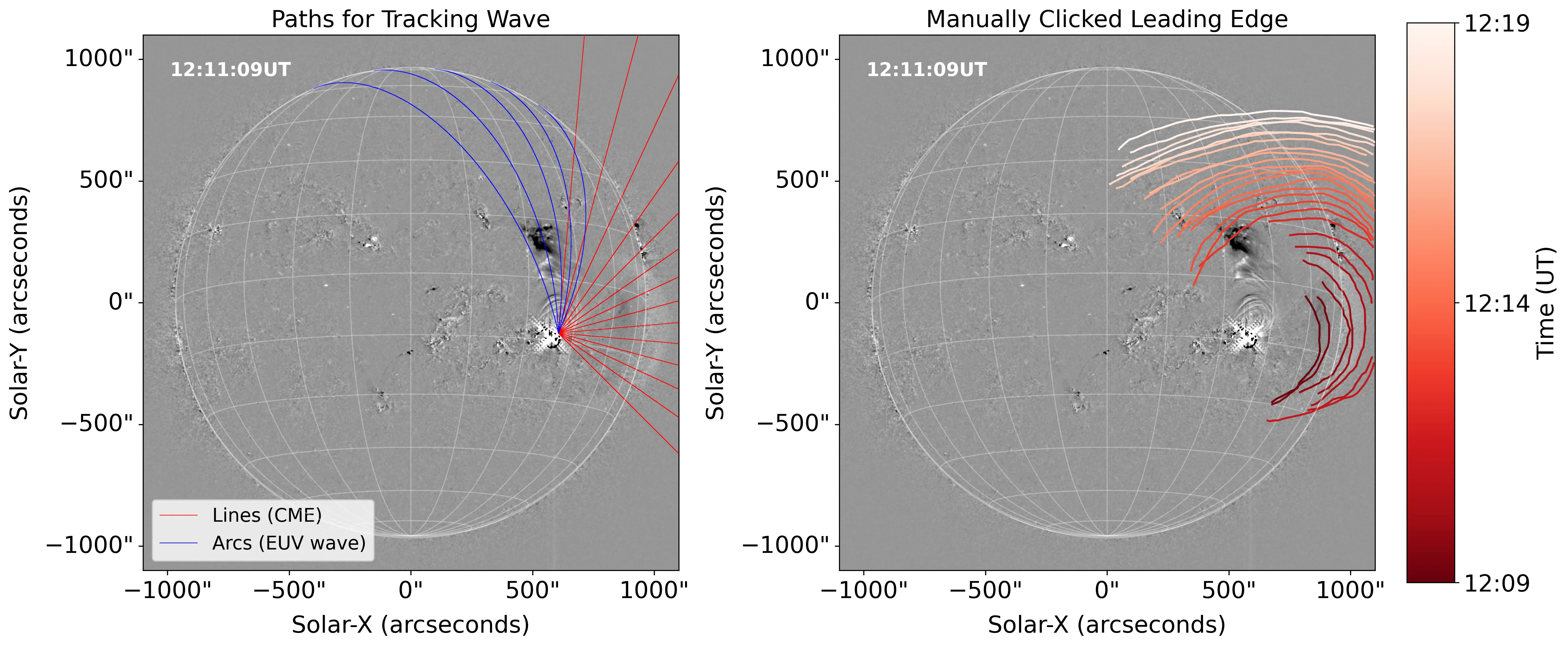
A shock wave in the Sun's corona is like the sonic boom from an airplane, except instead of air there is scorching plasma, and instead of sound there is a jump in density and magnetic field. On March 10, 2024, such a wave swept across the western part of the solar disk. It was so weak that its speed exceeded the local speed of magnetic waves by only half a percent (Mach number about 1.005). You'd think such a 'quiet' wave couldn't accelerate anything.
But when the wave reached a region where the magnetic field lines did not loop back to the Sun but extended into interplanetary space, everything changed. There, the wave struck the open field lines almost perpendicularly. At that moment, radio telescopes caught bursts that looked like frequent 'fir trees' on the dynamic spectrum: that's what beams of electrons ejected along magnetic field lines look like. From the tilt of these 'fir trees,' the electron energy was estimated: from 75 to 122 kiloelectronvolts. For comparison, the energy of particles in a candle flame is fractions of an electronvolt.
This case is important: previously, it was thought that strong shock waves from powerful flares were needed to accelerate particles. Here, the wave was barely noticeable, but the field geometry, open lines perpendicular to the front, did the trick. So even weak disturbances in the corona can contribute to the flux of energetic particles that later reach Earth and affect space weather.
So a quiet wave, almost indistinguishable from the background, reminded us: in solar physics, it's not just the strength of the impact that matters, but also where it's directed. An open door sometimes matters more than a fist.
An energy of 122 keV means the electron is traveling at about 60% of the speed of light. If such an electron could run along a wire, it would circle the Earth in a second.
In Arthur C. Clarke's novel 'Solar Storm,' a stream of accelerated particles from the Sun knocks out technology on Earth, just the scenario studied through such observations.