Enrico Fermi in 1949 proposed an elegant explanation for the origin of galactic cosmic rays: charged particles scatter off inhomogeneities in the interstellar magnetic field, gaining energy each time they are reflected by a moving front. Initially he estimated the effect from random clouds (second-order acceleration), but later it turned out that acceleration at shock waves (first-order) is much more powerful, where a particle crosses the front back and forth, each time drawing energy. The spectrum of such particles turns out to be a power law with an index of about -2, which brilliantly matches observations.
History
Enrico Fermi in 1949 first mathematically described the process of accelerating cosmic rays, assuming interaction with magnetic clouds. Later, in the 1970s, Anatoly Vlasov, Vitaly Ginzburg, Sergey Syrovatsky, and independently Roger Blandford and Ralph Ostriker developed the theory of shock acceleration, which became the standard model for generating nonthermal radiation in astrophysical objects.
How it works
It is applied to explain the radio spectra of supernova remnants, active galactic nuclei, solar flares. However, the mechanism has an energy ceiling because the accelerated particle may eventually leave the acceleration region due to diffusion or energy losses from synchrotron radiation.
In practice
Understanding the mechanism helps predict the radiation environment in space and design protection for satellite electronics.
Fun fact
The most energeticcosmic rays are accelerated to energies millions of times greater than the capabilities of the Large Hadron Collider, and it is still a mystery what cosmic accelerator can do this.
In 1929, Edwin Hubble pointed his telescope at distant galaxies and discovered they were receding. Ninety years later, two measurements of this recession rate, from ancient light and from nearby stars, stubbornly disagree. A 9% discrepancy cannot be chalked up to error. It is as if the Universe in its youth and in its maturity runs on different clocks.
An optical trap holds an atom almost motionless, like a ball on a soft spring. But as soon as acceleration appears, say gravity, the equilibrium shifts. The atom moves within the standing light wave, and this changes the rate at which it exchanges energy with the field. The frequency of this exchange becomes a direct indicator of acceleration.
The furnace is white-hot, but the ceramic powder remains loose. Turn on the electric field, and within seconds the material settles, hardens, and turns into a solid monolith. This technique is called flash sintering (from the English "flash"), and it saves hours of firing and gigawatts of energy. But what exactly happens to the atoms at the moment of the flash remained a mystery.
At the center of a distant galaxy, where a supermassive black hole weighing a hundred million suns spins, space is threaded with magnetic fields. They coil into tight vortices, like a drain in a sink, but instead of water, there's plasma whipped up to near-light speeds.
The flash lasts a thousandth of a second, but in that instant it releases as much energy as the Sun emits in a day. Such signals, fast radio bursts, have been caught by telescopes since 2007, and their source remains a mystery. A new study offers an elegant answer: it's all about a cosmic amplifier.
In the vast clouds of rarefied gas that fill the space between stars, something is always churning. Supernova explosions, colliding streams — all of it shakes the plasma. And in this rippling, as it turns out, hides the mechanism that gives birth to magnetic fields.
Plasma is a gas in which electrons are stripped from atoms.
Space is threaded with magnetic fields. They exist around galaxies, stars, and even in nearly empty voids — the vast empty spaces between galaxy clusters. It's usually thought that fields are amplified from weak 'seed' fields by turbulence, much like a dynamo. But the origin of the seed fields themselves has remained a puzzle.
The enigma of fast radio bursts (FRBs) is not just a question of 'what exploded?' It’s a drama of energy transfer under extreme conditions, where the slightest stumble leads to collapse.
Nearly a decade and a half ago, the Fermi gamma-ray telescope spotted mysterious "bubbles" — giant plasma blobs, as if inflated by invisible lungs, towering tens of thousands of light-years from the Galactic center.
A massive star doesn’t simply fade away — it blows up as a supernova, leaving behind an expanding remnant and a wildly spinning neutron star — a pulsar. In this cosmic storm, astonishing patterns emerge, and the 'Nimbus'–'Thunder' system is a dazzling illustration.
When an electric charge moves with acceleration, it emits electromagnetic radiation, i.e., light — a familiar phenomenon in physics. However, researchers have found that when moving along a specially chosen trajectory, the radiation acquires unusual properties.
Every second, invisible projectiles from the depths of space pierce through us. These are cosmic rays — atomic nuclei accelerated to speeds nearly indistinguishable from the speed of light. Their energy is hundreds of millions of times greater than what our most powerful accelerators can achieve. Where does this monstrous force come from?
When a massive star explodes as a supernova, its outer layers are blasted into space at thousands of kilometers per second. A shock wave forms — a giant invisible bulldozer that sweeps up interstellar gas and dust. In this maelstrom, particles can be accelerated to energies comparable to that of a flying tennis ball compressed into a single proton.
Interstellar space is not empty: it is filled with tenuous gas, which is warm in some places and cold in others. The boundaries between such regions resemble the walls between soap bubbles.
An electron beam in an accelerator is like a flock of birds: it flies in a tight group, but over time it spreads out. To keep particles together, heavy magnets are usually used. Here they did without them — the beam squeezed itself.
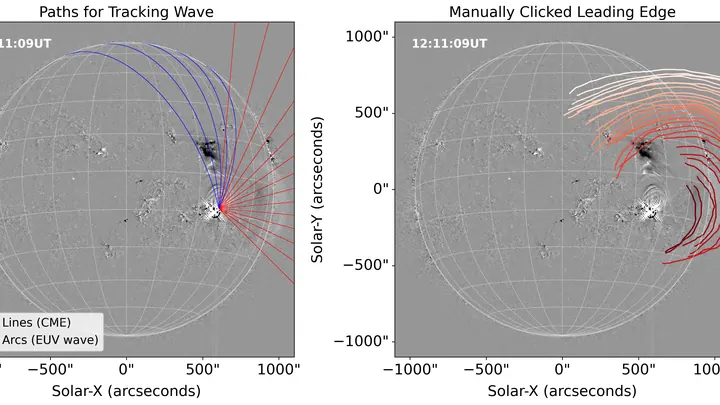
A shock wave in the Sun's corona is like the sonic boom from an airplane, except instead of air there is scorching plasma, and instead of sound there is a jump in density and magnetic field. On March 10, 2024, such a wave swept across the western part of the solar disk.
A powerful laser strikes a tiny target, and it instantly turns into a cloud of scorching gas — plasma. Within this cloud, magnetic fields spontaneously arise. Like invisible hands, they prevent heat from freely escaping the hot core.
A gamma-ray burst is like a shot from a cosmic cannon: a brief but dazzling flash that outshines an entire galaxy for a few seconds. But when observed in the hardest gamma-ray band (photons with energies above a gigaelectronvolt), the signal often gets lost in the noise, like a whisper in a noisy hall.
Physicists trapped a cloud of lithium atoms between mirrors. Light bounces inside, like in an echo chamber, forcing the atoms to emit synchronously — resulting in superradiance, akin to a choir where voices merge into a single thunder. Like a stadium chanting in unison: each whisper turns into a deafening rhythm. The secret is density.
When a massive star dies and explodes, it releases not only light but also invisible lightweight particles. They fly out in all directions at nearly the speed of light. Only a small fraction reaches Earth, but each explosion sends its own clump. These clumps stretch along the way: fast particles overtake slow ones, and by the time they arrive, a clump can be spread over tens of thousands of years.
In a blacksmith's forge, a blast of air fans the glowing coals, and shock waves blow bubbles of hot gas. In galaxy centers, a supermassive black hole drives the same process. Its narrow plasma jets, like bellows, punch through the surrounding space and create bubbles visible in X-rays.
When a massive star exhausts its thermonuclear fuel, its core collapses, and the outer layers are ejected into space at speeds of thousands of kilometers per second. This is how a supernova remnant is born — an expanding cloud of shock-compressed gas spanning light-years.
In 1961, Stanislaw Ulam proposed a simple model: a particle bounces between a fixed wall and a wall that oscillates according to a piecewise-linear law. It seemed like just another billiard. But behind this simplicity lay a question that troubled physicists for decades: can the particle accelerate to infinity?
The answer turned out to be paradoxical. In the classical version, almost never.