Cosmic ray acceleration is the process by which charged particles—mostly protons and atomic nuclei—are boosted to energies far beyond those achievable in human-made accelerators. These particles, arriving at Earth from space, carry energies up to 10^20 electronvolts, millions of times higher than the Large Hadron Collider can produce. The dominant sources are supernova remnants: when a massive star explodes, it drives a shock wave into the surrounding interstellar medium, and particles bouncing across this shock gain energy with each crossing—a mechanism known as diffusive shock acceleration.
History
The idea that supernova remnants could accelerate cosmic rays was proposed by Enrico Fermi in 1949, and the specific diffusive shock mechanism was developed in the late 1970s by Anthony Bell and others.
How it works
The key mechanism is repeated scattering by magnetic turbulence. A particle crossing a shock front from upstream to downstream and back gains a small energy boost each time, because the magnetic irregularities act as moving mirrors. Over thousands of crossings, the particle's energy grows exponentially. The process is self-limiting: once a particle's gyroradius becomes comparable to the size of the remnant, it escapes. This explains the observed power-law energy spectrum of cosmic rays, which extends over many orders of magnitude.
In practice
Understanding cosmic ray acceleration helps interpret data from gamma-ray observatories like Fermi-LAT and CTA, which detect the high-energy photons produced when accelerated particles interact with matter and radiation.
Fun fact
The most energetic cosmic rays, above 10^20 eV, are so fast that they would take only about 10 minutes to travel from the Sun to Earth, yet their sources remain mysterious because they are deflected by magnetic fields.
295 000 meters per second. Not even particles in solar coronal ejecta move that fast. But at the center of the galaxy cluster H1821+643, hot gas does exactly that. The quasar at its heart takes a breath, and its breath stirs everything around for 60 thousand light-years.
Space is threaded with magnetic fields. They exist around galaxies, stars, and even in nearly empty voids — the vast empty spaces between galaxy clusters. It's usually thought that fields are amplified from weak 'seed' fields by turbulence, much like a dynamo. But the origin of the seed fields themselves has remained a puzzle.
A factory laser that cuts and welds metal on production lines has been made to work as a particle accelerator for the first time. Physicists took a standard ytterbium laser, its heart is a crystal the size of a palm, and turned its flashes into a tool for accelerating electrons to nearly the speed of light.
On a scorching afternoon, a stifling haze hangs over the city, and not a single cloud is on the horizon. Usually, in such weather, all you can do is wait for nature to take pity and send some cool relief. But what if shade and rain could be switched on schedule, like a light in a room?
In an orchestra, each musician plays their own part, but at a certain moment all instruments pause on a single note. Cosmic rays behave somewhat like this — particles flying toward us from distant stars.
When a massive star explodes as a supernova, its outer layers are blasted into space at thousands of kilometers per second. A shock wave forms — a giant invisible bulldozer that sweeps up interstellar gas and dust. In this maelstrom, particles can be accelerated to energies comparable to that of a flying tennis ball compressed into a single proton.
Interstellar space is not empty: it is filled with tenuous gas, which is warm in some places and cold in others. The boundaries between such regions resemble the walls between soap bubbles.
When a heavy nucleus slams into interstellar gas at enormous speed, it shatters into pieces. Those pieces (lithium, beryllium, boron) then fly onward, and their abundance in the cosmic-ray flux depends on how the breakup unfolded. Conventionally, one expected the proportions to shift smoothly with energy, like the taste of soup when you keep adding water.
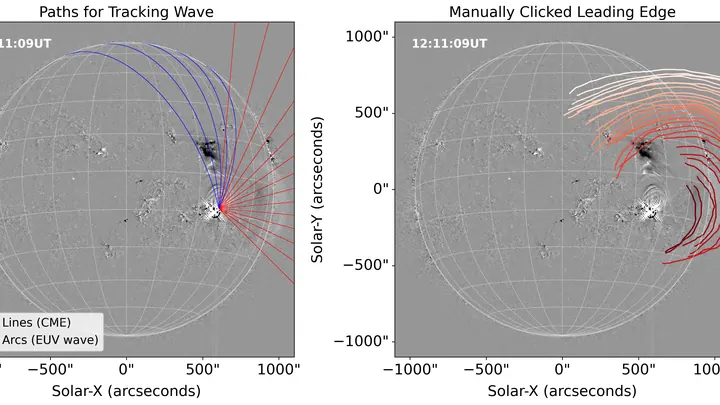
A shock wave in the Sun's corona is like the sonic boom from an airplane, except instead of air there is scorching plasma, and instead of sound there is a jump in density and magnetic field. On March 10, 2024, such a wave swept across the western part of the solar disk.
A stream of water from a hose hitting a wall splashes sideways. Astrophysical jets behave similarly — narrow plasma flows ejected from the vicinity of black holes or young stars. When such a flow encounters resistance from surrounding gas, a shock wave forms inside it, akin to a standing wave in a fast-flowing river.
A quantum computer is like an orchestra, where each qubit is a musician playing their part. But every now and then, a cosmic ray bursts into the hall, and the violinist flinches, losing the rhythm. These particles from deep space pierce the chip, knock out extra electrons, and spoil the delicate quantum music.
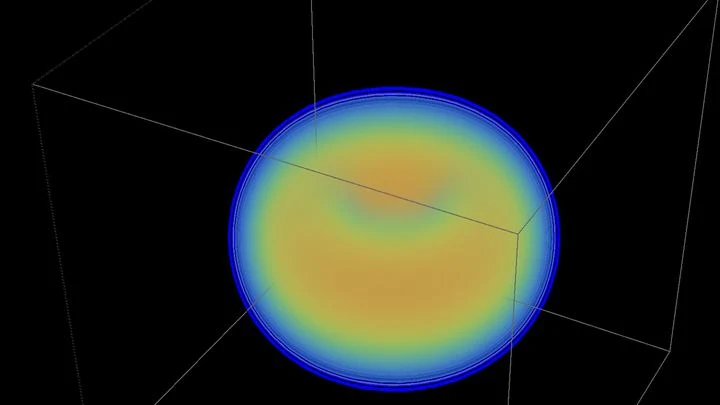
A spinning black hole acts like a cosmic generator: its rotation pumps energy into an invisible scalar cloud — a prime candidate for dark matter. A scalar field is like temperature: at every point in space it's just a single number, with no arrows or vectors. The cloud grows until it overflows.
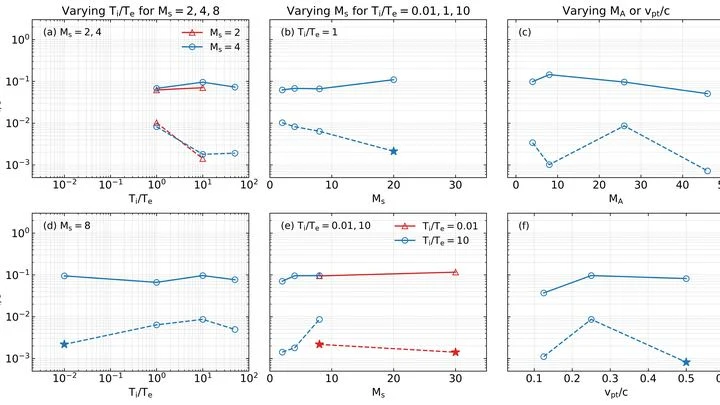
A new study confirms: shock waves in plasma around supermassive black holes at the cores of galaxies act like ocean swells, shoving protons to near-light speeds. Even a weak wave passes on a tenth of its energy, like a gentle surf launching a surfer into space.
When a massive star exhausts its thermonuclear fuel, its core collapses, and the outer layers are ejected into space at speeds of thousands of kilometers per second. This is how a supernova remnant is born — an expanding cloud of shock-compressed gas spanning light-years.