Magnetic Monopoles on Quantum Ice express
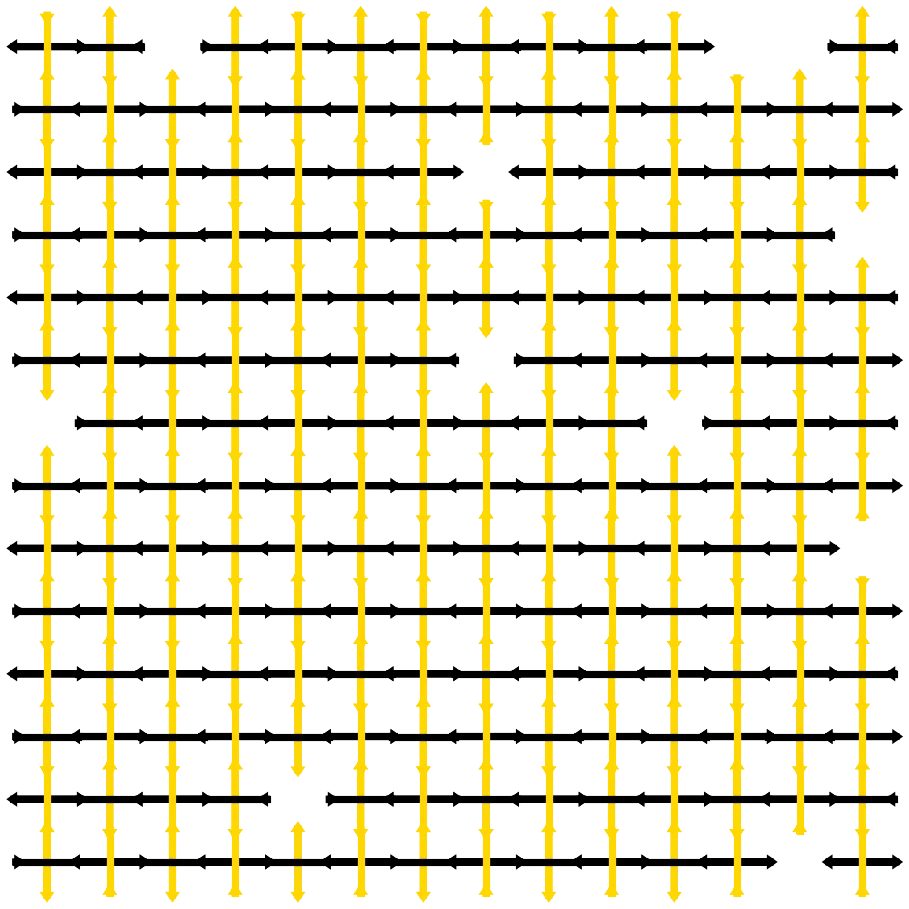
Magnetic monopoles are like halves of a magnet that cannot exist alone in ordinary materials. But in spin ice, they appear in pairs connected by an invisible thread — a Dirac string. Previously, such monopoles were only seen in artificial systems at room temperature, but their quantum motion remained a mystery.
Now researchers took a quantum annealer, a machine that solves problems by finding energy minima, and turned it into a programmable square spin ice. Each qubit became a tiny magnet, and the couplings between them were tuned to reproduce dipolar interactions. The result was a lattice of more than 400 vertices where monopoles could move freely.
This result shows that quantum annealers can not only solve optimization problems but also serve as a laboratory for studying exotic quasiparticles. In the long run, this could help understand how collective quantum phenomena emerge in complex materials.
Spin ice gets its name from the similarity between the arrangement of spins and the positions of protons in water ice: both exhibit geometric frustration, where not all pairs of interactions can be satisfied simultaneously.
In Greg Egan's novel Schild's Ladder, physicists create a new vacuum phase where monopoles and exotic particles emerge — somewhat like a programmable quantum spin ice, but on a cosmic scale.