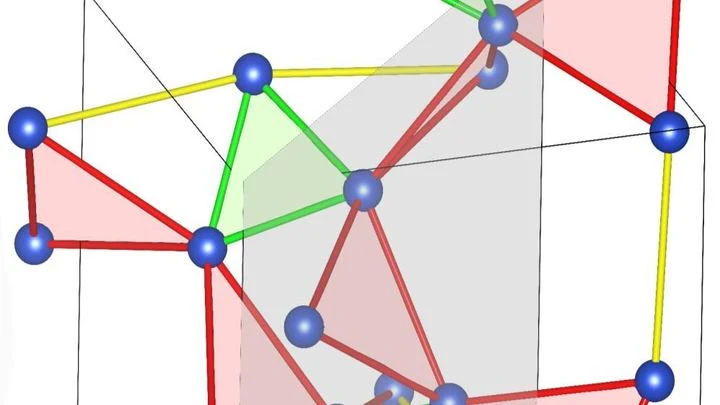
Spin foam is a formalism of loop quantum gravity, where spacetime is represented not as a continuous background, but as an evolving network of boundary surfaces (simplices), each face of which is labeled by quantum numbers — spins. These spins determine the area of the face in Planck units.
History
The roots of the idea go back to John Wheeler, who in 1955 suggested that at Planck scales, spacetime turns into a 'quantum foam' due to fluctuations. In the 1990s, Carlo Rovelli and Lee Smolin, developing loop quantum gravity, turned this into a precise mathematical structure of spin foams, where amplitudes are computed using representation theory. John Baez also made significant contributions, connecting foams with topological quantum field theory.
How it works
Spin foam is built from 4-simplices (four-dimensional analogs of tetrahedra), whose faces are colored by spins. Spacetime arises as the history of merging and splitting of these quantum cells. The transition amplitude is computed according to rules similar to Feynman's, but with discrete spatial quanta. It resembles a crystal lattice, where defects and vibrations are interpreted as particles. The formalism leads to a discrete spectrum of areas and volumes and eliminates singularities, for example, in black holes and the Big Bang.
In practice
The theory aims to describe the quantum nature of gravity, replacing continuous spacetime with microscopic 'building blocks' that could constitute a black hole or the Universe itself.
Fun fact
If a 'quantum microscope' existed, at the scale of 10⁻³⁵ meters (Planck length), space would look like a bubbling foam with changing topology.
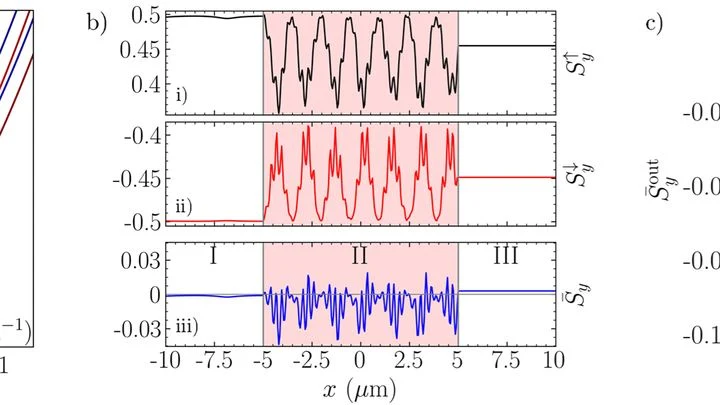
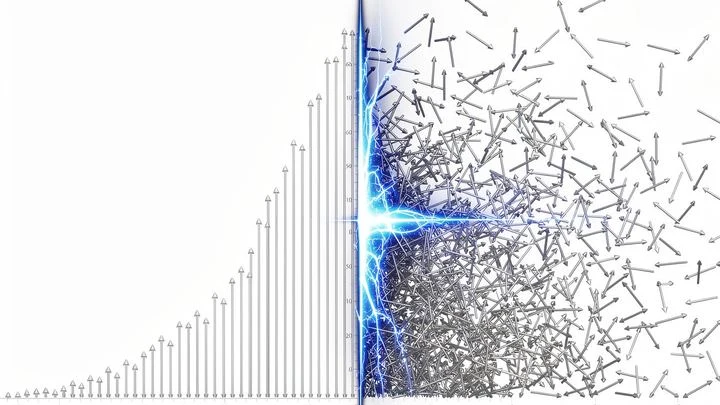
In an ultracold cloud of atoms cooled to near absolute zero, regions with different spin orientations emerge, like patches with different magnetization. The boundaries between them are called domain walls. Usually they are stationary, but in this experiment the walls started moving on their own.
In an ultracold cloud of atoms cooled to near absolute zero, regions with different spin orientations emerge, like patches with different magnetization. The boundaries between them are called domain walls. Usually they are stationary, but in this experiment the walls started moving on their own.
A stone thrown at a wall bounces off. In the quantum world, a particle can pass right through, as if the wall were woven from mist. This is quantum tunneling: it lights up stars, works in microchips, and even operates in the cells of our bodies. But most particles have spin — an intrinsic rotation, like a spinning top.
A stone thrown at a wall bounces off. In the quantum world, a particle can pass right through, as if the wall were woven from mist. This is quantum tunneling: it lights up stars, works in microchips, and even operates in the cells of our bodies. But most particles have spin — an intrinsic rotation, like a spinning top.
Quantum field theory is the language physicists use to describe elementary particles and their interactions. The authors of the work decided to slightly "tweak" this language: they introduced deformations, that is, small changes to the rules of the game.
The PbCuTe₂O₆ crystal resembles a three-dimensional web of copper, tellurium, and oxygen. Inside, the magnetic moments, tiny arrows tied to electron spins, are so entangled that they can't settle into an orderly arrangement even near absolute zero.
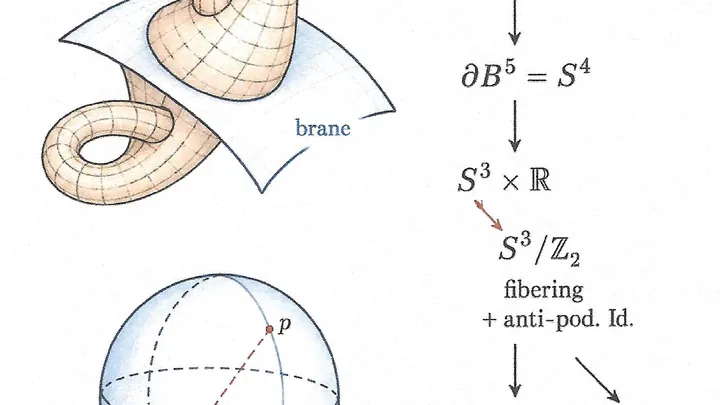
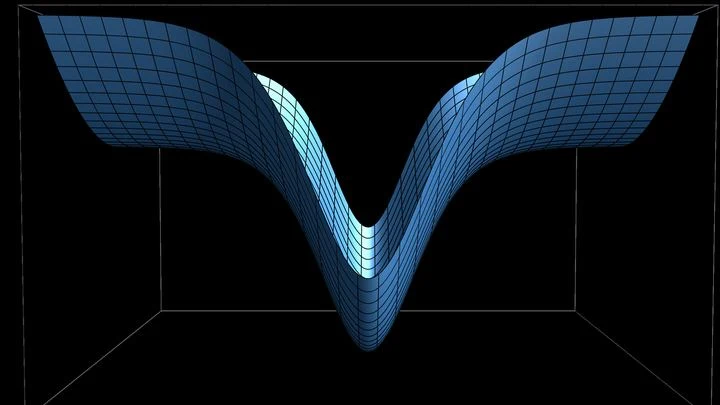
The neck of an hourglass is the narrowest point where grains of sand change sides. In quantum gravity, there is a similar object: an instanton (an instantaneous solution connecting two states of space). It acts like a tunnel through which the geometry of the universe flows from one form to another.
The universe sometimes resembles an old fabric: after rapid cooling, wrinkles could have remained — thin, almost invisible threads of monstrous density. They are called cosmic strings. Usually, at the center of such a string hides a singularity — a point where the laws of physics lose their meaning.
A translator gets distracted by every rustle in the hall, and a one-hour meeting stretches into two. A single wrong intonation changes the meaning beyond recognition. That's roughly how a particle with spin 3/2—the gravitino — behaves. It cannot exist in isolation: its "speech" must be perfectly coordinated with its surroundings, or the whole structure falls apart.
A quantum wire is like a high-speed highway where electrons race in a dense stream. Each electron has its own rotation, spin, and until now it was thought that splitting this stream into two lanes, for 'left' and 'right' rotation, without losing quantum order was nearly impossible. You'd need either strong magnets or complex tricks that waste energy.
Space is not a void but a mosaic of tiny cells. In loop quantum gravity, spacetime curvature is transferred from a smooth sheet to a network of 'atoms' of volume — spin networks. Each node of such a network is a quantum of space, and the links between them are quanta of area.
But how does this mosaic change over time?
A stone falls into still water, and smooth rings spread across the surface. If the stone doesn't just fall but also spins, tiny whirlpools, vortices, appear on the surface. Light can do the same, only instead of water, it's space and time themselves.
In a world locked in a crystal lattice and cooled nearly to absolute zero, matter knows how to hide its deepest secrets. A quantum spin liquid is a state where electron spins never freeze, even at zero temperature, remaining in an eternally flickering superposition.
In the conventional Heisenberg picture, spins at low temperatures are supposed to line up in a strict pattern. But there are crystals — like pyrochlore — where geometry has its own way. Each ion sits at a vertex of a tetrahedron, and the main interaction enforces a rule: two spins point inward, two outward.
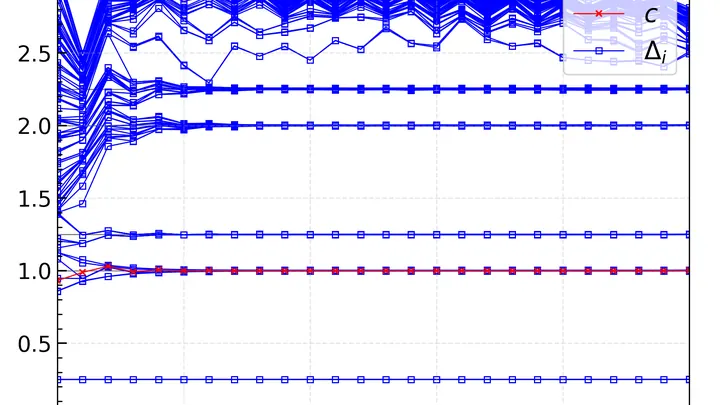
In quantum physics, there are theories where everything follows clear proportions, like a musical rhythm that always returns to the beginning of the bar. But there are also 'irrational' theories where the rhythm breaks and predicting the next beat is nearly impossible. One such theory is the compactified boson: a particle lives on a circle, and its behavior depends on the radius of that circle.
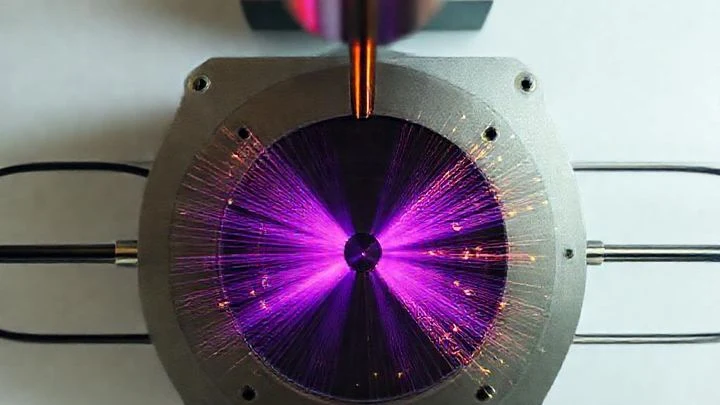
In a crystal that for centuries was called 'fool's gold,' physicists have spotted genuine treasure. The compound MnTe2 with a pyrite structure has become the stage for a quantum ballet: spin waves here twist into left- and right-handed vortices, with the twist direction firmly tied to momentum.
The mergers of black holes, first predicted by Karl Schwarzschild, are the main source of gravitational waves picked up by LIGO detectors. Over the years, 259 events have accumulated, each one an encrypted birth story of a pair. But is there a hidden system in this data?
In the ocean, a whirlpool pulls everything into a closed loop, just as a gravitational wave in empty space twists time into a loop. Gravitational wave — a ripple in the fabric of spacetime, and its special shape can turn the usual flow of events into a closed cycle. In such a zone, an object can return to its own past without violating the laws of physics.
Building a house on sand is a bad idea. In physics, it was long believed that a quantum theory of gravity could not be built on a fixed "sand"—a pre-existing spacetime.
In 1905, Einstein showed that the chaotic motion of pollen in water results from the jostling of invisible molecules. A century later, physicists have learned not only to observe but also to control motion at the quantum level.
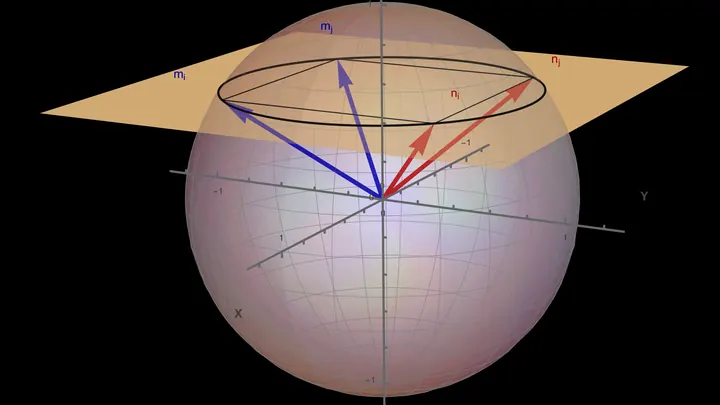
Two coins are tossed simultaneously, and they always land the same way — heads with heads, tails with tails. Their behavior is strictly correlated. In the microworld, a similar connection between particles is called spin correlation.
Picture a pot of boiling soup, but every grain in it is not just a point but a tiny top spinning around its own axis. That's the world of spin-1 particles. For example, some short-lived mesons born in accelerator collisions.
Trying to count people in a dark room by the sound of their breathing hits a wall of background noise — individual breaths are inaudible. Scientists working with quantum spins in solids face a similar challenge. Each spin (the electron's magnetic moment) has its own "voice," but it is drowned out by the technical noise of the instruments.
A neutron star is the leftover core of an exploded giant, compressed to the size of a city. A teaspoon of its matter weighs a billion tons. Inside such a star, particles are packed so tightly that quantum effects start to show. One of them is the intrinsic rotation of particles, or spin.
A quantum particle traveling around a closed ring leaves two distinct 'records' along its path. The first is like a fingerprint on a doorknob: it remains unchanged no matter how many times you turn the knob, and it only tells you about the shape and material.
Every quantum particle has spin — an intrinsic magnetic property, like a tiny arrow. In an experiment, a beam of such particles passing through a magnet splits in two, like a coin that lands either heads or tails. That’s exactly how particles like a hydrogen atom behave.
Run a current through a spring of organic molecules, and the electrons that come out are almost all spinning the same way. This trick is called chiral spin selectivity, and it has long puzzled physicists. In light atoms, spin (the particle's intrinsic rotation) is too weakly coupled to charge motion to achieve nearly perfect sorting.
Spacetime is often pictured as a smooth fabric. But at the very microscopic level, this fabric might not be continuous; instead, it could consist of individual 'atoms'—events linked by causality. This picture of the world is called causal set theory.
The quantum world is known for uncertainties: for example, you can't measure a particle's position and its speed at the same time. But new research shows that in a 'fuzzy' spacetime, even probability itself — the measure of chance — loses sharpness. A foggy compass doesn't give an exact direction: its needle wavers.
The end of the Universe is not just the fading of light. If dark energy, the mysterious substance accelerating cosmic expansion, tears it apart in a Big Rip scenario, or if expansion reverses into a contraction that pulls everything back to a point like a big bang in reverse, a…
A fundamental string plucked at the moment of the Big Bang doesn't just hum a single note — waves run along it, and occasionally tiny loops peel off. These loops, like tuning forks, begin to ring at their own frequency, producing a very high-pitched sound.
A rubber band stretches and snaps back. A steel spring compresses and expands. Elasticity seems like a property of simple things — a piece of metal or a drop of gel. But the authors of this work looked deeper.
They showed that the electron's spin, its own tiny rotation, can also be elastic.
A rubber band stretched in different directions behaves differently from a whole sheet of paper. If you pull on an edge, the deformation does not spread evenly but seems to linger in certain spots.
Toss a handful of sand onto a table. Each grain lies separately, but together they form a surface you can run your finger across. That's roughly how spacetime works in causal set theory: it isn't continuous but consists of point-events linked only by causality — what influenced what.
The authors studied how a signal (say, a flash of light) spreads in such a granular world.
A figure skater glides across the ice, gradually approaching the center of the rink. A slight twist of the torso, and the smooth spiral breaks, the trajectory becomes unpredictable. Something similar happens when a small black hole with its own rotation (spin) falls toward a giant black hole.
According to the Standard Model, the vacuum is not emptiness but an ocean of virtual ghost particles. An ultra-strong electromagnetic field, like a storm, yanks electron-positron pairs into reality.
In a dark room, a flashlight beam picks out only a narrow strip from the gloom. In much the same way, Roger Penrose proposed looking at gravitational waves — ripples in spacetime traveling at the speed of light.
The birth of the universe is often compared to inflating a balloon: in the first moments, it stretched rapidly. But the very "rubber" of this balloon was probably not perfectly smooth — rather, it was covered with the finest ripples.
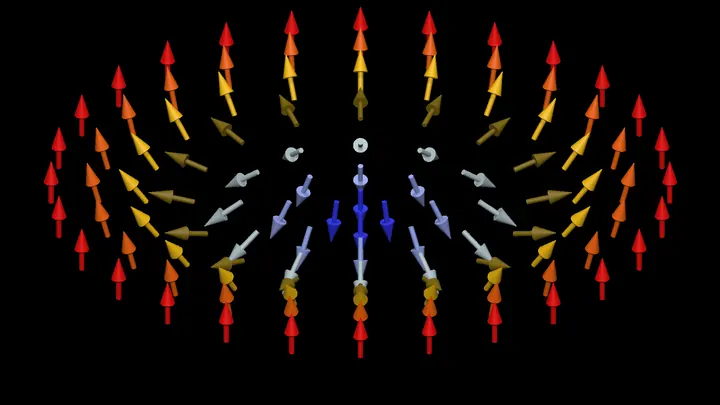
In a field trap, scientists assembled a crystal — 150 ions at ultra-low temperature. Each ion behaves like a tiny magnet, capable of rotating in any direction. By controlling forces that depend on this rotation, physicists made all the magnets swirl into a common vortex called a skyrmion.