Molecules from an Oven: A New Way to Catch Light express
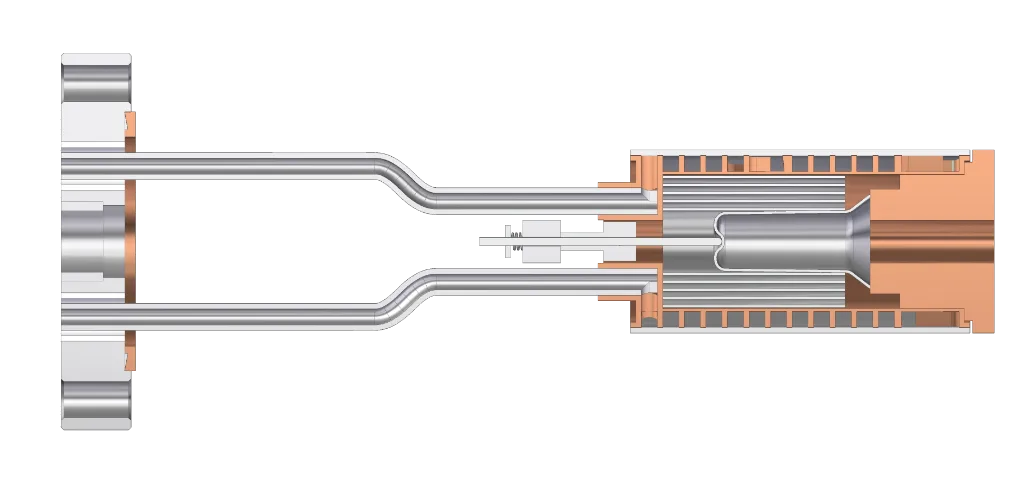
An ordinary aluminum pot on a stove doesn't emit molecules you can catch with light. But if you take aluminum and an aluminum salt, heat them together in a small oven, you get a stream of aluminum fluoride molecules, like steam from a kettle's spout, except instead of water droplets, tiny particles fly out.
These molecules can already be laser-cooled, but previously they were made differently — by blasting a target with a powerful laser pulse. That source gives bright but short bursts. The new oven works continuously: it emits 5×$10^{15}$ molecules per second in one direction, as if a billion kettles were simultaneously releasing steam at a single point. At a temperature of 923 kelvin (about 650°C, just below aluminum's melting point), the flow becomes denser than that from the pulsed source for certain molecular states.
Next, the molecules are passed through cold neon gas. There they cool to 30 kelvin (minus 243°C) and slow from 600 to 200 meters per second. It's like dipping a runner on a hot track into an ice bath: they suddenly slow down.
Such a source paves the way for a magneto-optical trap — a device where molecules are held by light and magnetic fields. And ultracold molecules are needed for ultra-precise clocks, quantum computing, and searching for new forces of nature.
Original abstract
as written by the authors arXiv:2604.04509
The AlF molecule, currently subject to laser cooling and trapping efforts, has the advantage that it can be efficiently produced in a thermochemical reaction between sublimated aluminum trifluoride and aluminum metal. Here we present a series of experiments with continuous molecular beam sources of AlF, utilising this reaction. We demonstrate a compact AlF molecular beam oven whose total far-field brightness is $$5\times 10^{15}$$ molecules per steradian per second at 923~K, just below the melting temperature of aluminum metal. The continuous output from the oven begins to exceed the peak brightness of a jet-cooled, ablation-based supersonic AlF source for the $$v=0$$, $$J=7$$ level, and we obtain an excellent signal-to-noise ratio with the oven in pulsed laser ionisation spectroscopy experiments. By delivering flux from the oven into a cryogenic Ne buffer gas cell, we lower the rotational temperature of the beam to around 30~K and reduce its most probable forward velocity from 600~ms$$^{-1}$$ to 200~ms$$^{-1}$$. In addition, we demonstrate that AlF can be made in a simple dispenser package, and observe that molecules thermalise to the laboratory temperature after colliding with vacuum chamber walls of the experiment. The resulting transient AlF vapour may enable direct loading of a molecular magneto-optical trap.
A temperature of 923 kelvin is nearly 650 degrees Celsius; at that temperature, aluminum is still solid but ready to melt.