The path to the blue LED took several decades. The main difficulty: obtaining a semiconductor with a bandgap of about 3.4 eV (corresponding to blue light) and doping it p-type (adding impurities to create hole conductivity). Shuji Nakamura at the Japanese company Nichia first created high-quality GaN films on a sapphire substrate and developed a thermal annealing method to activate magnesium acceptors, obtaining p-GaN. In 1993, he demonstrated a bright blue LED, and later — the first blue laser.
History
In the 1970s, Jacques Pankove (RCA) obtained the first blue emission from GaN, but without p-doping. In 1986, Isamu Akasaki and Hiroshi Amano first created p-GaN using electron-beam irradiation. Shuji Nakamura, working independently at Nichia, in 1993 applied thermal annealing and developed a structure with a double heterostructure InGaN/GaN, which led to a commercially successful blue LED. In 2014, Akasaki, Amano, and Nakamura received the Nobel Prize 'for the invention of efficient blue light-emittingdiodes which has enabled bright and energy-saving white light sources'.
How it works
Blue LEDs serve as the foundation for solid-state lighting (LED lamps) and displays (OLED, microLED). They are also used in laserdiodes for Blu-ray drives (λ=405 nm) and Li-Fi systems (visible light communication). Limitations: efficiency still drops at high current densities ('droop'), and there are degradation issues during prolonged operation.
In practice
Thanks to the blue LED, we have energy-efficient LED lighting, phone and TV screens with full color gamut, and laser projectors.
Fun fact
Shuji Nakamura was awarded the Nobel Prize in 2014, but his company Nichia initially paid him a bonus of just $200 for the invention, after which a long legal battle ensued.
To probe deeper into the workings of the universe, physicists accelerate electrons and smash them together. An ordinary electron is like a spinning top that wobbles randomly. For delicate experiments, you need particles whose spins all point in the same direction: this is called polarization.
An ordinary diode in electronics works like a one-way street: current flows in only one direction. In superconductors, where electricity flows without resistance, such behavior has long been elusive — current is usually symmetric.
The authors of the new work found a way to create a perfect superconducting diode using light.
Light leaves a trace even when there is almost none of it. A single photon, a tiny bundle of energy, strikes a silicon wafer and knocks out a handful of electrons. The trouble is that the handful is too small to notice. You need an amplifier.
Usually, the signal is amplified by applying a voltage to metal contacts on the detector's surface.
Diamond is the hardest natural material and usually does not conduct electricity. But if you add a few foreign atoms to its crystal lattice, it can become a semiconductor, like silicon in computer chips.
A conventional laser is like an orchestra where musicians must warm up before playing in unison. You first need to pump enough atoms with energy so they 'flip' and are ready to emit light: this is called population inversion. Only then does the beam flash. A polariton laser plays by different rules: its 'musicians'—a mix of light and matter — join in almost without preparation.
Blue is the most finicky part of any screen. Producing it takes a lot of energy, and the light often comes out dull. Chemists have long searched for molecules that glow deep blue brightly and for a long time. Now they've come up with a new design based on europium, a rare-earth metal that can deliver pure blue light.
Blue pixels in screens are like light bulbs that burn out fast. Conventional organic LEDs for blue are unstable: their light dims over time, and the color shifts. Chemists found a replacement — the rare metal europium.
An ordinary aluminum pot on a stove doesn't emit molecules you can catch with light. But if you take aluminum and an aluminum salt, heat them together in a small oven, you get a stream of aluminum fluoride molecules, like steam from a kettle's spout, except instead of water droplets, tiny particles fly out.
Infrared light is invisible to the eye, but it's everywhere: from TV remotes to the heat of the human body. Catching it requires special materials. Conventional detectors are bulky, rigid, and not easily tuned to specific wavelengths.
The laser based on diamond converts almost half of the pump energy into bright yellow light — an efficiency of 47.7%, a record for such devices. But the main advantage is not the power, but the exceptional purity of the color: the beam is so monochromatic that it can be compared to a musical instrument playing just one note without the slightest wavering.
A green flashlight beam dives into a pool and reaches the bottom with barely any loss. Water is transparent to green light, which is why it's used for underwater communication. But to send video or sensor data, the light needs to be switched on and off very quickly — billions of times per second. Ordinary lasers are too slow and unstable for this.
Modern X-ray light sources are like an orchestra without a conductor: electrons in the beam fly every which way, and the radiation comes out blurry. The new idea is to make electrons line up in neat rows with a spacing of a few nanometers. Then the light they emit becomes coherent, like a laser beam.
An ordinary free-electron laser is like a musical instrument with a single string: it can play only one note until you change its design. To get a different wavelength, you have to retune magnets or accelerate electrons harder. That's expensive and bulky.
An electron beam can be compared to the light from a laser pointer: if it diverges, the spot on the wall quickly spreads out. In the lab, physicists created such a narrow beam that it remained thin over a long distance, like the beam of a good pointer.
A typical light sensor is like a well with a windlass: to bring up the bucket, you have to turn the crank. Similarly, a photodetector needs an external voltage to pull out an electric charge. But there are materials that convert light into current by themselves — like a spring that flows without a pump.
A conventional thermal camera is like a thermometer that slowly heats up and cools down. It shows where heat is well, but it can't keep up with fast motion. The new sensor works differently: it counts individual quanta of heat, like a droplet counter during rain.
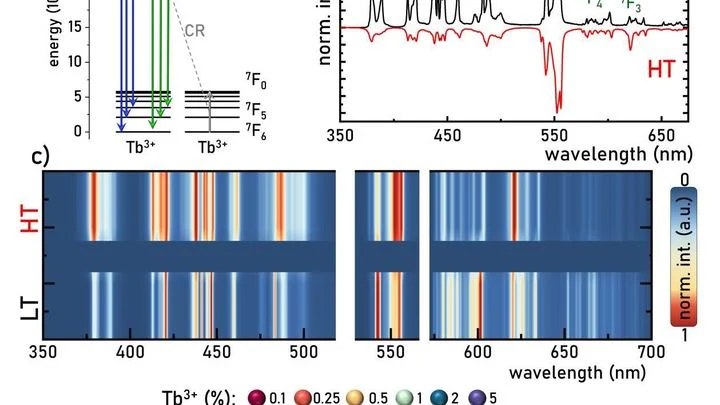
A piece of material glows blue. Heat it up, and the glow turns green, as if someone flipped a switch at a traffic light. That's how the new luminescent thermometer described in the paper works.
Inside the material are terbium ions — a rare-earth metal that knows how to shine. At room temperature, they emit blue light.