Molecules from an Oven: A New Way to Catch Light express
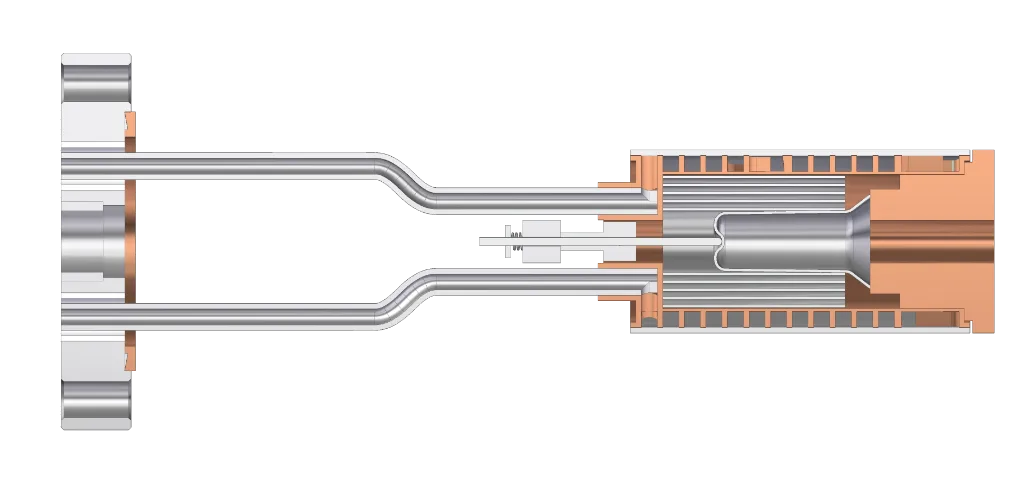
An ordinary aluminum pot on a stove doesn't emit molecules you can catch with light. But if you take aluminum and an aluminum salt, heat them together in a small oven, you get a stream of aluminum fluoride molecules, like steam from a kettle's spout, except instead of water droplets, tiny particles fly out.
These molecules can already be laser-cooled, but previously they were made differently — by blasting a target with a powerful laser pulse. That source gives bright but short bursts. The new oven works continuously: it emits 5×$10^{15}$ molecules per second in one direction, as if a billion kettles were simultaneously releasing steam at a single point. At a temperature of 923 kelvin (about 650°C, just below aluminum's melting point), the flow becomes denser than that from the pulsed source for certain molecular states.
Next, the molecules are passed through cold neon gas. There they cool to 30 kelvin (minus 243°C) and slow from 600 to 200 meters per second. It's like dipping a runner on a hot track into an ice bath: they suddenly slow down.
Such a source paves the way for a magneto-optical trap — a device where molecules are held by light and magnetic fields. And ultracold molecules are needed for ultra-precise clocks, quantum computing, and searching for new forces of nature.
A temperature of 923 kelvin is nearly 650 degrees Celsius; at that temperature, aluminum is still solid but ready to melt.