Lithium Reveals the Secrets of Young Stars express
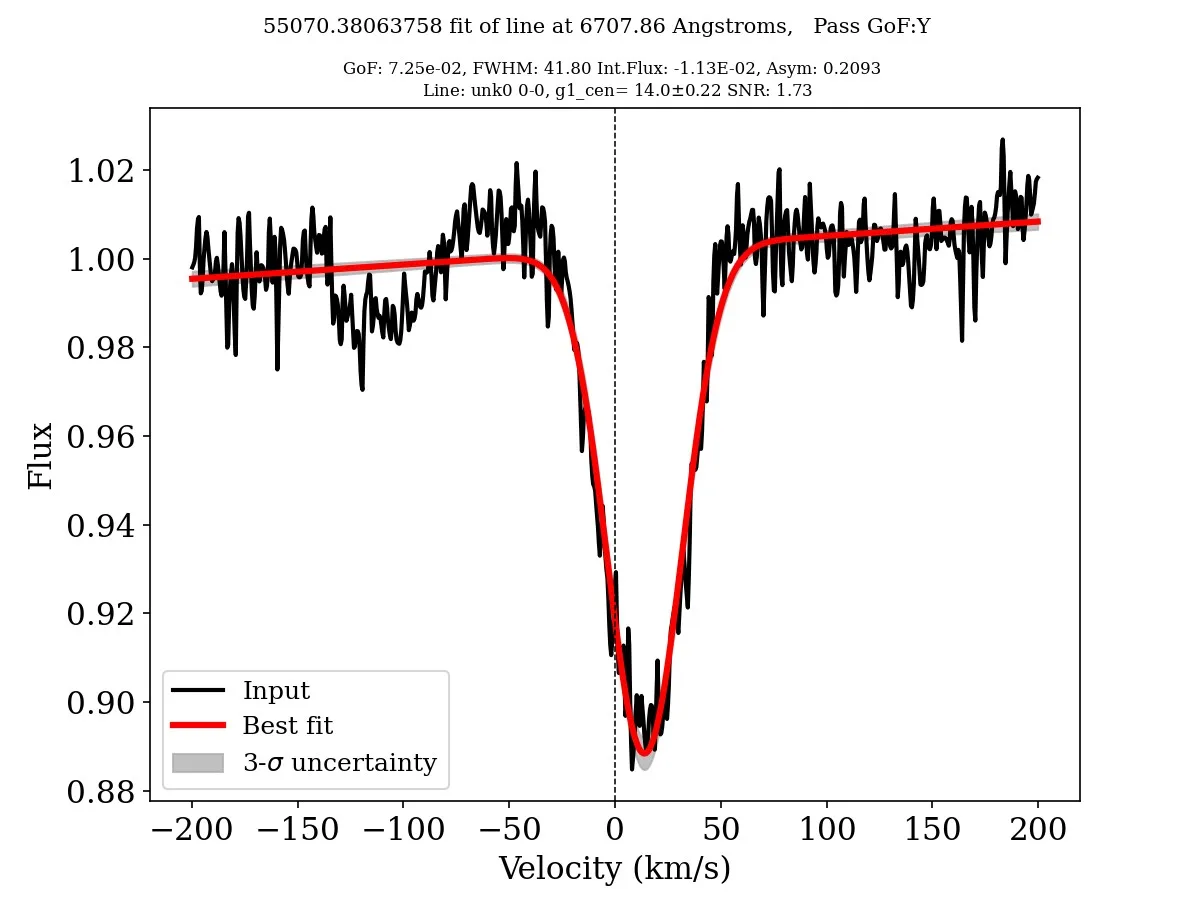
Lithium is like a thermometer dipped into a star's interior. This light element is destroyed at temperatures around 2.5 million degrees, so its abundance on the surface tells us how deeply the star's material has been mixed.
Spectra of 71 young intermediate-mass stars (from 1.5 to 3.5 solar masses) show that 25–30% of them have noticeably less lithium than the original cloud. For low-mass stars, this happens more often, but for intermediate-mass stars it's a surprise. The cause is rapid rotation: like a figure skater pulling in their arms, the star spins up, enhancing mixing that carries lithium into the interior, where it perishes.
For intermediate-mass stars, this transition occurs about twice as fast as for low-mass stars. The star's magnetic field, which previously anchored to the disk, contracts, and the star spins up three times faster, while material from the disk falls onto it four times more actively. This is similar to a cyclist who lets go of the handlebars — the wheel picks up speed.
Perhaps the same link between lithium and rotation explains why stars with planets have less lithium: planets may have influenced the star's early rotation, which in turn affected lithium's fate. It's a chain: from the disk and planets to rotation, and from rotation to lithium.
Lithium is one of the three elements born in the first minutes after the Big Bang, along with hydrogen and helium. Stars mostly destroy it rather than create it.
In Liu Cixin's novel "The Three-Body Problem," aliens study stars to understand their evolution; the lithium test is from the same arsenal of astrophysical reconnaissance.