Cosmic Sirens: How Gamma-Ray Bursts Reveal Neutron Star Mergers express
Two neutron stars collide, and the space around them ripples like the surface of a pond after a stone is thrown. Huge gravitational wave detectors catch these ripples. If the collision also launches a narrow beam of gamma rays, space telescopes see it as a short gamma-ray burst.
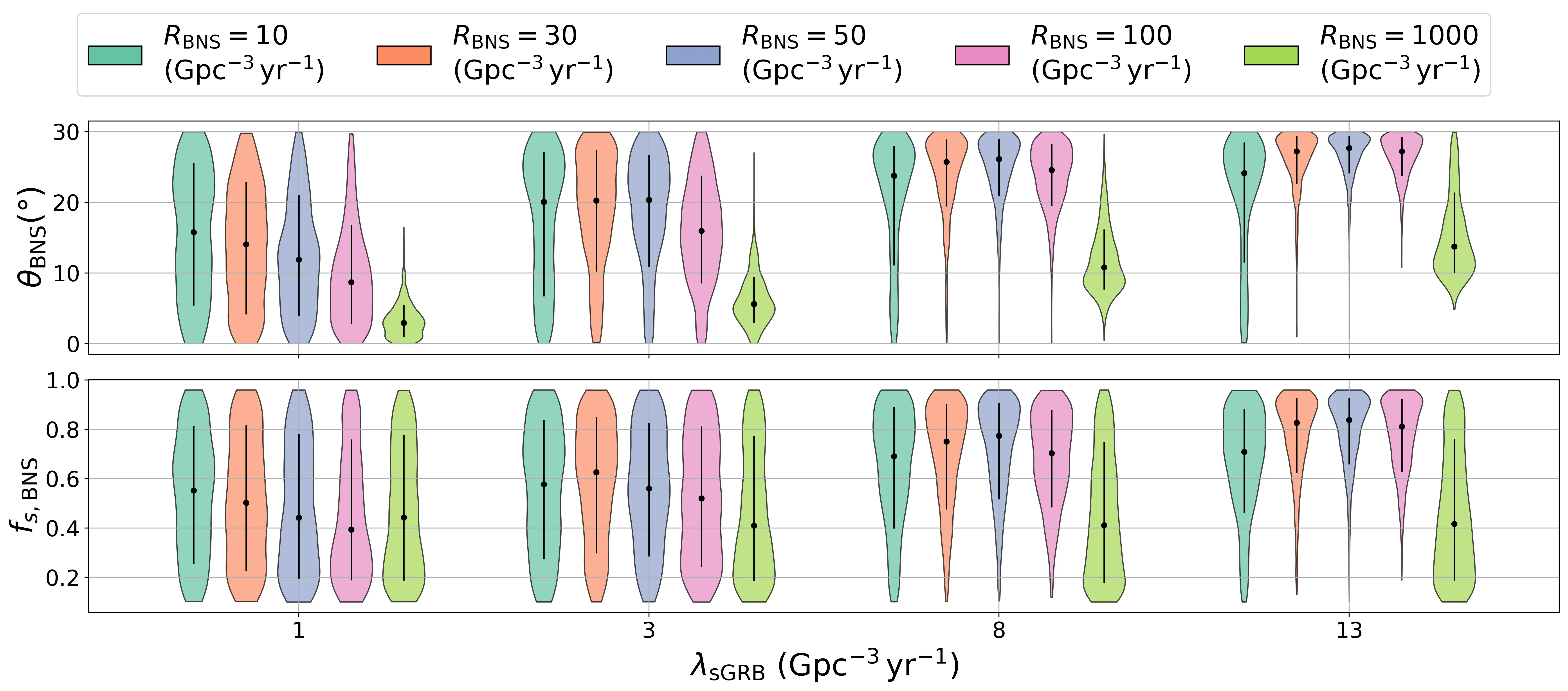
Both signals tell the same story, but they don't always match in numbers. Recent data from LIGO, Virgo, and KAGRA show fewer neutron star mergers than expected from the number of gamma-ray bursts. Astrophysicists tested whether this discrepancy can be explained if the plasma jets from mergers are not emitted in all directions but only at certain angles.
It turns out that if more than half of neutron star mergers produce jets with an opening angle of at least 10 degrees, the numbers of gamma-ray bursts and gravitational wave signals match. But for narrow jets of 6 degrees, the gamma-ray burst rate would need to be lower than some estimates suggest.
Neutron star–black hole mergers also contribute, but only a small fraction — about 6–16% of all short gamma-ray bursts. They can't explain the highest burst rate estimates, but they don't disrupt the overall picture.
So far, the data don't contradict each other. Mergers of two neutron stars remain the primary sources of short gamma-ray bursts, and their jets tend to be wide rather than narrow.
A short gamma-ray burst lasts less than two seconds, yet in that time it releases as much energy as the Sun will emit over its entire lifetime.
In the movie Interstellar, the merger of black holes produces gravitational waves that the characters use for communication — a principle similar to what we use to observe neutron star mergers.