Superconductivity in a Crystal That Changes Type express
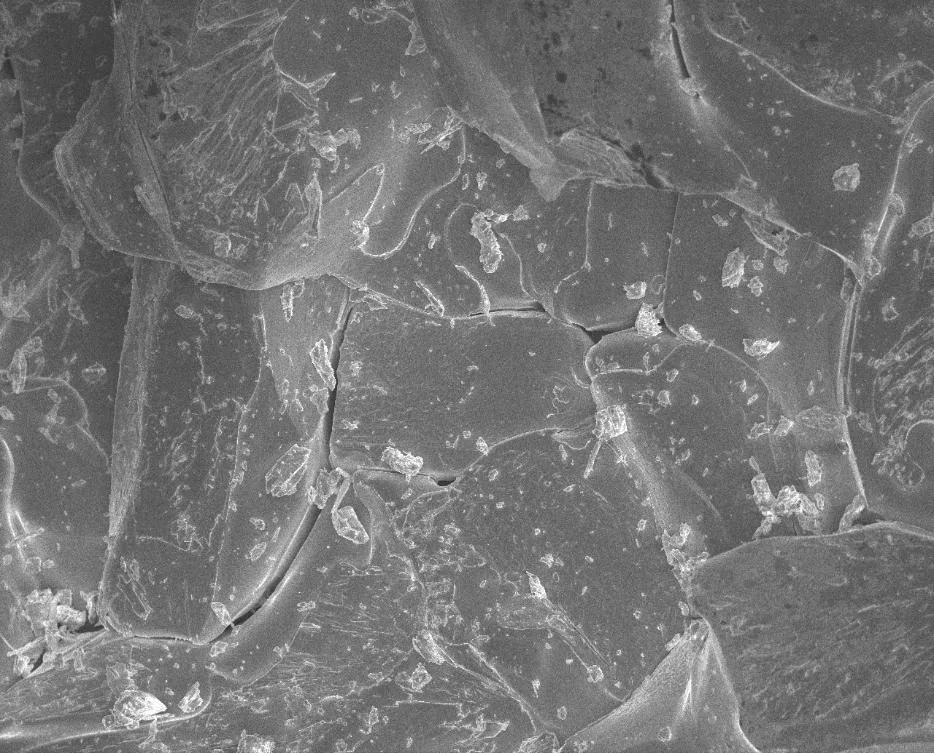
A superconductor is a material that, when strongly cooled, loses its electrical resistance: current flows through it without losses. Scientists took a layered crystal of PdTe2, similar to a stack of sheets of paper, and cooled it to temperatures below 1.8 kelvin (that's about -271°C). Under these conditions, PdTe2 becomes superconducting.
Previously, it was believed that PdTe2 is a type-I superconductor: the magnetic field is completely expelled from it, like water from a sponge when squeezed. But in new experiments with mosaic crystals (composed of many slightly rotated pieces), something different was found. The magnetic field penetrates inside the material in the form of thin filaments — vortices. This is a hallmark of a type-II superconductor. The transition from type I to type II is likely caused by disorder in the crystal — small defects and boundaries between pieces.
Measurements of the magnetic field penetration depth showed that the superconducting gap (the energy required to break a pair of electrons) is the same in all directions. This is the so-called s-wave symmetry, like a perfectly round sphere, without protrusions. This type of superconductivity is often found in simple metals, but here it coexists with the unusual topology of the electronic states of PdTe2.
This discovery makes PdTe2 a convenient platform for studying how superconductivity, topology, and surface effects interact in a single material. Possibly, by varying disorder, it will be possible to create materials with switchable superconductivity for future quantum devices.
Original abstract
as written by the authors arXiv:2604.11047
We report on the microscopic superconducting properties of the Dirac semimetal PdTe2. In this study, we have focused on mosaic crystals of PdTe2, and used detailed zero field and transverse field muon spin relaxation/rotation ($$\mu$$SR), ac-magnetic susceptibility, and resistivity measurements to investigate their superconducting properties. The magnetic susceptibility measurements reveal two superconducting transition temperatures at 1.8 and 1.6~K, respectively, in agreement with earlier reports. In contrary to these reports, we find that these mosaic PdTe2 crystals, are not type-I, but rather type-II superconductors. In fact, we observe the clear manifestation of a flux line lattice through a clear diamagnetic shift and Gaussian broadening of the Fourier spectra in the superconducting state. This behavior is likely caused by the disorder in the mosaic crystals of PdTe2 studied here. Our analysis of the superconducting order parameter by the means of temperature dependent magnetic penetration depth $$\lambda(T)$$ reveals a fully gapped superconducting state that can be well-fitted using an s-wave symmetric gap. We find that PdTe2 is a promising model system for the investigation and interplay of non-trivial topology, surface superconductivity, and type-II bulk superconductivity in a van-der-Waals material. Moreover, our results indicate that the superconductivity in this material can be easily modified from type-I to type-II by disorder in the system.
PdTe2 is a superconductor, but its critical temperature is only 1.8 K. This is colder than the temperature of the cosmic microwave background radiation (2.7 K), which is left over from the Big Bang.