Simple

The Galactic Family Tree: How Star Chemistry Tells the Story express
Original: "Reconstructing chemical enrichment pathways in disc galaxies: A phylogenetic approach"
arXiv:2604.11974 · 2026-04-13 · CC BY 4.0 · 1 min · Galaxies
Astronomers used a genealogical method to trace the evolution of stars in different parts of the galaxy.
Abstract

Scientists applied a method from biology—building family trees—to stars in a computer model of a galaxy. Using the chemical makeup of the stars, they reconstructed their formation history and found that the center and outskirts evolved differently, like two families with different fates. What other hidden chronicles do the stars hold?

Links in the knowledge graph 1

A star inherits the chemical makeup of its parent gas cloud—just like a child inherits genes from its parents. Astronomers turned this into a method: by measuring the fraction of carbon and other elements with spectroscopy (splitting light into colors), they construct family trees for the stars in a galaxy. It’s like genealogy, but instead of DNA, you’re tracing chemistry.

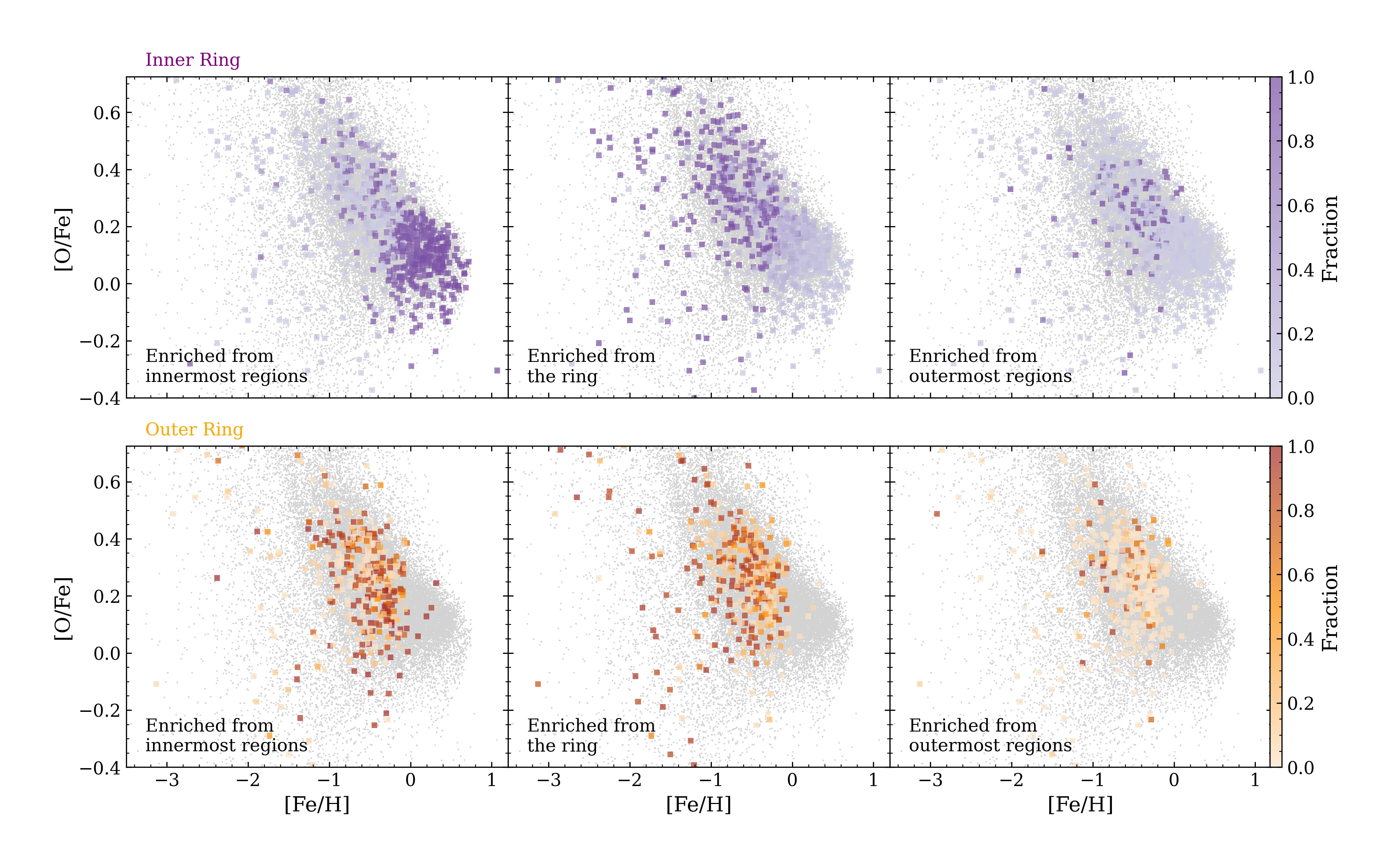
In the center of the Milky Way, gas poured in stormy streams, stars were born rapidly, and enriched by supernova explosions. Their tree is a tangled bush with short, thick branches. On the outskirts, shaped by spiral arms, the process was smooth: the tree grew with thin, long, symmetrical branches.

The oldest stars are almost devoid of heavy elements—like canned samples of early Universe chemistry.

This chemical pedigree acts as a time machine for galaxies. By studying these “fossils,” we read the history of bursts and stellar winds, reconstructing the growth of our own Galaxy.

🎯 Some of the Milky Way’s oldest stars contain almost no heavy elements, as if frozen in the era of the early Universe.

Scientists
Christian DopplerD. B. McLaughlinDidier QuelozMichel MayorR. A. RossiterJames Clerk Maxwell
Tags
spectroscopy galaxy supernova carbon
Laws
Doppler effectMaxwell's equationsPlanck's lawPlanck–Einstein relationWien's displacement lawRydberg formula
Original: arXiv:2604.11974 · CC BY 4.0 · bridge42worlds