Light Instead of Wires: Photonic Chip Computes Faster express
A typical computer shuttles electricity along copper traces, and every operation is a queue: first one thing, then another. Light works differently. In a single beam, you can mix dozens of signals without them interfering, like different voices in a choir, singing at once but each heard distinctly.
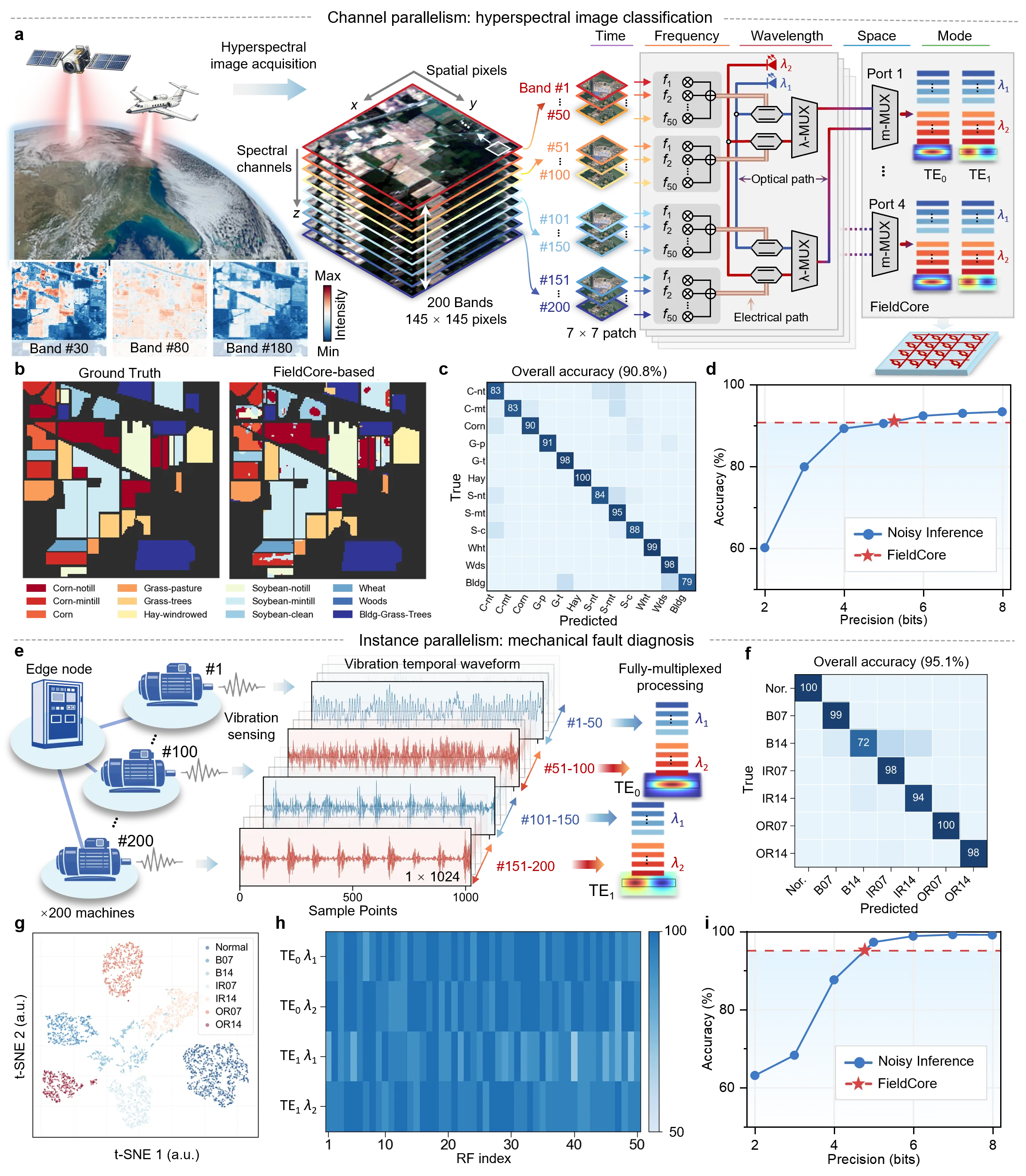
The new FieldCore chip uses five such "voices" at once. The first is the beam's color: different wavelengths carry different data. The second is a radio wave that modulates the light. The third is the shape of the beam itself, its pattern. The fourth is the moment in time when the signal is sent. The fifth is the spot where the beam lands at the output. All five work simultaneously, and the number of parallel streams multiplies rather than adds. That's why a single chip handles up to 1800 streams at once.
Tests show the chip can handle tasks that previously required bulky servers. It recognizes handwritten digits, processes camera images, classifies satellite data, and even listens to machinery vibrations to detect faults. The speed is 69.12 trillion operations per second, all in a tiny package.
Original abstract
as written by the authors arXiv:2604.22660
Tensor operations dominate modern computational workloads, yet their further acceleration demands hardware platforms with greater parallelism. Although photonic computing provides a compelling route for parallel processing, fully exploiting all native multiplexing dimensions of optical fields is impeded by the challenges in routing and programming light in all dimensions simultaneously. Here we introduce FieldCore, a fully multiplexed photonic tensor core that jointly harnesses wavelength, radio-frequency, guided-mode, time and space dimensions, thereby enabling parallelism to scale multiplicatively within a single optical field. Enabled by inverse-designed silicon photonics, FieldCore preserves a uniform programmed computation across all multiplexed channels in parallel. Experimentally, we validate and benchmark its performance from ultra-high-baudrate arithmetic operations to high-fidelity image convolution and parallel handwritten-digit recognition. We further use FieldCore to unlock applications that naturally require high-dimensional data processing, such as high-dimensional hyperspectral classification and massively parallel mechanical fault diagnosis. Our FieldCore supports an estimated aggregate compute throughput of 69.12 tera operations per second (TOPS) and accommodates up to 1,800 parallel input streams within a single core, establishing a scalable paradigm for fully multiplexed photonic tensor computing and AI inference.
Light in optical fiber travels almost 200,000 times faster than an electrical signal in a copper wire.
Such chips resemble the computing cores from Star Trek, where data is transmitted via light pulses.