The Universe on the Scales: Gravity and Matter in a New Dance express
You're inflating a balloon, but with each pump of the bulb, the rubber doesn't just stretch: it subtly changes its elasticity. Gravity works similarly in the new model: not as a rigid stage for the cosmic play, but as a living material that responds to every speck of matter.
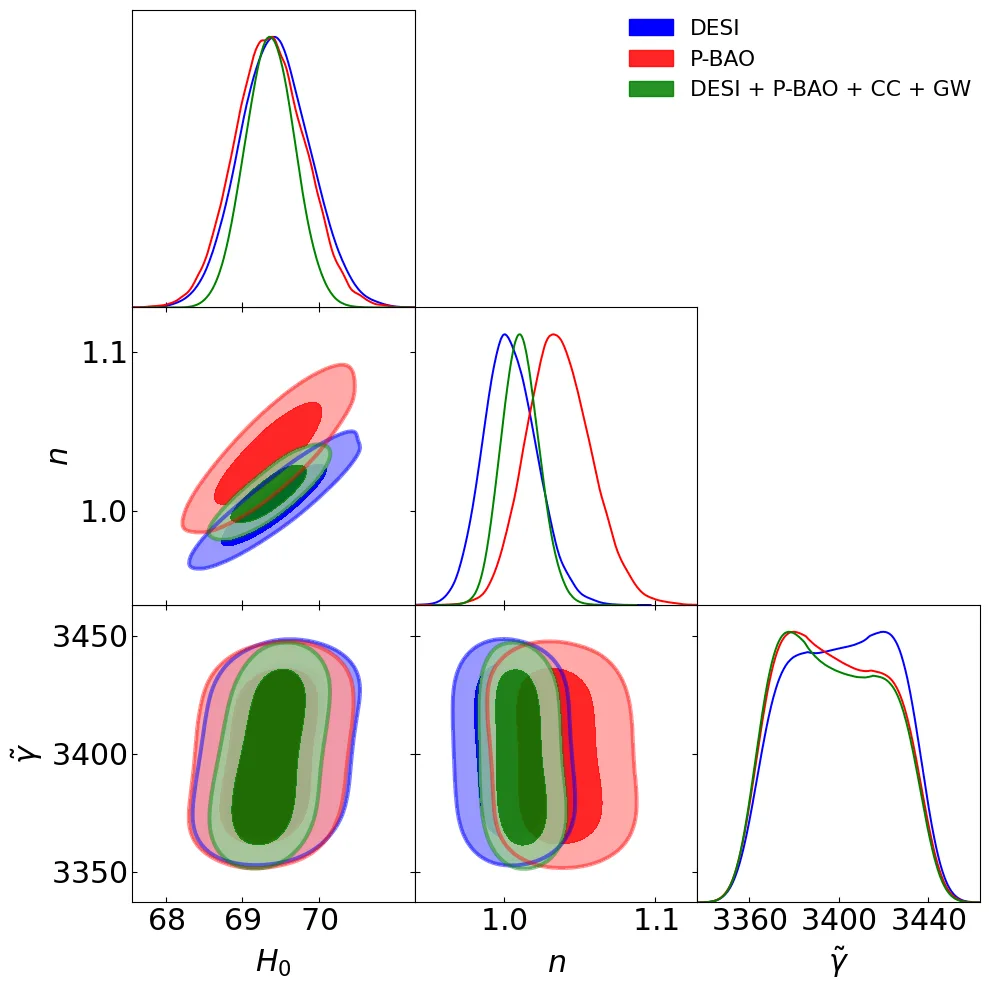
In standard cosmology, dark energy is a separate ingredient that makes the universe expand faster and faster. Here, the acceleration emerges on its own. The coupling between the geometry of space (its "non-metricity," i.e., its ability to change lengths and angles when bodies are transported) and matter makes the expansion uneven. The authors tested this idea with three independent rulers. The first is baryon acoustic oscillations: frozen sound waves from the early universe, now visible as a preferred spacing between galaxies. That spacing is about 490 million light-years, like the echo of the Big Bang frozen into a giant comb. The second ruler is "cosmic chronometers," old stars whose ages are known almost as precisely as museum exhibits. The third is gravitational-wave standard sirens — neutron star mergers whose distances are measured by the trembling of space, not by light.
Calculations with these data showed that the model is not just as good as the standard ΛCDM, but in some details it describes the transition from decelerated to accelerated expansion even better. That transition occurred about 6 billion years ago. The equation-of-state parameter — a quantity that indicates how the expansion "pushes"—came out close to minus one, but slightly varying with time. Like a pendulum that never quite settles at one point. Such behavior resembles quintessence — a hypothetical field that is not constant but slowly evolves.
This approach does not eliminate dark energy but embeds it into the very fabric of gravity. As if the balloon's rubber itself decides when to stretch faster. Perhaps the mystery of cosmic acceleration lies not in new matter, but in our incomplete understanding of an old friend — gravity.
Baryon acoustic oscillations are the sound of the Big Bang frozen into the distribution of galaxies. The wavelength of this sound, about 150 megaparsecs, serves as a "standard ruler" for measuring cosmological distances.
In Isaac Asimov's novel "The End of Eternity," altering the fundamental laws of reality leads to unpredictable consequences for all of human history — much like how modifying gravity could rewrite the fate of the universe.