Quantum Entanglement on a Chip: 80 km Without Loss express
Two mailboxes at opposite ends of a city. Drop a letter in one, and an identical one instantly appears in the other. That's roughly how quantum entanglement works: two particles behave as a single unit, even when separated by a great distance. But until recently, this connection could only be maintained within a single room or across a lab bench. Once you moved the particles truly far apart, the connection broke.
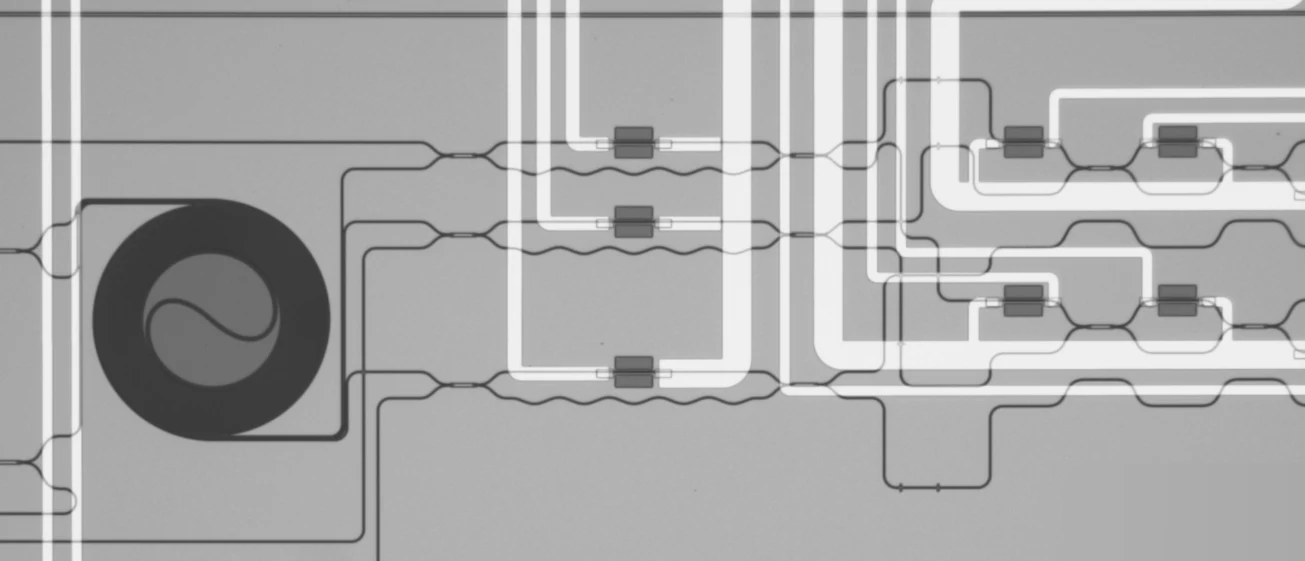
In the new work, scientists took two tiny silicon chips, a transmitter and a receiver, and linked them with an 80-kilometer optical fiber. On the transmitter chip, pairs of photons were born entangled in a special way: not by polarization (like light through sunglasses), but by the path they take inside the circuit. It's like two droplets that always fall on the same spot, even if you spray them from different bottles. Previously, this "path-based" trick didn't work over long distances: the slightest vibration in the fiber disrupted the synchronization.
To check whether the entanglement survived the trip, the researchers measured the so-called Bell state fidelity — a measure of how well the two particles remain a "single organism." It came out to 85.7%, well above the classical limit of 50% achievable without any quantum magic. Then, on the same setup, they ran the BBM92 quantum cryptography protocol and obtained a secure key at a rate of 2 bits per second. Slow, but absolutely secure: any attempt to eavesdrop would immediately destroy the entanglement and expose the spy.
Thus, silicon chips, similar to those in our computers, have for the first time proven that entanglement can be distributed between cities without bulky lab setups. This isn't just a beautiful experiment; it's a bid for future quantum networks where information is transmitted with the guarantee that no one has intercepted it. After all, the key feature of such a network isn't speed: it's trust.
A speed of 2 bits per second seems laughable compared to the megabits of home internet, but it's already enough to refresh an encryption key once a minute for top-secret communications.
In the series "The Expanse," quantum entanglement is used for instantaneous communication between ships, but in reality it doesn't transmit information faster than light — instead, it makes it immune to interception.