Gravity Entangles Without Free Fall express
Two balls suspended on threads swing side by side. Each moves on its own, but between them is an invisible thread — the attraction of masses. If gravity is quantum, it could bind them into a single whole: nudge one, and the other responds, even without contact.
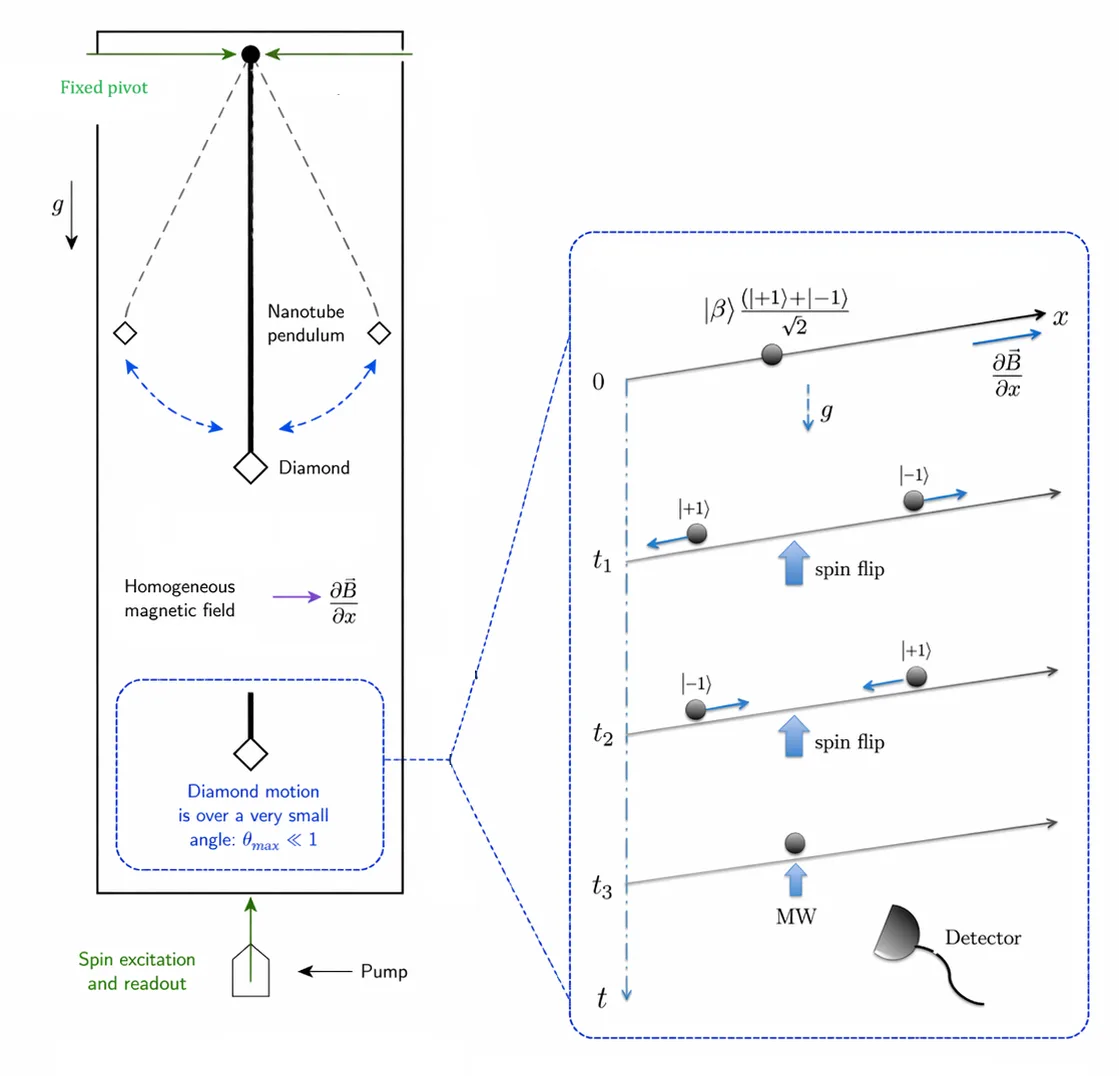
Previously, it was believed that such a connection could only be observed by dropping particles into free fall, like in a tower where everything falls and weightlessness lasts for seconds. But engineers find this inconvenient: it's hard to keep particles in place and prevent them from hitting the walls. It turns out that a pendulum made of a carbon nanotube (a hundred thousand times thinner than a hair) behaves almost like a free one if the swing is fast. The error from being tethered grows smoothly, like the square of time, and remains tiny, less than one millionth, for short kicks.
The authors tested the calculation using pendulums made of such tubes. The phase, the wave advance that determines whether experimenters see quantum entanglement, barely degrades. The interference visibility (the sharpness of the fringes by which success is judged) remains high. This means that the Bose–Marletto–Vedral protocol for testing quantum gravity can be run not in a space laboratory but on a tabletop with suspended particles.
Thus, the pendulum, Galileo's ancient instrument, becomes a window into the quantum world. Freedom turned out to lie not in the absence of support, but in the speed of motion.
Original abstract
as written by the authors arXiv:2605.00967
Tests of gravity-induced entanglement have been proposed as a route to probing the quantum nature of gravity, but existing schemes rely on free-fall interferometry of massive spatial superpositions, imposing severe experimental constraints. We show that systems exhibiting effectively inertial dynamics in the short-time regime reproduce the same gravitational phase accumulation responsible for entanglement generation. Deviations from the free-fall phase enter at order $$(t/T)^2$$, where $$t$$ is the interferometer timescale and $$T$$ is the characteristic period of the constrained motion. We analyse a representative mechanically constrained implementation using carbon nanotube pendula and show that the resulting correction to the entangling phase remains below $$10^{-6}$$ in experimentally relevant regimes, leading to a negligible modification of the interference visibility used to certify entanglement. These results demonstrate that gravity-induced entanglement protocols extend beyond free-fall implementations to a broader class of constrained dynamical systems, significantly relaxing the requirements for experimental realisation of the Bose-Marletto-Vedral protocol.
Carbon nanotubes are so thin that their diameter, about a nanometer, is comparable to the length of a chain of ten atoms. Yet they can withstand tension equivalent to the weight of a car on a cross-section the size of a human hair.
In Hannu Rajaniemi's novel 'The Quantum Thief,' gravity is used as a tool for quantum computation. The experiment described here is a step toward making such a thing a reality.