Simple

Object in Two Places: Gravity Becomes Quantum

Original: "Quantum gravitational contrast in creating Schrödinger cat state"
· Anupam Mazumdar, Tian Zhou
arXiv:2605.05153v1 · 2026-05-06 · CC BY · ⏱ 1 min · General Relativity
A massive particle in quantum superposition casts two gravitational shadows; their similarity reveals whether gravity obeys the laws of the micro-world.
Links in the knowledge graph 1

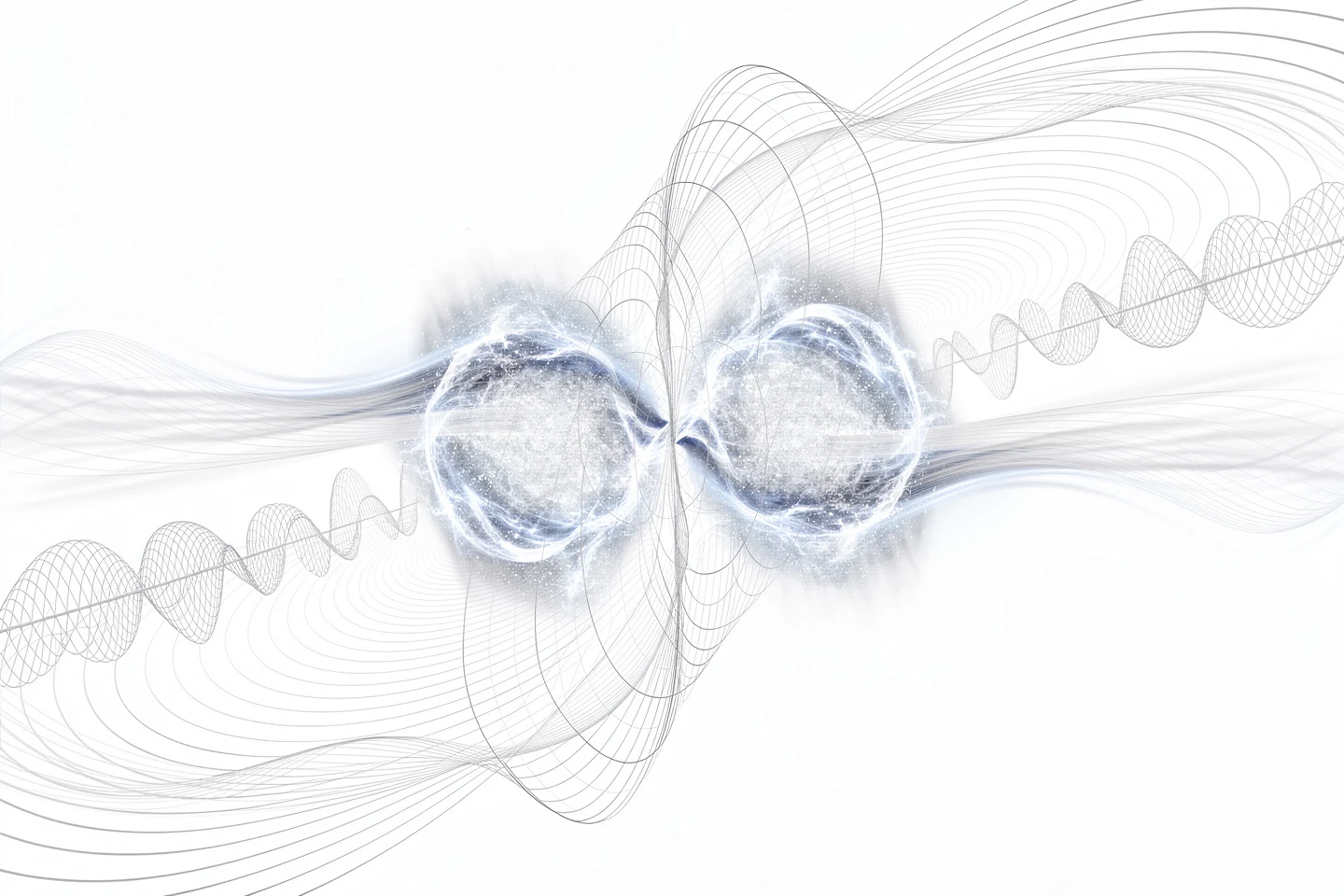
A person under two lamps casts two shadows: close lamps give merged shadows, distant lamps make them diverge. Similarly, a massive object in quantum superposition, being in two places at once, curves space twice. Einstein showed that mass curves space — like casting a shadow. In superposition, two overlapping gravitational shadows emerge.

Scientists calculated how similar these two gravitational 'shadows' are, and called it the contrast. For small mass, the shadows are almost identical — the contrast is high. As mass or distance increases, the contrast drops, triggering a cascade of quantum effects: entanglement (we learn the particle's position from the field), entropy (a measure of uncertainty), decoherence, and wave function collapse — gravity seemingly forces the object into one location. An experiment with gravity as a quantum field (obeying the laws of the micro-world) is ready to test this.

Irony: Schrödinger invented the cat to mock quantum mechanics, yet today physicists plan to use nanodiamonds as such cats, smeared in space, to test quantum gravity.

A vibrating object would additionally create gravitational waves — ripples in space, further confirming the quantum nature of gravity.

🎯 Schrödinger's famous cat, originally a joke, now aids scientists: instead of cats, they smear nanodiamonds through space to test quantum gravity.

C = \left(1 + \frac{\delta x}{4\sigma}\right)^{-\frac{GM^2}{2\pi}}
C is a measure of the overlap of gravitational shadows: the smaller C, the weaker the connection between worlds. δx — superposition distance, σ — width of the mass wave packet, M — mass, G — gravitational constant. When GM²/2π ≈ 1, the contrast drops almost to zero.
S = -\frac{1-C}{2} \ln\left(\frac{1-C}{2}\right) - \frac{1+C}{2} \ln\left(\frac{1+C}{2}\right)
S — the von Neumann entropy of the reduced density matrix of matter; when C → 0 it reaches its maximum ln 2 ≈ 0.69, signifying complete decoherence and the maximum information capacity of the gravitational channel.
Scientists
Erwin SchrödingerHugh Everett IIIStephen HawkingJacob BekensteinEmmy NoetherBernhard Riemann
Tags
quantum entanglement gravity gravitational waves spacetime curvature Quantum Field entropy Wave Function Collapse quantum decoherence
Laws
second law of thermodynamicsSchrödinger equationHawking radiationNoether's theoremBekenstein-Hawking entropyEinstein field equations
Original: arXiv:2605.05153v1 · CC BY · bridge42worlds