Gravitational Shadows: How Mass Splits Reality ✛ ✎ ✦
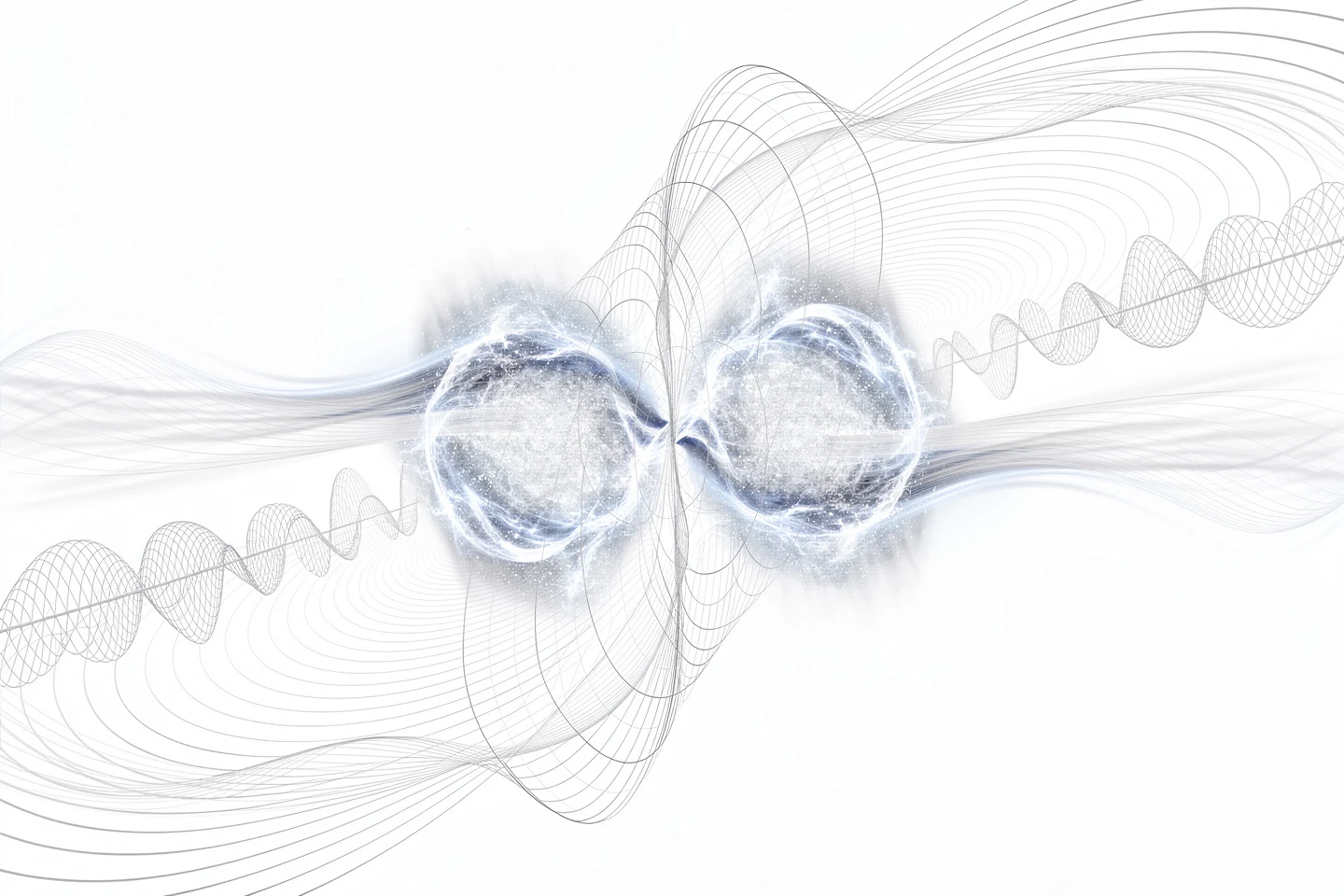
A massive nanodiamond inside a quantum interferometer splits in two, pulling itself into two realities. Its gravity — tiny, almost imperceptible — stirs the quantum field of the vacuum, giving rise to coherent clouds of gravitons. These are the gravitational shadows cast by each position of the mass. For light bodies, the shadows almost merge — the contrast is close to one, and the world hasn't yet split into independent branches.
The key measure is the contrast C — the overlap of coherent graviton states in the left and right arms of the interferometer:
C = (1 + δx/4σ)^{-GM²/2π}.
Here δx is the distance between positions, σ — the width of the wave packet, M — the mass, G — the gravitational constant. The exponent is the dimensionless gravitational coupling GM²/2π. When it exceeds one, the overlap goes to zero: the gravitational shadows separate irreversibly. At that moment, the quantum entanglement between the mass and the field reaches its maximum, and the corresponding entropy S approaches ln 2. The decoherence caused by gravity itself becomes complete — the two worlds stop communicating.
This is not just a mathematical trick. Each gravitational shadow is actually a classical metric — the linearized Schwarzschild geometry arising around each mass position. The spacetime curvature ends up in a superposition of two nearly orthogonal states — this is how parallel classical universes sprout on laboratory scales. The famous thought experiment of Schrödinger with the cat takes on a relativistic tone: the "liveliness" of such a gravitational cat is measured by the contrast C. And the more massive the object, the faster the cat becomes either dead or alive in different realities.
The next step leads to dynamic scenarios: moving masses emit gravitational waves, which further reduce the contrast. In the paper's appendices, it is shown that for oscillating bodies, the overlap decreases with increasing amplitude and frequency. Here we already hear echoes of a full theory of quantum gravity, where the collapse of the wave function might not be postulated but deduced as a consequence of gravitational dynamics. This work is a bridge thrown from Einstein to the quantum technologies of the future. Next-generation interferometers with masses in the nanogram range promise not just to detect gravitational decoherence but to turn it into a resource for quantum sensors and computing, where spacetime itself becomes the information carrier.
The idea that gravity "peeks" at a quantum system and destroys its superposition has been wandering through physics since the mid-20th century. But the precise calculation of the contrast C turns it into an elegant tool: we know at what mass and distance Schrödinger's cat will split into two forever separated worlds. A thought-provoking detail: the entanglement entropy reaches ln 2 — the maximum information capacity of a single qubit. Gravity seems to pack reality into two classical bits, between which no quantum whisper will ever leak again.