Quantum-Gravitational Contrast in Creating the Schrödinger's Cat State ✛ ✎ ✦
Context
Verifying the quantum nature of gravity remains one of the main unsolved problems in modern physics. Matter-wave interferometers, now reaching macroscopic mass scales, offer a unique chance to probe quantum entanglement between matter and the gravitational field itself. It has been predicted that the exchange of virtual gravitons can entangle two massive objects (the QGEM protocol), meaning that wave function collapse and decoherence in such systems are sensitive to the quantum properties of gravity. Understanding how spatial superposition of matter affects the gravitational vacuum is crucial for interpreting future experiments.
Methods
The authors apply an effective field theory approach to gravity, where spacetime curvature is described by small metric perturbations—a massless spin-2 graviton. Quantization is performed in the canonical form of Einstein on a Minkowski background. The matter-graviton interaction in the non-relativistic limit leads to a shift of the graviton vacuum, much like creating a coherent state in quantum optics. The mass is modeled as a Gaussian wave packet with width σ, which regulates ultraviolet divergences. The displacement parameter, dependent on the matter’s energy-momentum tensor, is computed, and a squeezing operator is derived that transforms the free graviton vacuum into a new ground state—a quantum field with a shifted vacuum.
Results
Key result: the overlap (contrast) C between the graviton coherent states of the left and right interferometer arms is C = (1 + δx/4σ)^{-GM²/2π}, where δx is the superposition distance, M the mass, G the gravitational constant. For large masses or small σ, the overlap falls off exponentially, C → 0, corresponding to maximal quantum entanglement between matter and graviton. The entanglement entropy S = −(1−C)/2 ln((1−C)/2) − (1+C)/2 ln((1+C)/2) reaches $S_{max}$ = ln 2. Numerical analysis (Fig.1) shows that at GM² = 2π and δx/σ = 5, the entropy is about 0.6, approaching the limit. Additionally, it is shown that the shifted gravitational vacuum creates an effective classical geometry: in each interferometer arm, the metric matches the linearized Schwarzschild metric at distances greater than the wave packet width. Thus, spacetime curvature becomes a superposition of two classical geometries, and their overlap determines the degree of quantum decoherence.
Implications
The results show that the Schrödinger’s cat state for a massive particle is intrinsically tied to the emergence of a superposition of gravitational geometries. This provides a theoretical underpinning for protocols like QGEM, where graviton-induced entanglement acts as a witness of the quantum nature of gravity. The computed contrast C serves as a measure of the “quantum bridge” between the worlds in which the mass resides at different positions. The drop in contrast with increasing mass signals the inevitable birth of entanglement entropy, which could be detected experimentally.
Future development
Future work must include time dependence: when masses move, say in a harmonic oscillator, gravitational waves are emitted, complicating the contrast picture. In an appendix to the paper, the authors treat exactly that case and show that the overlap decreases as oscillation amplitude and frequency increase. Next steps involve adding post-Newtonian corrections and loop effects, as well as analyzing how the environment influences decoherence. Advancing the techniques for creating spatial superpositions of nano-sized massive bodies will allow testing these predictions in the lab.
Impact
The work impacts several areas: phenomenology of quantum gravity, quantum information (entanglement as a resource), and precision tests of the equivalence principle. It also deepens the connection between gravitational wave theory and quantum mechanics.
Next steps
Near-term experimental steps include implementing a Stern–Gerlach interferometer for masses on the order of 10⁻¹⁴ kg with controlled superposition size and spin entanglement measurement. On the theory side, developing field methods beyond perturbation theory is needed to describe strong gravitational fields in the quantum regime.
Key open problems
The study directly ties into the fundamental problem of uniting quantum mechanics and general relativity. In particular, it sheds light on whether wave function collapse could be caused by gravitational effects, as hypothesized in models of gravitational decoherence harking back to the Schrödinger thought experiment. Moreover, the findings are important for understanding the quantum nature of black holes and the measurement problem in quantum cosmology.
The knowledge machine's view
This section is addressed to the author of the paper and their colleagues. Neighbouring works were found by meaning-based search across our archive, not by word overlap. We do not review: we show the field around the work.
What the work does
The paper demonstrates how the state of Schrödinger's cat, created in a matter-wave interferometer, serves as a setup for probing quantum gravity. The authors use an effective field theory: a massive particle in superposition interacts with a quantized graviton, leading to a displacement of the graviton vacuum and the formation of coherent states. They calculate the contrast between the coherent states of the interferometer arms, which determines the entanglement entropy between matter and the gravitational field.
Where its strength is
The key strength of the work is the explicit calculation of the overlap of graviton coherent states, which provides a quantitative measure of entanglement and links it to experimental parameters. This allows matter-wave interferometry to be considered a direct test of the quantum nature of gravity.
Where it could go next
- It might be interesting to see how rotational degrees of freedom in interferometers with massive particles affect the contrast and entanglement entropy: there is a paper on arXiv nearby about testing quantum gravity using rotation.based on: Testing Gravity's Quantum Nature with Spin arXiv:2606.31678
- There is a study nearby proposing to test quantum properties of gravity with a single atom; comparing with such an extremely small mass scale might help clarify how the contrast depends on mass and wave-packet width.based on: The Key to Quantum Gravity Lies in a Single Atom arXiv:2508.03052
- There is a paper on arXiv about how gravity might repel in a quantum experiment; perhaps incorporating such effects within your model could yield additional observable consequences for interferometry.based on: Gravity Can Push Away — A Quantum Experiment arXiv:2602.12266
Worth trying
- Test the contrast calculation for rotating particles by including angular momentum in the stress-energy tensor and comparing with results for point masses.
- Consider the limit of very small masses (a single atom) to check whether the entanglement entropy remains significant and whether new regimes emerge.
- Check whether your model can produce an effective repulsion between the arms of the superposition for certain parameters, as in a neighboring paper.
Why this may matter
If the contrast and entanglement entropy turn out to be measurable in planned experiments, this would provide a direct way to distinguish quantum gravity from classical models, where the gravitational field does not become entangled with matter. Such a test would be an important step in understanding the role of quantum effects in gravity.
Nearby works in our archive
- Testing Gravity's Quantum Nature with Spinsimilarity 0.65
- The Key to Quantum Gravity Lies in a Single Atomsimilarity 0.65
- Gravity Can Push Away — A Quantum Experimentsimilarity 0.64
- Gravitons Don't Spy on Particlessimilarity 0.62
- A Graviton's Quantum Conversation with a Detectorsimilarity 0.62
- Weak Attraction: How Gravity Spares Quantum Superpositionssimilarity 0.62
The closest work in the archive sits at 0.65 by meaning — the usual level for our corpus.
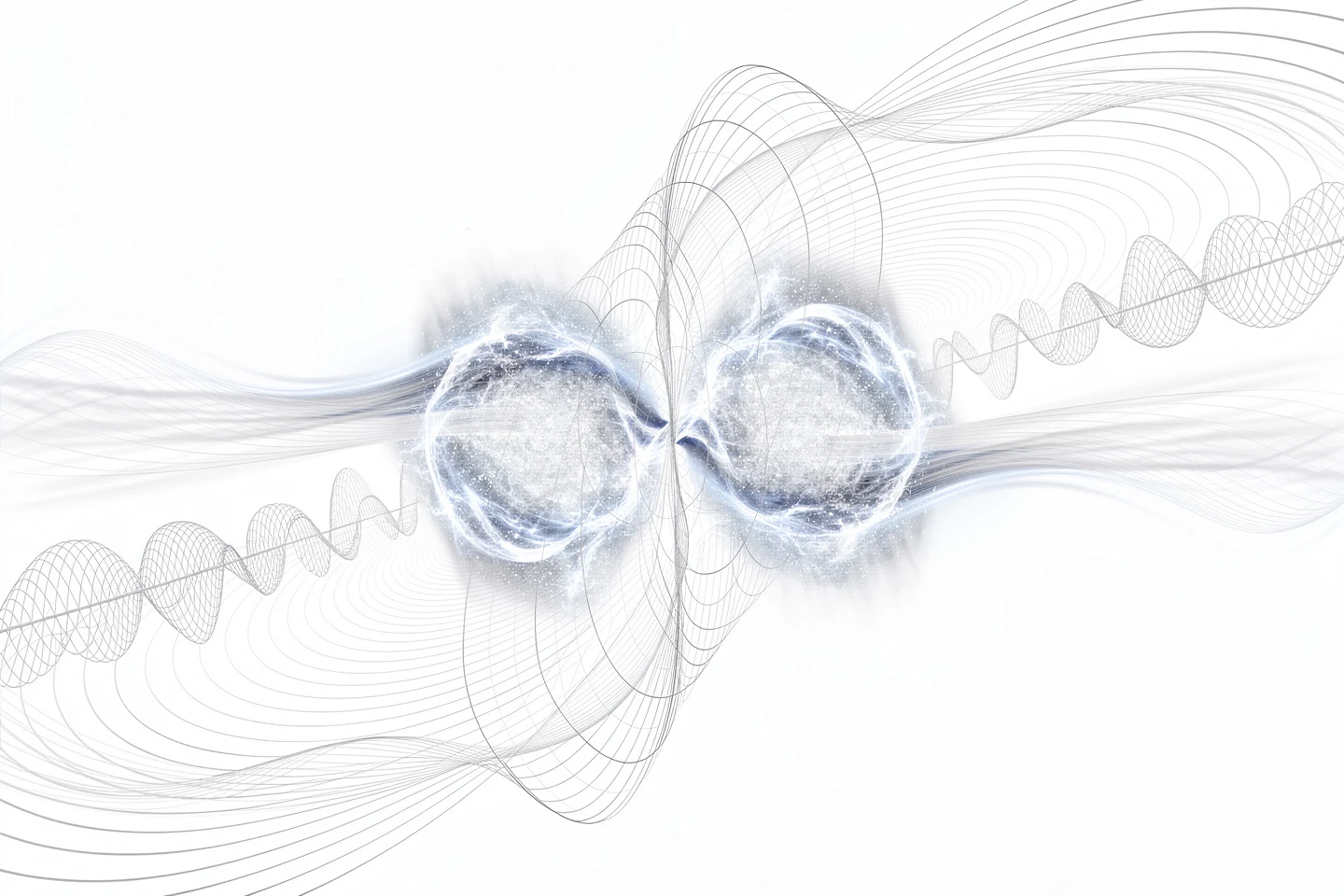
Erwin Schrödinger’s famous thought experiment of a cat both alive and dead gets a gravitational upgrade: a massive object in a superposition of two positions creates around itself a superposition of two almost completely distinct curved spacetimes, and the “aliveness” of this gravitational kitty is gauged by the quantum contrast.
Key numbers
- Nanodiamond mass: 10⁻¹⁴ kg
- Schwarzschild radius: 10⁻⁴¹ m
- Maximum entanglement entropy: ln 2 ≈ 0.69
- Gravitational coupling parameter: GM² = 2π
- Superposition-to-width ratio: δx/σ = 5