Gravitational Waves: A New Listener at the South Pole express
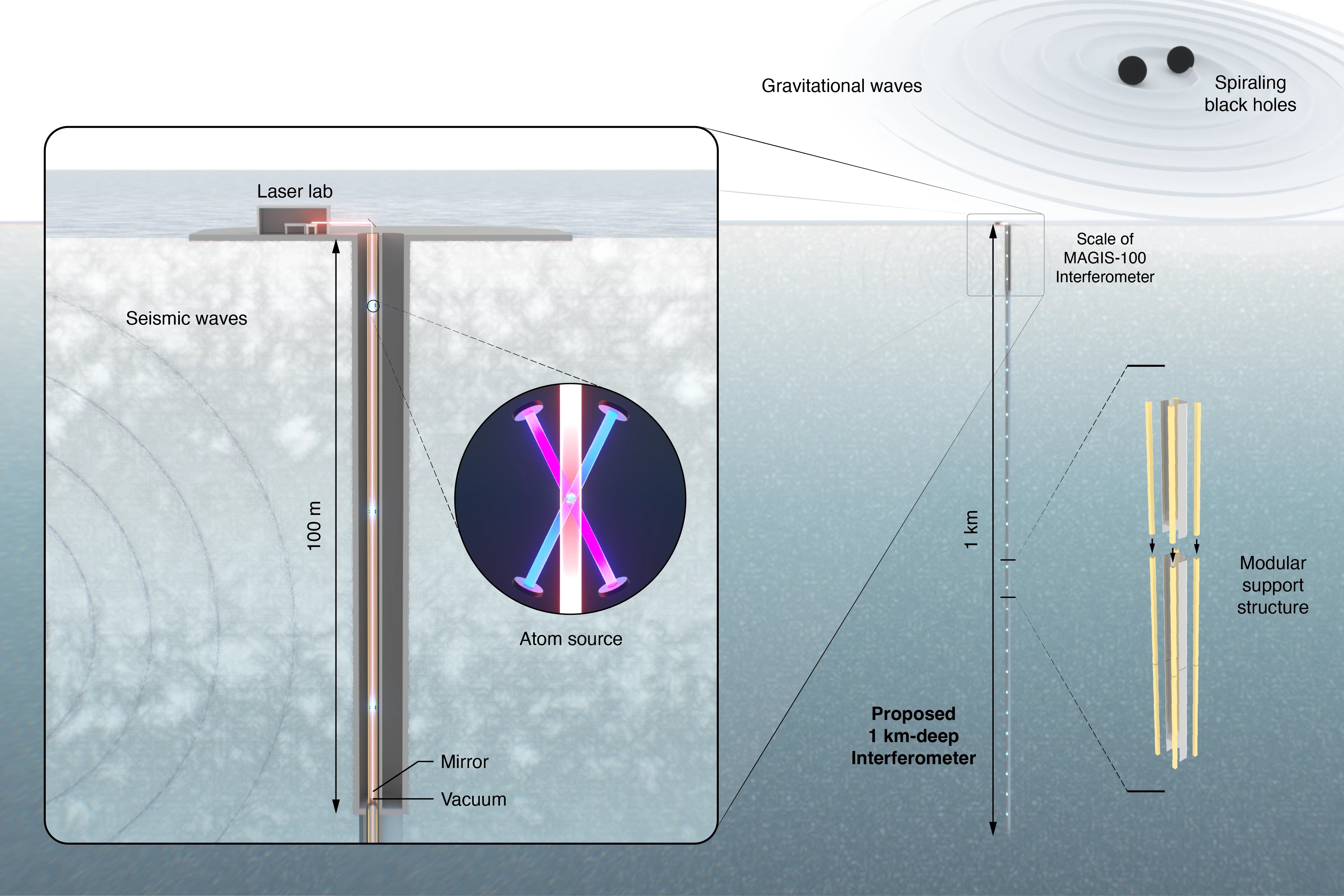
Gravitational waves are ripples in space from the mergers of black holes and neutron stars. Existing detectors, built with contributions from Kip Thorne and Rainer Weiss, work like highly sensitive microphones but only hear the highest 'notes'. Yet the main cosmic symphony plays at low frequencies — like the distant roar of the ocean surf.
A new type of gravitational-wave antenna will help capture this hum. It uses clouds of atoms cooled to near-total stillness. Like ripples on a pond from a tossed stone, these atoms form a wave pattern. A passing gravitational wave subtly changes the curvature of space, shifting the pattern — the device detects the displacement. The South Pole is an ideal listening post: the frozen ground doesn't tremble, and the research station provides power and communication. Combined with other observatories, it will pinpoint the exact direction of the source.
An amazing bonus: this antenna will not only detect stellar deaths but also primordial gravitational waves — echoes of the Big Bang in the fabric of space itself. So the silence of the icy continent will reveal the bass notes of the cosmos.
Original abstract
as written by the authors arXiv:2605.14279v1
Atom interferometers represent a promising approach for gravitational wave detection in the decihertz frequency band, complementary to existing light-based detectors. The South Pole offers unique advantages for such experiments: exceptionally low seismic noise, established infrastructure for large scientific projects, and a location that strengthens gravitational wave source localization through global triangulation. Here we discuss the scientific case and practical considerations for deploying a long-baseline atom interferometer at the South Pole, which has the potential to expand the global network of gravitational wave detectors while enabling precision tests of fundamental physics.
Frequencies around 0.1–10 hertz are exactly the range where the hum of giant black hole mergers lies, inaccessible to ground-based lasers and even the future LISA space observatory.