The Unheard Hum of Neutron Stars express
A spinning top whirls at great speed and, instead of a steady hum, emits a quiet buzz — because it is slightly dented. Neutron stars work much the same way: city-sized spheres compressed to such density that a teaspoon of their material weighs as much as a mountain. If such a star is not a perfect sphere but has a tiny "bump" on its side, it emits continuous gravitational waves — ripples in space itself that travel across the universe.
Catching this ripple is extremely difficult. It is fainter than a whisper and also changes pitch as the star orbits a companion, like a car siren that approaches and recedes. The authors of this study searched for exactly such pairs: for the first time, they probed the region where the "hum" frequency exceeds 520 oscillations per second and the orbital dance lasts less than three days. Previously, these spots on the "sound map" remained blank: there wasn't enough computing power to sift through all possible configurations.
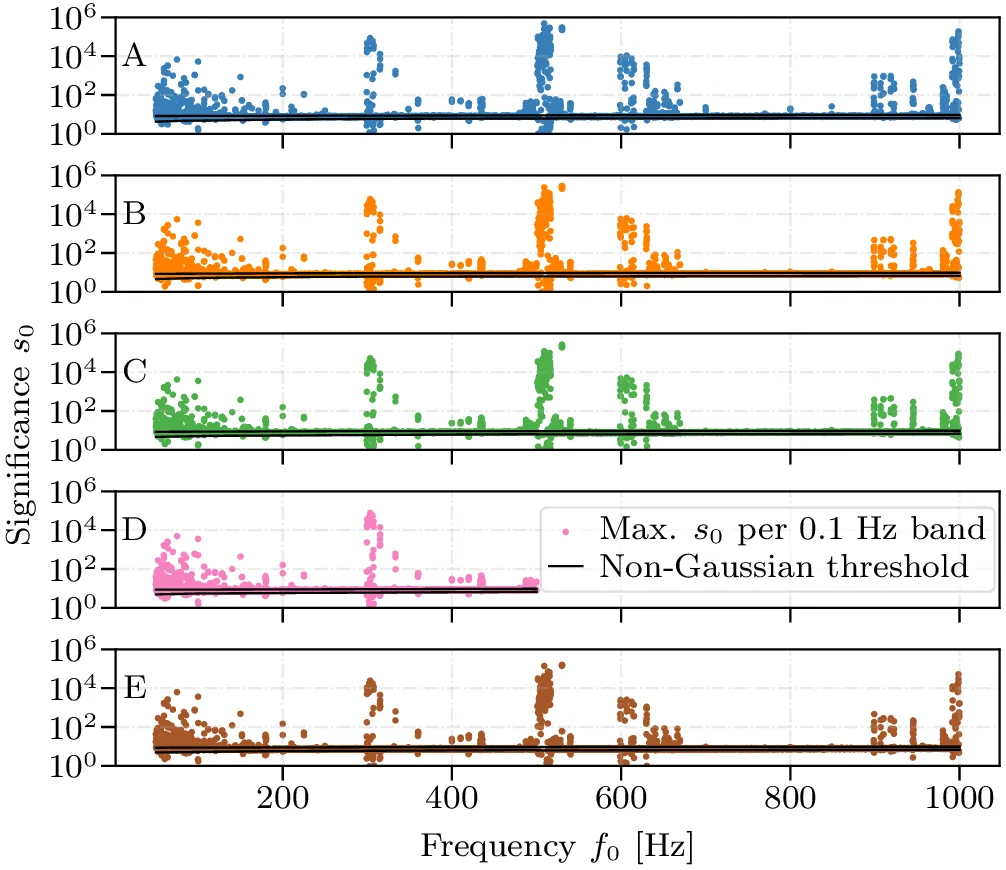
The LIGO and Virgo detectors caught no sound. But the silence is also a result. Now we know: if within a hundred parsecs (about 300 light-years) there is a neutron star spinning more than 495 times per second, its oblateness cannot exceed 5.2 millionths of its own size. In other words, the "bump" on its side is no taller than a couple of millimeters. If Earth were that smooth, the highest mountain wouldn't even reach your knee.
This search is like listening to a vast forest hoping to catch the rustle of one particular cricket. So far, only silence is heard, but the very ability to hear it at this level speaks to the sensitivity of the instruments. Perhaps the next generation of detectors will finally pick up this continuous hum, and then we'll learn just how "dented" the hardest objects in the universe can be.
If a city-sized neutron star could be perfectly polished, its surface would be a million times smoother than the best mirror ever made by humans. And a tiny "wrinkle" just a millimeter high would already make it emit gravitational waves.
In Carl Sagan's novel "Contact," an alien signal is detected at a frequency that is a multiple of a pulsar's rotation rate, as if someone had deliberately embedded a message in the rhythm of a neutron star.