Popular

How the Universe is Born from Nothing ⚡ экспресс

Original: "Gaussian fluctuations in the tunneling probability of a closed universe"
· L. Salasnich
arXiv:2605.16150 · 2026-05-15 · CC BY 4.0 · ⏱ 1 min · General Relativity Quantum Physics
Physicists have refined the probability that an entire universe can arise from nothing.
Abstract

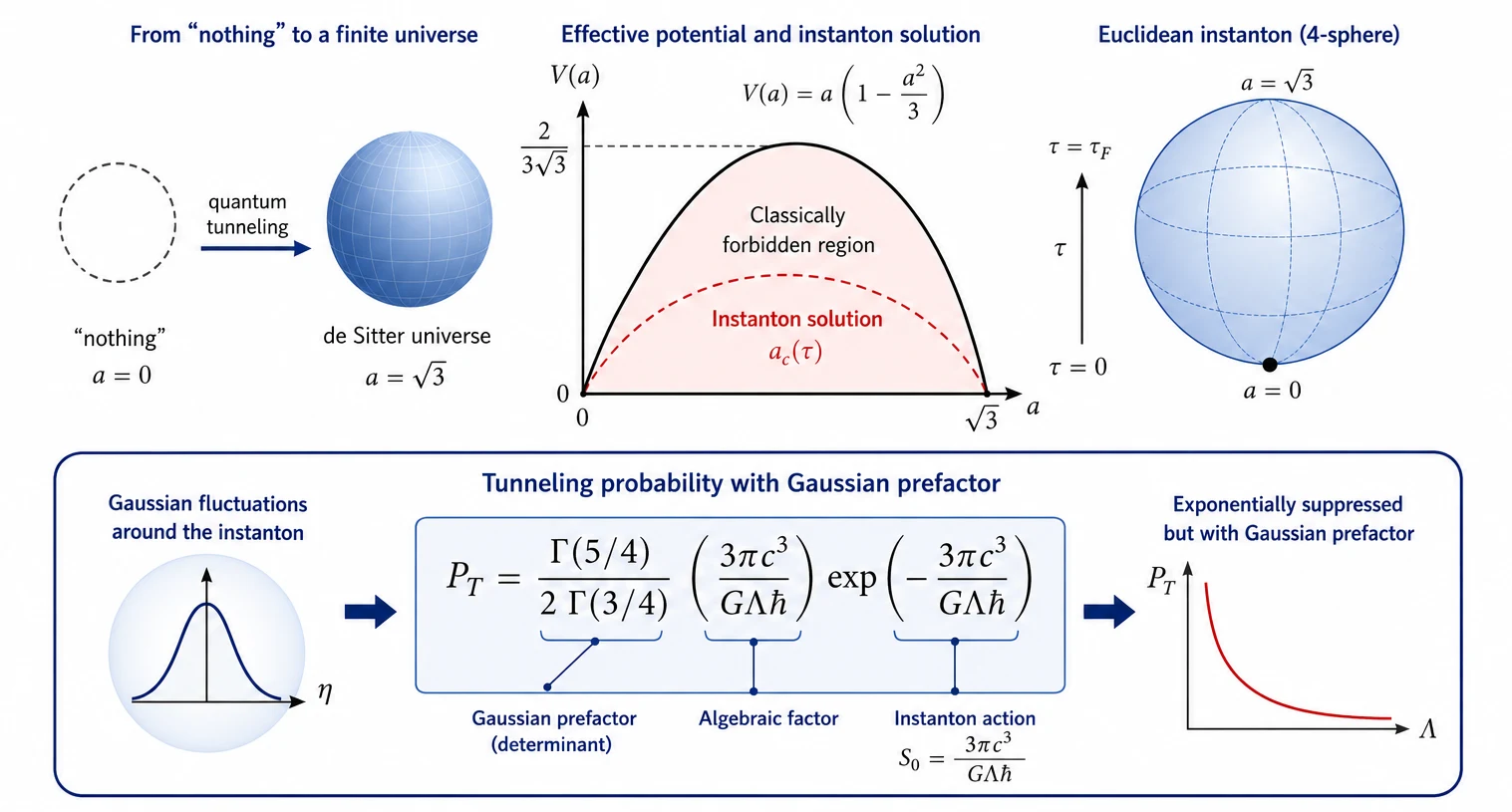
The birth of the universe from 'nothing' in quantum cosmology is described as a tunneling transition. For the first time, this work obtains an analytical expression for the probability of such an event in a closed model, including not only the exponential suppression but also a precise pre-exponential factor arising from Gaussian fluctuations around the instanton — the most probable trajectory in imaginary time. It's like a calculation that takes into account not just the height of the barrier, but also how it curves under your feet. The refined estimate gives a more reliable nucleation rate for universes, eliminating inaccuracies of previous approaches.

Links in the knowledge graph 1

📄 Showing the "Simple" version — "Popular" is not ready yet. Add it to favorites to help prioritize it.

Quantum nothingness resembles water in a pot just before boiling. From time to time, a bubble spontaneously swells up — but not of steam, but of an entire universe. Such a bubble doesn't collapse; instead, it inflates into spacetime, triggering its own Big Bang. The only question is how often this happens.

Physicists took this metaphor seriously and calculated the exact probability. They used a mathematical trick: treating time as a fourth spatial dimension. The resulting formula resembles the one describing a particle passing through a wall. Previously, only the main factor was considered, which made the chance vanishingly small. Now they added quantum fluctuations — chaotic jitters inherent to every bubble at the quantum level. These turn a rough estimate into a precise calculation.

These fluctuations, like ripples on a soap film, are described by a bell-shaped curve and provide an important correction to the probability of a closed universe being born.

Ultimately, they obtained a simple formula where the chance of a Universe appearing from nothing is expressed through familiar physical constants. Most surprising: structurally, it barely differs from calculations for elementary particles — as if the entire cosmos behaves like one big quantum object.

🎯 In quantum physics, even a particle can pass through a wall. It turns out that mathematically, a whole universe is no different — it's the largest 'tunneling' object ever studied by scientists.

P \approx A \, e^{-S_E/\hbar}
P — probability of a universe being born; A — contribution from quantum fluctuations, described by a bell-shaped curve; S_E — a measure of how 'reluctantly' the void gives birth to a world (calculated using a mathematical trick treating time as a fourth dimension); ħ — Planck's constant.
Scientists
Alan GuthAndrei LindeGeorges LemaîtreJames PeeblesAdam RiessBrian Schmidt
Tags
big bang spacetime curvature entropy
Laws
Friedmann equationsHubble's lawsecond law of thermodynamicsBekenstein-Hawking entropyEinstein field equationsPlanck's law
Original: arXiv:2605.16150 · CC BY 4.0 · bridge42worlds