Dimension three is the critical number for quantum probability. In 1957, mathematician Andrew Gleason proved that in a Hilbert space (the mathematical home of quantum states) with three or more dimensions, any consistent probability measure automatically turns into the trace of the product of a density matrix and a projector. That is the Born rule. Before that, physicists suspected that other ways of assigning numbers to outcomes were possible — Gleason closed the loophole.
History
The problem arose in the 1930s during attempts to axiomatize quantum mechanics. The pioneer was John von Neumann, but his proof contained a gap. In 1957, Andrew Gleason, in the work 'Measures on the Closed Subspaces of a Hilbert Space,' gave an impeccable proof that became a classic. Later, generalizations were found for real and quaternionic Hilbert spaces.
How it works
It is used in the foundations of quantum mechanics and quantum information theory to prove the uniqueness of probabilistic predictions. In dimension two (one qubit), there are counterexamples — as if voting with two candidates allows tampering. A practical application is in quantum cryptography: without the guaranteed unambiguity of the Born rule, key distribution protocols would be meaningless.
In practice
It justifies the uniqueness of probabilistic predictions in quantum theory. Without this theorem, engineers could not confidently design quantum computers – the operation of any chip would reduce to the same mathematics.
Fun fact
Gleason himself was not a physicist — he solved a purely mathematical problem thrown at him by colleagues. The theorem became a cornerstone of quantum logic.
In a hall with a thousand spectators, applause blends into a general noise, but if someone falls out of rhythm — a ripple runs through the crowd. The quantum world works similarly: atoms in a trap can behave as a single whole, or they can fall apart into independent individuals.
Quantum mechanics allows a particle to be in two places at once: this is called superposition. But massive objects, like a dust grain or a ball, don't behave that way: their position is always definite. Why? One idea is that it's an illusion: the particle is constantly "jittering" from random environmental kicks, and the blurred picture averages out.
The quantum world is like a kitchen where particles suddenly appear out of "nothing." But you need a chef — a classical field acting as an external source. Glauber's theorem, long known in optics, has now been generalized: it shows exactly how the field "cooks up" particles, be they photons or gravitons.
Gravity in our world is curved spacetime. That's how Einstein's general theory of relativity describes it. But what happens to gravity at the level of atoms and particles, where quantum mechanics rules? This question has remained unanswered for nearly a century.
A low rumble coming from underground could be the noise of a distant construction site, or it could be the echo of an ancient earthquake. Astronomers faced a similar puzzle in 2023 when they detected ultra-low-frequency gravitational waves — the trembling of spacetime itself, rippling across the universe.
Ever since Fritz Zwicky noticed that galaxy clusters were moving too fast, and Vera Rubin measured the rotation of spiral arms, dark matter has remained cosmology's greatest mystery.
The classical Mpemba paradox — hot water freezes faster than cold — has teased scientists for centuries. Only recently has nonequilibrium statistical mechanics explained it: it’s all about boundary conditions; the system seems to seek an excuse to “hit the wall” and speed up cooling.
In mathematics there is a sieve that sifts not dust, but infinity itself. It’s called a Q-space: here any subset turns out to be a Gδ set — a countable intersection of open sets, as if sifted through an unimaginably fine mesh.
In quantum mechanics, everything is fuzzy: a particle is not at a single point but smeared across space, and an event does not happen at a single moment. Yet our everyday world is full of definiteness — the coin landed heads, the light bulb turned on, a note appeared in the notebook.
Twins enter a room from different doors. Each gets a box with a button, and each time they press it, either a red or a green light flashes. If the twins are perfectly identical, you'd expect their lights to follow the same internal rules. But what if the rules differ even though the twins are exact copies?
That's precisely the scenario the authors explored.
The light cone is a blueprint of causality, laser-cut onto the fabric of the universe. In classical physics, it is as sharp as a scalpel: events inside are linked by invisible threads of influence, while outside lies eternal isolation, sealed by the ultimate speed limit.
A soap bubble hangs in the air, and its shape already contains everything needed to calculate the internal tension. A similar principle worked in a new study on quantum gravity. Physicists took a closed surface, an analog of such a bubble, and specified a few numbers on it: for example, the electric field strength and the curvature.
Gravity is the curvature of spacetime, not just an attraction, as Einstein showed. On such a curved "dance floor", even the hypothetical carriers of gravity — gravitons — move oddly.
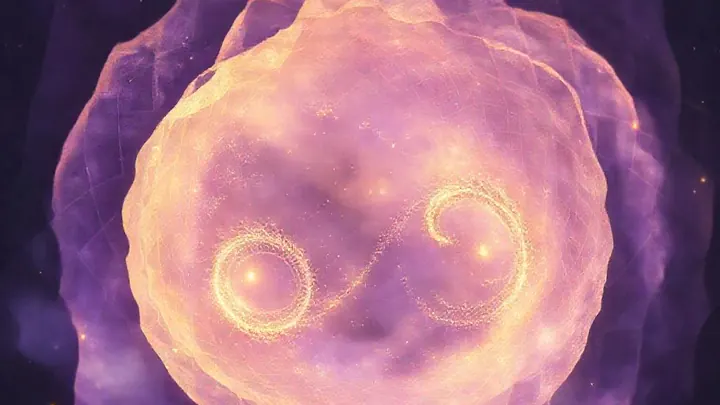
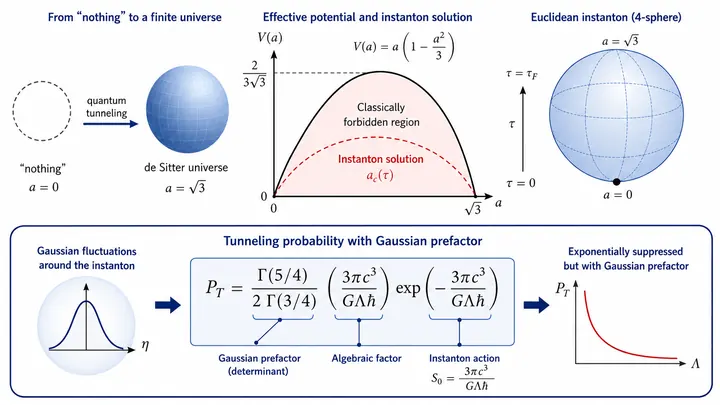
Quantum nothingness resembles water in a pot just before boiling. From time to time, a bubble spontaneously swells up — but not of steam, but of an entire universe. Such a bubble doesn't collapse; instead, it inflates into spacetime, triggering its own Big Bang. The only question is how often this happens.
A coffee whirlpool can span two spots in a cup — a blur of swirling liquid. Quantum particles behave similarly: a spacetime whirlpool where they exist in two places at once. But gravity acts as the spoon that stirs the fabric of space and time.
Two particles behave like a pair of unusual dice: thrown at opposite ends of the universe, they always land on the same face. Physicist John Stewart Bell calculated: if the dice had hidden rules, the frequency of matches would have a strict limit.
Quantum objects live in a world of superpositions — being here and there at the same time, with one spin and another. But as soon as they gain enough mass, this magic fades. Roger Penrose suggested that gravity itself is to blame.
Three people sit in three corners of a room. Each receives a sealed envelope from an invisible courier, but the couriers do not coordinate and have never met. The people open the envelopes and see a note with one word: "yes" or "no." They choose nothing themselves: they just read.
A handful of sand lands on the table. The grains settle in different ways, but if the handful is large, the total volume barely changes. That's roughly how classical gravity works: space appears smooth and definite. But look closely at the individual grains, and you'll find that at the quantum level, volume itself is no longer fixed.
A distant orchestra plays a symphony, but the recording is full of noise. The melody is written for two instruments, yet a third voice seems to break through the static — quiet and unfamiliar. This is how astrophysicists listen to gravitational waves, trying to catch the slightest deviations from Einstein's predictions.
According to Einstein, spacetime is a flexible fabric, curved by matter. But in the quantum world, everything is different: particles are smeared over a probability cloud, governed by a rigid rule discovered by Max Born.
A typical recipe explains how to cook a dish: step by step, from the initial ingredients to the finished result. The new approach flips the logic: imagine that the future pie itself dictates how much flour to add now. In the quantum world, researchers suggest, a particle receives signals from the future measurement outcome.
Before measurement, a quantum object lives in a world of possibilities, where wave amplitudes add up like sound waves in a studio before pressing the “record” button. Crests amplify each other, troughs cancel out.
The universe wasn't born in silence. Primordial gravitational waves — ripples in spacetime — still carry the echo of that event. Scientists try to hear it in two ways. Low 'notes' are captured in the Big Bang's afterglow — light emitted 380,000 years later.
In everyday life, time flows on its own, like a river past its banks. But in quantum gravity, things are different: time does not flow; it emerges from relations between objects, like a pattern in a carpet that is only visible when viewed from a certain spot.
A regular wall clock runs smoothly, but quantum clocks are a different story. They tick at random moments, and each tick can have a different duration. On average, if you watch such a clock for a long time, it will show the correct time. But at any given moment, its hand might jump forward by an unexpected amount.
The birth of the Universe is usually associated with the Big Bang — a point of infinite density. But at that point, the laws of physics break down, which bothers scientists. Stephen Hawking and James Hartle back in the 1980s proposed a different view: time has no boundary, like the surface of a globe.
The world of physics works like a music box: there's a speed knob. Turn it slowly, and the melody is strict — balls roll along trajectories (classical mechanics). Speed it up — the notes blend into a chord: a particle is in many places at once, all probabilities (quantum regime).
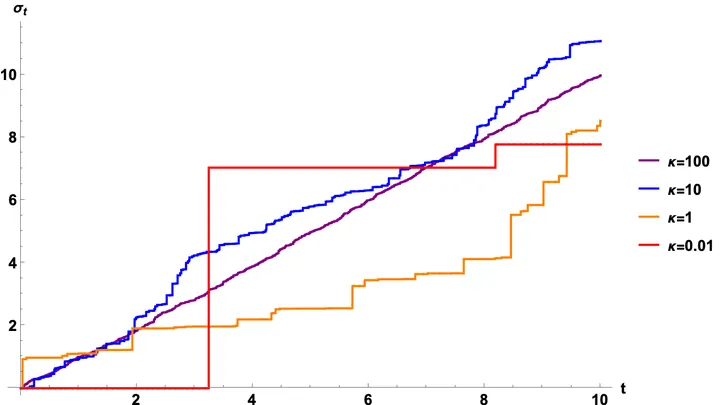
The secret of switching is in the parameter κ.
There's always a risk that someone will peek at your ballot during an election. Physicists have come up with a solution: anonymous voting safeguarded not by people, but by the laws of nature.
Their 'magic ballot box' operates with light particles — photons.
Two particles begin their dance in complete independence. Neither knows of the other's existence. But under the invisible music of deformed spacetime, their motions gradually synchronize: entanglement is born in the system—that very quantum connection Einstein called 'spooky action at a distance.'
In the ordinary world, energies add up simply: take the energy of…
At the hilltop of classical physics, a particle is frozen in unstable equilibrium. The slightest nudge — and it rolls down with increasing speed. In the quantum universe, no nudge is needed: the uncertainty principle itself acts as an all-pervading wind, blowing the particle off the peak.
A translator in a meeting room hears not only individual voices but also how they bounce off each other: one speaker trails off, another picks up the thought, a third clarifies. Remove that interplay, and you are left with a set of monologues, and the meaning of the conversation slips away.